WBJ sat down with CEO, Tomasz Spalik, to discuss how the company balances growth with discipline, tackles labor shortages, embraces AI and expands abroad while protecting the relationships and stability built over 25 years in business
WBJ: The company is celebrating 25 years in business. Construction has gone through several very different economic cycles during that time. What has allowed you to keep growing?
Tomasz Spalik: I think the numbers tell part of the story. Over those 25 years, the company has continued to develop, paid its bills and invoices, and never recorded a loss-making year. But behind that is a certain way of thinking about the business.
We have always focused on long-term relationships. Acquiring a client is only the beginning; the real question is whether you deliver in a way that makes them want to come back.
We have also learned to say no. We know what we are good at and which projects make sense for us. At our scale, taking the wrong contract can affect employees, subcontractors and suppliers, so decisions have to be based on more than revenue.
Quality is fundamental too, and not just the final result. It is the entire process: the offer, negotiations, communication, logistics, timing and, above all, the client’s sense that the project is in safe hands.
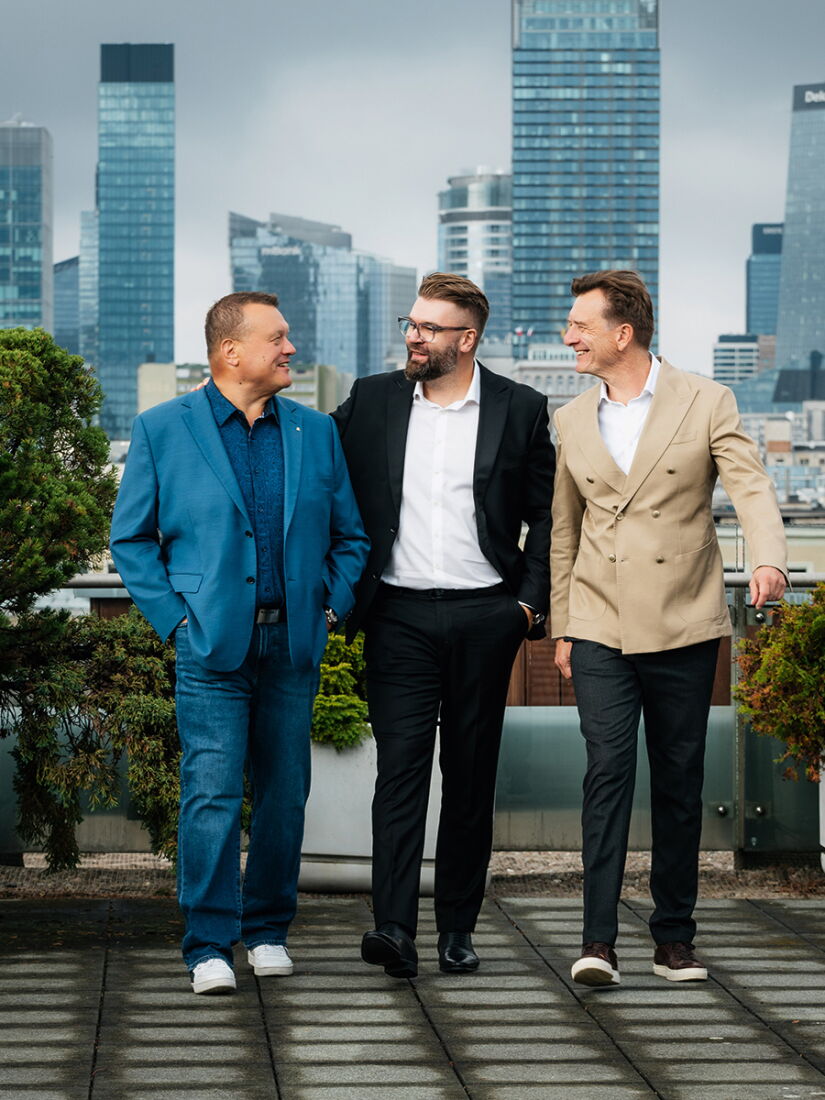
(Left to right) Rajmund Węgrzynek co-founder of Neo Świat, Tomasz Spalik CEO of Neo Świat, Paweł Brodzik co-founder of Neo Świat
You have been with the company for almost 20 of those 25 years. How did your own path prepare you to become general manager?
I was new to the industry when I joined. I started by working on project bids and spent time on construction sites because I wanted to understand what the company actually did. Later I moved into business development and spent many years growing the business and building client relationships.
It was important to me not to manage solely from a bird’s-eye view. If you take responsibility for a company like this, you need to understand how the processes actually work. That experience matters today. I have been on those sites. I know what the sequence of work looks like and what should already have happened.
My move into the general manager role did not mean that the founders handed over the company and left. They remain closely connected to its vision. More day-to-day responsibility has shifted to me, but their experience remains extremely valuable.
What does being a CEO in this industry mean in 2026?
The hardest part today is matching team capacity to the amount of work we bring in. You need contracts to build an organization, but you can’t win a project and then discover that you do not have the teams to deliver it. The job is a constant balancing act.
I do not think a general manager can be a soloist. You have to be more like a conductor. I want people around me who will challenge an idea. Ultimately, somebody has to make the decision, but I prefer a decision that has been tested by different perspectives.
I also want to remain accessible. If there is a problem on a site and my presence can make a difference, I will go. With dozens of projects running at once, problems have to be identified early or they become much harder to fix.
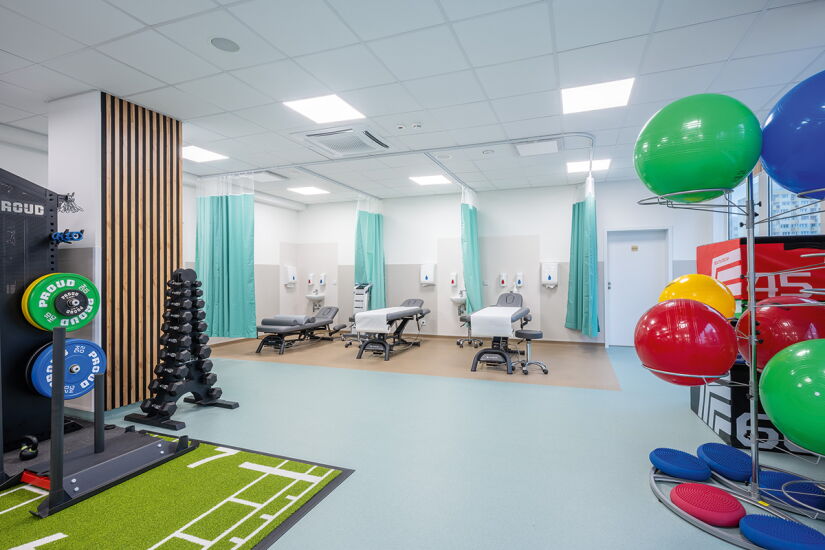
A new MediSpace facility has opened in the Brama Zachodnia building in Warsaw
One of the biggest challenges facing construction is the shortage of skilled labor. How serious has the problem become?
It is very visible. We employ many of our own construction workers, which is still relatively unusual in Poland, so we see the demographic change directly. The workforce is getting older, and on large projects today, I simply do not see many young people.
For years, construction was presented almost as a warning to children: if you do not study, you will end up carrying bags of cement on a building site. That image has had consequences. The irony is that genuinely skilled tradespeople are in a very strong position today. Good tilers, carpenters, stoneworkers or painters are difficult to find, and clients are prepared to wait for them.
That makes retention extremely important. Some people on our sites have been with us for more than 20 years. Our own experienced teams also give us the flexibility to move people between projects when needed.
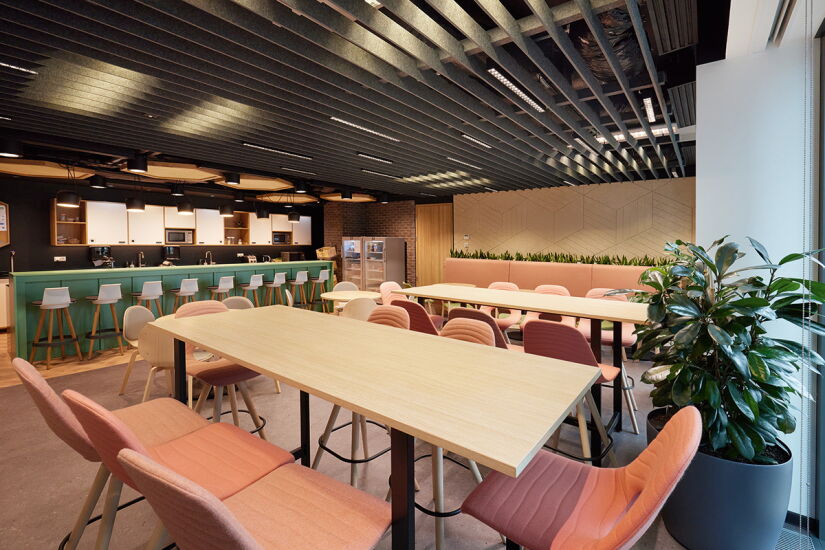
Comprehensive office renovation for Marsh McLennan Group companies in the Nimbus building, Warsaw
Does the generational shift create a different challenge on the managerial side of the business?
Absolutely. A new generation is entering the office with different expectations about work and life. I do not think those expectations are worse; they are simply different.
My generation could devote enormous amounts of time and energy to a company and see that as natural. Younger people think differently about priorities, mobility and work-life balance. We cannot turn that clock back, and companies have to understand those changes.
It has to work both ways. Employees have expectations, but the company does too. I listen to younger employees, and many have impressed me with their awareness and sense of responsibility. Age alone doesn’t mean you automatically have all the answers.
Responsibility matters more than proving that you can win every contract
– Rajmund Węgrzynek, co-founder of Neo Świat
AI is one of the forces accelerating that change. Where can digitalization and artificial intelligence genuinely improve construction and fit-out today?
I do not yet see AI physically taking over most of the work on a construction site. There are too many different activities, environments and variables involved. But around the construction process, there is enormous potential.
We are looking at how to digitize project management and administrative work: notes, summaries, schedules, handovers, documentation, communication and standards checks. A fit-out project may last only three or four months, so anything that makes those processes faster and more reliable has value.
My concern is that AI should not replace the thinking process. If I make a decision based on an AI-generated recommendation and it turns out to be wrong, the responsibility is still mine. AI should support judgment, not remove the need for it.
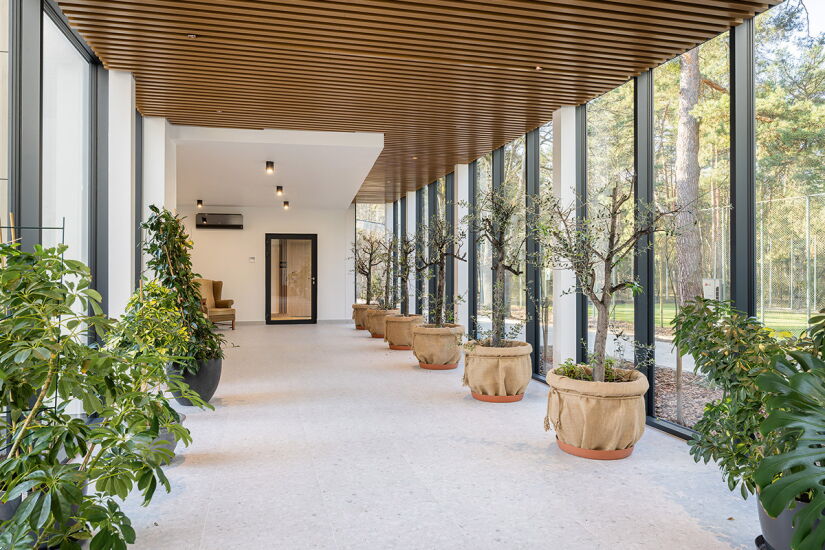
Las Woda Recreation and Business Park in Wilga
Your roots are strongly connected with office fit-out, but today you work across very different sectors. Was diversification a deliberate strategy?
We define ourselves as a general contractor for interiors, whether an office, hotel, spa, apartment, shopping center, automotive showroom or hospital. Our medical segment, for example, has been developing strongly.
We do not want to build the company around whichever segment happens to be fashionable. In 2008, for example, we delivered around 120 bank branches across Poland in a single year. Today, no single segment dominates our portfolio in the same way.
Office space remains important, but the market for new offices is limited, and competition is intense. After 25 years, we have built a brand around interior construction rather than one narrow segment. Our high level of repeat business is one of the strongest signs that the model works.
Competition is intense, particularly on price. How many fit-out companies do you think will survive the next few years?
I don’t spend much time watching competitors. I would rather focus on what we can improve ourselves. But I do see behavior in the market that I consider dangerous.
You cannot live on revenue alone. Taking contracts simply to maintain turnover is a short-term strategy. There is a point at which a price stops being aggressive and simply stops making financial sense.
The consequences do not affect only the owner. Employees need salaries, subcontractors and suppliers need their invoices paid, and clients depend on deadlines being met.
Large companies can sometimes consciously accept more risk because they have the capital and organization to absorb it. When a small company without that financial base takes a contract at any price in the hope that something will work out along the way, the risk is completely different.
I don’t think companies operating that way will survive indefinitely. I have seen projects go wrong because of exactly that kind of decision.
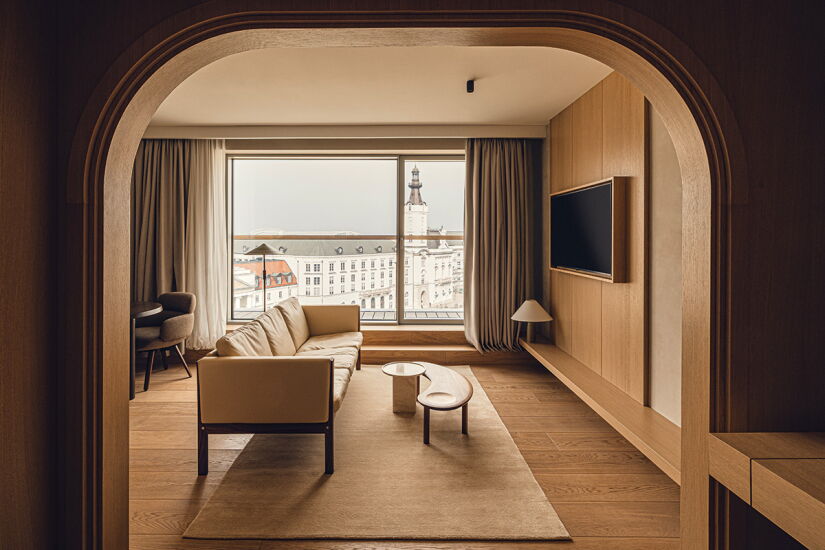
PURO Hotel, Warsaw, Old Town
How is fit-out itself likely to change over the next five to 10 years?
Speed will become even more important. Fit-out costs have increased significantly in recent years, largely because of labor costs, while landlords and tenants want projects delivered faster.
At the same time, the purpose of the office has changed. Tenants are no longer simply buying square meters. They are also buying an argument for why employees should want to come into the office. Hybrid work has changed the expectations people have of the workplace, even if companies have now had several years to adapt to it.
Labor availability will influence design too. If one type of specialist becomes scarce, perhaps you change the material or method. If another wall finish is faster and easier to apply than paint, the economics may change the design decision.
I also expect offices to become much more data-driven. Sensors can show how spaces are used and where energy can be saved, while AI can turn that data into decisions.
So the future of fit-out is not simply about how a space looks. It is about how efficiently it can be built, how well it attracts people, how sustainably it operates and how much useful information it can generate.
Growth at any cost can be just as dangerous as no growth
– Paweł Brodzik, co-founder of Neo Świat
You are increasingly looking beyond Poland. How important is international expansion to the next stage of growth?
It is becoming very important. We have recently completed a project in Austria. We are working on a large project in Budapest, preparing for projects in the Czech Republic and we are also in advanced discussions connected with Germany.
International projects force you to rethink how you organize the work: where to use Polish teams, where you need local partners and how to combine the two.
Poland is also no longer simply the cheap market it once was. Our cost position has changed considerably, so expansion cannot be based only on the idea that Polish labor will always be cheaper. We have to compete on quality, organization and the ability to deliver.
We are also thinking seriously about our first office abroad. Opening one just to issue a press release is easy; building a real team with real projects is different. Expansion has to make business sense.
After 25 years, is there a point at which you say the company is big enough?
We are still growing and building new teams. But growth has to be stable, deliberate and responsible. A company can overheat if it expands too quickly, and we are very aware of that.
That is another reason international markets are attractive. At some point, achieving the scale we want entirely within Poland could become difficult without making decisions that do not make sense. Expanding geographically gives us another route.
But growth itself is not the objective. You still need the people, projects and organization to support it. We want to keep moving forward without sacrificing the continuity and stability we have built over 25 years.
Finally, if a young person asked you whether construction is still a good career choice in the age of AI, what would you tell them?
I would tell them not to be afraid of it. Construction is one of the few industries where you can walk through a city years later, point to something and say, “I built that.” There is real satisfaction in that.
I have an uncle in Paris who is a stoneworker. Walking through the city, he can point to places where he worked, and you can see the pride he takes in his craft. Young people can underestimate the value of having that kind of skill.
There are not enough schools teaching these trades today. If somebody comes to us and genuinely wants to learn, that motivation is already half the battle. The technical skills can be taught.
I also think skilled construction work may be affected by AI later than many types of office work. Construction sites contain too many different physical tasks and unexpected situations to automate easily. Good carpenters, stoneworkers, tilers and painters will be in demand for a very long time.
Get the best of “Warsaw Business Journal” delivered to your inbox daily