Why are Warsaw’s two very different Vistula riverbanks an advantage, and how should the city develop them? WBJ spoke with Jan Piotrowski, the Mayor of Warsaw’s Plenipotentiary for the Vistula River, about how the city rediscovered its river and what it has learned along the way
Interview by Morten Lindholm
WBJ: The Vistula has shaped Warsaw geographically and historically, yet for many years the city seemed to turn its back on the river. Today, Warsaw’s two riverbanks offer radically different experiences. Why is that?
Jan Piotrowski: There is a certain paradox here. What the Vistula looks like today is partly the result of what did not happen. After the Second World War, Warsaw had to be rebuilt almost from scratch and the river was simply not a priority. Plans for development existed even before the war, particularly on the right bank, but many were never realized.
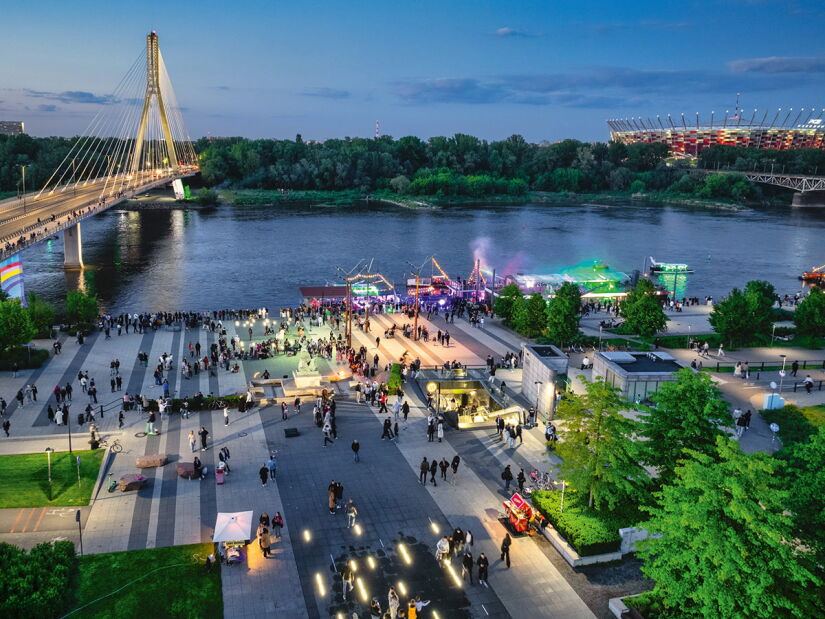
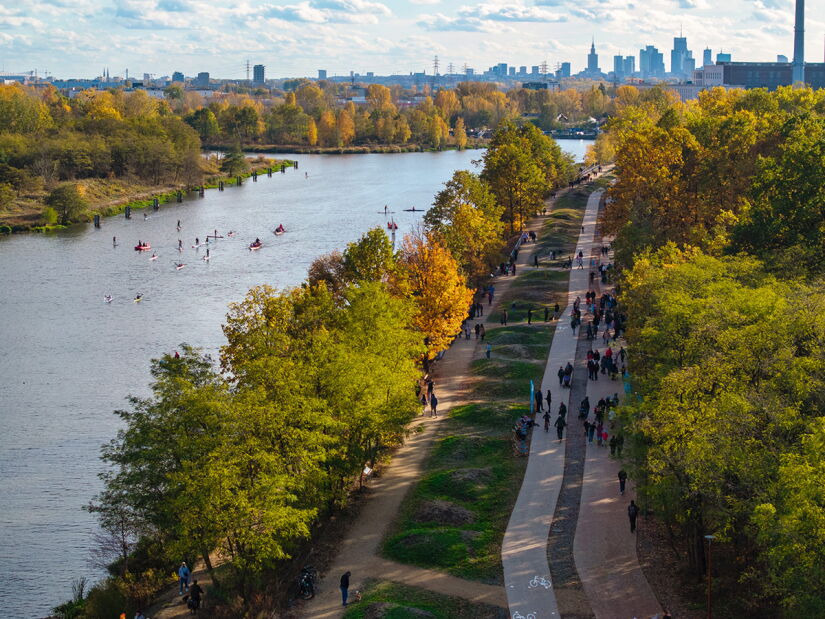
Today, we can be grateful for that. A lower level of investment on the right riverbank preserved something extremely valuable: two completely different riverbanks. On the left, we have an urban boulevard that is both a representative public space and part of the city’s flood-protection infrastructure. On the right, we have riparian forest, a wildlife migration corridor and a remarkably natural landscape in the middle of a major European city.
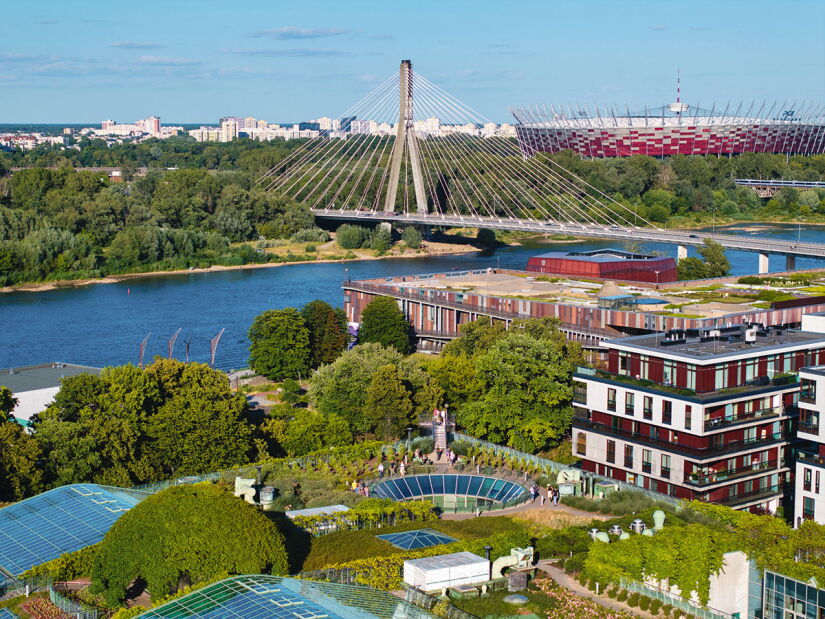
Investments on the Vistula River
Is that contrast something the city wants to preserve?
Absolutely. I would not even call it a contrast so much as two complementary spaces.
On one side, it’s peaceful and almost completely silent. You can walk through the forest, visit a wild beach and feel far removed from the city. Ten minutes later, you can cross the river by ferry and find restaurants, culture and nightlife.
Our responsibility is to keep those experiences complementary rather than allowing one to overwhelm the other.
At the same time, natural does not have to mean inaccessible. We experiment with things such as beach mats that allow wheelchair users, parents with strollers and people with limited mobility to reach the water. We meet with senior residents and learn from very simple observations. One senior resident once pointed out that a bench needs an armrest if an older person is expected to get up comfortably. These are small interventions, but they make public space genuinely more inclusive without fundamentally changing its character.
When did this change begin, and what does the Vistula represent to Warsaw today?
The real change began around 2008–2010, when Warsaw started looking at the river differently and recognized its potential. Importantly, the starting point was nature. Some of the first EU funding went to Natura 2000 and the LIFE+ program, protecting habitats and biodiversity while developing environmental education. The Kamień education pavilion grew out of that approach.
Only later came the larger investments and the revitalization of the boulevards and Czerniakowski Port. We initially looked abroad for benchmarks. Today, study groups increasingly come to Warsaw to see how a major city can open a river to residents while still respecting its natural character.
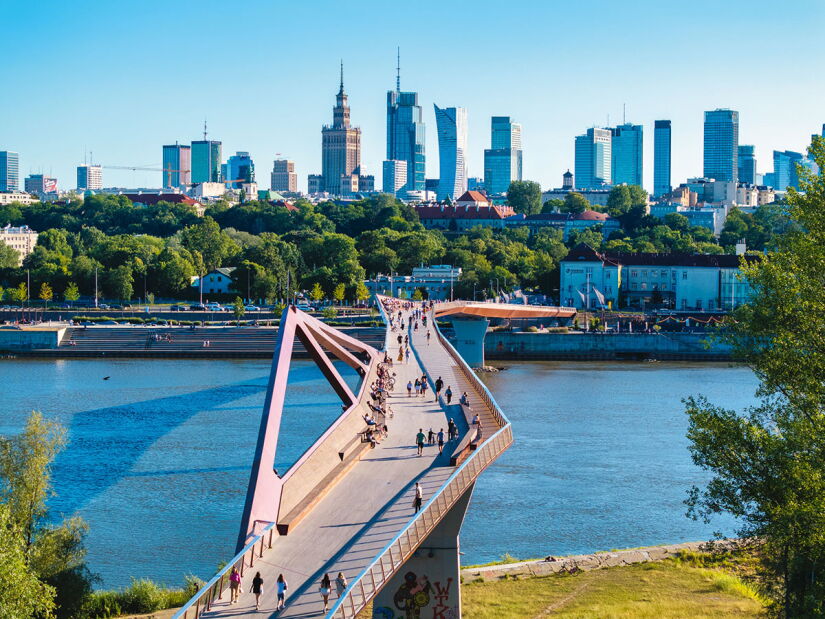
Pedestrian and cycling bridge over the Vistula River
In cities such as Paris or London, the river has long functioned as a shared public space. Has the Vistula begun to play that role in Warsaw?
Very much so. That is really where the idea of the Vistula District came from. It is Warsaw’s unofficial 19th district. It does not exist administratively, but it exists in people’s minds and, I would say, in their hearts.
At first, Vistula District was primarily an educational campaign. One of our earliest slogans was essentially: don’t smash things by the Vistula. We were dealing with broken glass and the consequences of large numbers of people discovering the river as a place to socialize.
Over time, something changed. People started treating the river as their own space. You see someone dropping trash and another person says: “That’s not how we do things here.” I recently saw children throwing things at ducks and people on the beach immediately intervened. That sense of social ownership is enormously valuable.
The space is also unusually egalitarian. You can come with children, walk a dog, run, row, exercise, attend an exhibition, go dancing or simply sit on a blanket. Throughout the summer, there are free cultural, recreational and sporting activities practically every day.
Our most recent visitor research, conducted in 2024, showed that on a sunny summer weekend, from Thursday afternoon to Sunday, the central section of the river can attract roughly 90,000–110,000 people. I sometimes say we have a festival here that lasts four months.
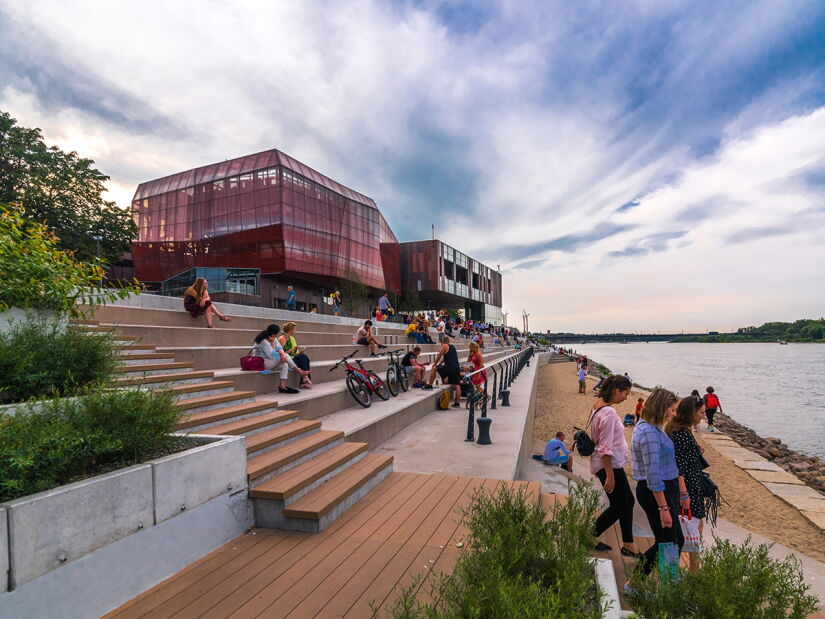
Copernicus Science Center
With so many people using the Vistula, how do you prevent its popularity from destroying the qualities that made it attractive?
We need people to use the river in better and more varied ways. Someone who comes for a walk might see rowers and decide to try rowing next time. Someone else might discover a running group, an exhibition or a cultural event. We are increasingly interested in the quality of the experience rather than simply increasing visitor numbers.
The same applies to tourism. It is a source of pride that the Vistula has moved much higher on the list of places visitors want to see in Warsaw. But we also work closely with the Warsaw Tourism Organization and we are very conscious of overtourism. Warsaw has the advantage of being able to learn from cities such as Kraków, Wrocław or Gdańsk and hopefully avoid some of the mistakes they have already experienced.
Vistula Bouleverds
Riverfront regeneration can easily become commercially driven. How can Warsaw attract private business while keeping the river a genuinely public space?
We set quite strict rules, and businesses do not always understand them at first.
If a company wants to promote itself along the Vistula, it cannot simply put up a large logo or advertisement. We have worked with major brands, but the principle is that they must contribute something to the space and to residents.
If you want to promote sportswear, organize sports activities. If you want to present yourself as environmentally responsible, run workshops that genuinely support that message. We have asked companies to organize free rowing, yoga, paddleboarding, upcycling workshops or educational activities.
The same principle applies to operators leasing riverside pavilions. You can run a restaurant. You can sell food or alcohol. You can operate commercially. But you have to give something back. We do not want the Vistula to become a space that has simply been sold to the highest bidder.
Kayaking on the Vistula
What kinds of investment does the Vistula need most today?
I am cautious about major new construction close to the river. The Vistula is one of Warsaw’s remaining ventilation corridors and, on the right bank, its floodplain and riverside forest also perform essential environmental and flood-protection functions.
Building too close to the river creates risks that are very easy to underestimate when water levels are low. Water levels on the Vistula periodically rise dramatically, and the natural floodplain needs to remain capable of doing its job.
There are, however, many existing spaces that can be revitalized without destroying nature. Żerański Park is a good example. It was a heavily industrial area that nature had begun to reclaim. Instead of erasing that process, we studied what was already there, retained elements of the industrial heritage and designed paths and public infrastructure around it.
We still have work to complete around Czerniakowski Port and the remaining sections of the boulevard. But wherever possible, the philosophy is to reuse and improve what already exists rather than introduce large new interventions.
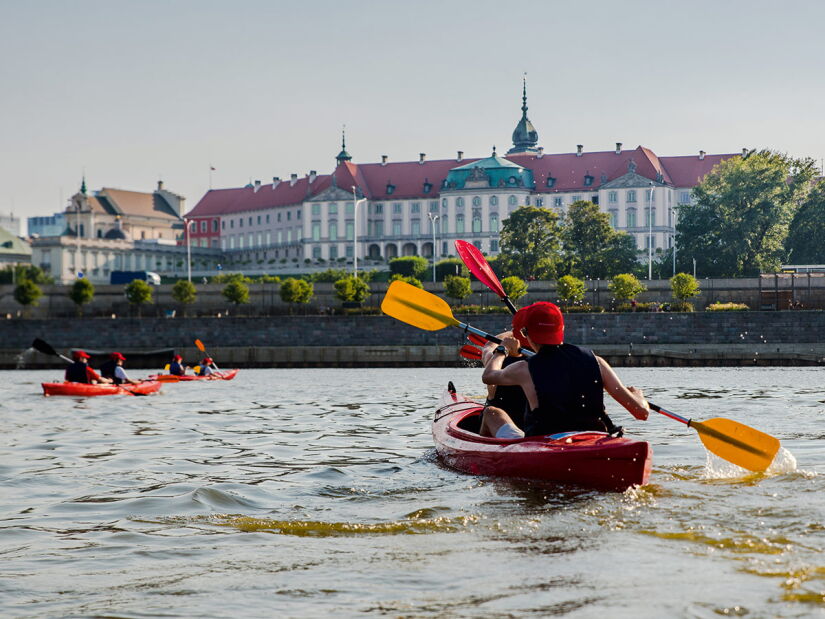
For business, I see strong potential in tourism, gastronomy and especially water-based recreation. Over the past decade we have seen a revival of Warsaw’s rowing traditions and growing interest in clubs, boats and river sports.
You have also spoken about connecting Warsaw more closely with other cities along the Vistula. What could that look like in practice?
One of my ambitions is to make people think differently about vacations and micro-tourism.
Perhaps you do not always need to take two weeks off and fly somewhere. Perhaps you can take a kayak or a traditional flat-bottomed Vistula boat and travel from Warsaw toward Płock or Toruń, spend several days on the river, sleep in natural surroundings, visit smaller towns and museums along the way and then return comfortably by train.
That requires cooperation between cities, operators and people who understand navigation on a river with increasingly low water levels. But it also gives each place the opportunity to present its own identity rather than create one uniform tourism product.
That is also why cooperation among Polish Vistula cities is important. Warsaw, Kraków, Płock, Bydgoszcz, Grudziądz, Tczew and Gdańsk have very different relationships with the river. There is a great deal we can learn from one another.
That idea is being expanded internationally through United by Rivers. What can Warsaw learn from other river cities, and what can it offer them?
The idea grew partly out of exchanges with Turin. They came to Warsaw to look at our river, including how we had dealt with areas affected by high water levels. We later visited them and discovered that they had once been involved in a network of river cities that had effectively become dormant. We proposed giving that idea new life.
We have also looked at cities including Oslo and Düsseldorf. United by Rivers brings together places facing completely different challenges.
Chicago, for example, is working on renaturalizing parts of its river system. Warsaw does not have to recreate a natural river because, fortunately, we still have one. Perhaps what we can offer is a lesson in what not to destroy.
Riga is at a much earlier stage and in some respects faces questions Warsaw was asking 20 or 25 years ago: how to reconnect residents with the waterfront, how to deal with major roads along the river and how to create a genuinely public boulevard.
Warsaw has become a leader in Poland in transforming its relationship with the river, but we do not want to present that arrogantly. We should share the things that worked and the things that failed, so other cities do not have to repeat our mistakes.
Żerański Park
Climate change is making rivers increasingly unpredictable. How does that affect Warsaw’s plans for navigation and recreation?
This is one of the most difficult questions we face. Other Polish cities often have more engineered rivers, with locks, weirs or other structures that maintain water levels. Technically, similar interventions could give Warsaw more water for navigation. I would love to have enough water for safe night cruises or regular passenger services of the kind Warsaw had several decades ago.
But the question is: at what cost? If we heavily engineer the Vistula, we interfere with precisely the natural system we have spent years trying to protect. Perhaps the broader hydrological drought affecting Europe should instead force us to manage water more intelligently, improve small-scale retention and think much more carefully about how we use the resources we have.
Navigation itself may also need to adapt. Traditional flat-bottomed Vistula boats are designed for shallow water. Rather than forcing the river to fit our expectations, perhaps some of our activities have to fit the river.
What do you hope initiatives such as United by Rivers can achieve beyond conferences and declarations?
The real value is practical exchange: sharing what worked, what failed and what other cities can learn from both. For me, the most important lesson is that a river cannot be treated only as infrastructure or as real estate. It is nature, public space, culture, transport, recreation, history and community at the same time.
And perhaps the best proof that something has worked is that people no longer wait for the city to tell them the Vistula belongs to them. They behave as though it does. That is what Vistula District ultimately means.
Get the best of “Warsaw Business Journal” delivered to your inbox daily