



A port in a storm
13:16
The residential market continues to attract money, but individual investors are no longer the only buyers. Institutional investors are joining in. Apartments are still hot, but aparthotels and other asset classes are increasingly in demand
By Beata Socha
Poles have taken a liking to investing their financial surpluses in residential real estate. The continually low interest rates and stock market volatility make the property market seem like a safe haven for an increasing number of individual investors.
In response to the growing demand, the number of different investment options is also getting bigger: apartments, both popular and luxury, niche residences like tenement houses, or aparthotels in tourist resorts and big cities.
By far the largest segment is apartments. They are the most easily accessible investment form, the sector is very liquid due to its sheer size and also often seen as the safest. After all, the “apartment deficit in Poland, also compared to Western economies, is still quite substantial, estimated at some 1 million apartments,” said Sławomir Horbaczewski, an economist and real estate analyst.
“A well selected apartment can yield as much as 4-7 percent, so an increasing number of people look to the residential market as an interesting alternative to low-interest bank deposits and an uncertain and limping stock exchange,” added Horbaczewski.
Investors, particularly those who were involved in the market during the 2007-2009 devaluation, are also looking more favorably at the upscale and luxury apartments segment, as it is subject to less volatility.
Old meets new
An interesting niche in the residential sector that is gaining on attractiveness is refurbished tenements in city centers. There are only a handful of players with sufficient know-how to tackle the complex ownership structure, not to mention the sometimes demanding collaboration with the curator for historic buildings. Hoża 42 is the latest such project in the heart of the capital, featuring 12 apartments ranging from 65 sqm to 200 sqm and four penthouses from 80 sqm to 350 sqm.
[negative]A well selected apartment can yield as much as 4-7 percent, so an increasing number of people look to the residential market as an interesting alternative to low-interest bank deposits and an uncertain and limping stock exchange[/negative]
“The market for apartments in old refurbished tenements is growing rapidly. They offer both spacious large-scale apartments, as well as smaller, 2-3 room dwellings. All share the same advantage: excellent location in the city center, with easy access to its infrastructure, as well as unique and meticulously restored interiors,” said Horbaczewski. He admitted, however, that the market mainly attracts investors with substantial funds to invest, as the tenements are often in poor condition and require quite a lot of work to regain their original glamor.
Short-term means more
Then there’s a new and growing asset class that has been gaining popularity over the past few years. While long-term apartment rental can be a secure and stable source of income, it is short-term rental that yields the highest returns. Thus, aparthotels (or condohotels) are best suited for those who are looking for stable returns, as well as a way to bring variety to their residential portfolio.
“The biggest plus that draws investors to this type of investment is the stable and guaranteed yield, exceeding the profit they can make from long-term rental of an apartment, and even several times higher than the interest on bank deposits,” said Małgorzata Czeboćko from Emmerson. Aparthotels also require zero or very little involvement from the investor as far as day-to-day management of the property is concerned. “The lease agreement is signed for several years, up to a dozen or so, depending on the business model,” she explained.
The aparthotel market has been developing both in large cities and in small tourist resorts. The former have been quite successful in most major Polish cities, including Warsaw, Kraków, Poznań, the Tri-City, and Wrocław. Only recently, J.W. Construction launched another aparthotel investment in the capital called Jerozolimskie Invest, west of the city center, adding to its current offer of Wola Invest.
J.W. Construction offers its buyers in Wola Invest or Jerozolimskie Invest a guaranteed annual profit of 5 and 7 percent respectively. “In Wola Invest, the client also receives 50 percent of the total profits, which means that with a 70 percent occupancy, the yield increases to over 10 percent annually,” explained Małgorzata Ostrowska, board member and sales director at J.W. Construction Holding.
The developer has also added five-star hotel services to its project, “which means that the guests will have access to a concierge, 24-hour two-storey lobby, room service, laundry services and a restaurant. Moreover, the owner will have unlimited access to use his or her apartment. Few other projects offer such incentives,” said Ostrowska.
Stay or no-stay?
Undoubtedly, aparthotels in tourist resorts have an added bonus: the owner can use the apartment for the purposes of his or her own vacation. Developers in the tourist segment have been churning out projects over the past few years, both in the most renowned and established tourist destinations, such as Zakopane and the Tri-City (which due to its dual character as a commercial and tourist destination can offer the highest yields), and in smaller and less recognized locations.
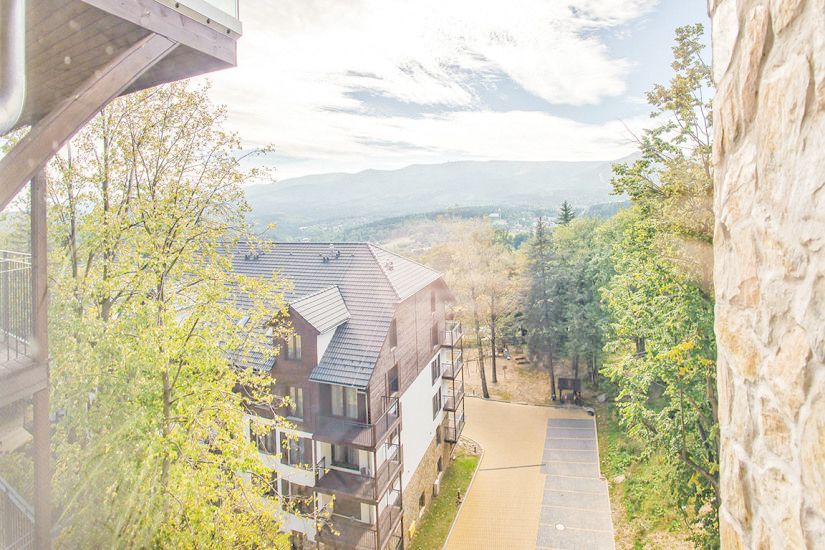
Szklarska Poręba, a ski resort in the Karkonosze mountains, is a particularly rapidly growing market. Developer Sun & Snow has recently launched another aparthotel project in the area dubbed Szklaska Perła, scheduled to be completed by the 2016/2017 winter season. “We offer investors income and a lease agreement for 10 years. We have already closed the first few deals,” said Dariusz Wilk, director at Sun & Snow Real Estate.
Szklarska Poręba has been attracting increasingly wealthier tourists over the past years. Another developer, Szrenica Resort & Spa is currently building the Blue Mountain Resort (scheduled to be completed in 2017), which will feature 248 apartments finished to a four-star hotel standard. The developer offers a 10-year lease deal, with an option to extend for another five years. “The investor has a choice between two investment options: either 8 percent annual yield without the option to stay at the resort, or a 7 percent yield with a two-week stay each year,” explained Czeboćko.
No longer just small-scale
The attractiveness of the residential market is not lost on institutional investors. As much as 73 percent of property professionals stated that “residential and student accommodation are now mainstream investment sectors,” according to PwC’s Emerging Trends Europe 2016 survey. “Many investors who have so far been investing in commercial property are also changing focus. Poland has been on the radar of large-scale investors for quite a while. Yet, so far there have been no meaningful and sizable assets available on the housing market to invest in. But the first investments show that where there is a will, there is a way,” said Maximilian Mendel, partner at REAS.
Mendel believes that in a few years, given the cyclical nature of the residential market, demand from individual investors may dwindle, at least temporarily. “Thus, more developers will be willing to look for alternative customers. And institutional investors seem the logical answer capable of offsetting the decreased demand by individual home buyers and small-scale investors,” said Mendel


