



Hospitable again
15:10
Developers are showing renewed interest in hotel projects in the Polish capital
By Adam Zdrodowski
After several years of slower activity, the hotel property market in Warsaw is now expected to see the launch of a number of new hospitality projects in the coming months, with real estate experts saying that there is still much room for new hotel schemes in the city. Several new hotel developments have recently been announced in the Polish capital. High occupancy levels and positive investor sentiment are now encouraging developers to commence new investments.
The trend is expected to continue in the coming years. “If we look at new hotel projects for Warsaw over the next five years, we can declare that there will be around 500 rooms added to the inventory every year,” said Alex Kloszewski, managing partner at Hotel Professionals. New schemes are expected to be developed in the major business districts of the Polish capital. “The predominant locations of choice in this period will be Mokotów and Wola,” Kloszewski added.
New projects galore
UBM will, at the beginning of next year, launch construction on the planned Holiday Inn Warsaw – City Centre scheme, which will be developed at the intersection of ul. Żelazna, ul. Twarda and ul. Złota in the downtown of Warsaw and will provide 254 rooms in early 2018. The developer has recently offloaded the planned project to Union Investment. “UBM will develop the property and be responsible as leaseholder for the successful running of the hotel until 2038,” UBM CEO Karl Bier said in a statement.
For its part, Starwood Hotels & Resorts has announced that the first Four Points by Sheraton-branded hotel in Poland will be located in the Mokotów district of Warsaw, with the company having just signed a franchise agreement with Mokotów Business & Airport Hotel. The Four Points by Sheraton Warsaw Mokotów project, which will be developed on ul. Suwak in the Służewiec Przemysłowy area of Mokotów and is scheduled to be opened in the last quarter of 2018, will comprise 192 rooms and over 500 sqm of conference space.
Gonçalo Duarte Silva, area manager, Poland, at Starwood Hotels & Resorts, said that the company and the property owners have chosen Mokotów because the district is an important business location and is located close to both the center of Warsaw and Warsaw airport. Silva views Mokotów and the Warsaw airport area as some of the most attractive hotel locations in the city at the moment. His company wants to make the planned Mokotów project the flagship hotel for the Four Points by Sheraton brand, he said.
On ul. Tamki, in the Powiśle neighborhood of downtown Warsaw, construction on the first Motel One hotel in Poland should start next year. Also, Puro Hotels is planning to open a new facility in the center of the city in the near future, which will be located on ul. Widok. A number of hotel chains which are not yet present in Poland are said to be looking for opportunities to open new facilities in Warsaw. They include InterCityHotel, Meininger and Leonardo.
Back in favor
[caption id="attachment_85280" align="alignleft" width="300"] Image: UBM[/caption]
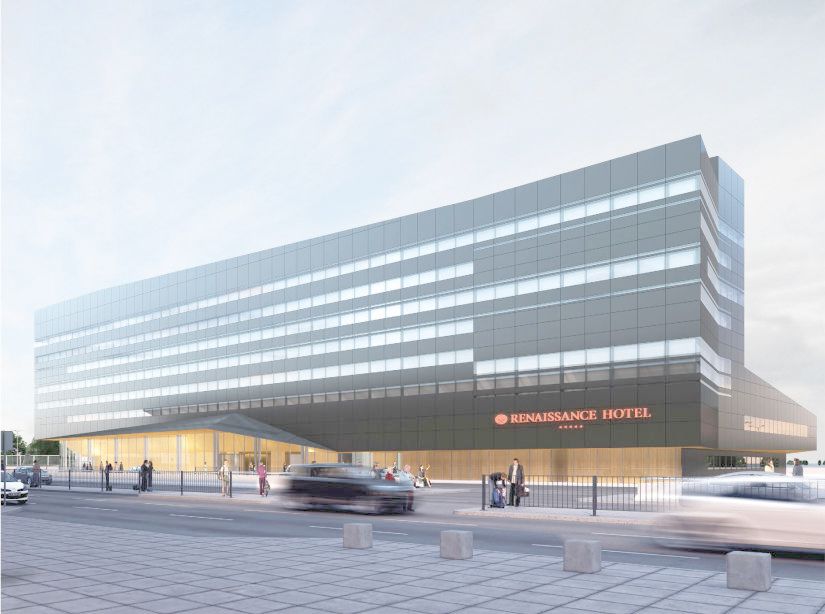
Few new hotel projects have been delivered in Warsaw in recent years, noted Adam Konieczny, country head, Poland, at Christie + Co. “Developers have, until recently, viewed investment in office schemes as more profitable,” Konieczny said. The most important branded developments completed in the Polish capital within the last two years were, a Hampton by Hilton hotel in the downtown area, which is the largest Hampton hotel in Europe, and a Doubletree by Hilton hotel in the Wawer district, he added. Construction is now underway on a Renaissance hotel located just next to the passenger terminals of Warsaw Chopin Airport. A new Golden Tulip hotel located in the Włochy district of Warsaw and a luxury Raffles hotel located in the downtown of the city are also in the pipeline. According to Konieczny, the rising vacancy rates in the office sector have resulted in renewed developer interest in hotel property. Additionally, investors and lending institutions have begun to show interest in the hotel sector.
“There is confidence in the hotel sector, from investors, developers and banks which want to finance branded hotels that are well located and managed by professional operators,” Kloszewski said. German investment funds are more and more active hotel buyers, he added. Moreover, REIT companies should start establishing their activities in Poland in the next few months. “This will drastically change the real estate investment sentiment in the country, which will be especially beneficial to the hotel real estate market in Poland,” Kloszewski said.
According to Martin Thom, director, head of hotels valuation, Germany & CEE, at CBRE, operators and developers see scope for new schemes in Warsaw, and the forecasts illustrate that this is across all market segments. Developers and owners are now actively looking at the potential to convert existing office buildings and schemes to hotel use. “We have seen a number of international operators, mostly in the economy segment, look seriously at such opportunities,” Thom said.
Room for more
There are now 73 hotels in Warsaw, which comprise a total of approximately 12,100 bedrooms and 22,280 beds, according to CBRE data. This means an increase in available bedrooms of around 3.4 percent, compared with the end of last year. “If you compare this against regional capital cities such as Budapest, Prague and Vienna, there is clear disparity in the supply of hotel accommodation,” Thom said. However, he pointed out that this is linked to demand.
When it comes to arrivals in terms of tourist accommodation in 2014, the Polish capital (approximately 2.86 million arrivals) was far behind Budapest (approximately 3.58 million), not to mention Prague (around 6.12 million) and Vienna (around 6.21 million), Thom noted. Nevertheless, there is the need for new hotel investments in Warsaw, according to Jakub Kleban, national director, valuation department, at JLL. The city is the strongest business destination in Central Europe, Kleban noted.
Indeed, very high room take-up levels have recently been recorded in the Warsaw hotel market. “Based on the latest data received from hotels in Warsaw, take up of rooms has been stronger than ever,” Kloszewski said. He added that as, of November 1, hotel occupancy was at a level of 80 percent throughout the entire sector. “We strongly believe that there is room for more hotel investments in all market segments from economy hotels to luxury products,” he said.
According to Konieczny, the main opportunity in the Polish capital is for economy and mid-market segment hotels, although the Warsaw market could also accommodate a high-end hotel if the hotel offers an original concept or new services and does not comprise more than 150 rooms. JLL experts are of a similar opinion, arguing that the Warsaw market can absorb another luxury project as long as it is developed in a prime location. They also see good prospects for lifestyle hotel developments which would meet the expectations of the so-called Generation Y.
New locations emerging
Where will new hotel projects in Warsaw be developed in the coming years? According to Thom, operators continue to look for central locations, but the extension of the Metro system also strengthens the possibility of further hotel development outside the traditional core. In Kleban’s opinion, hotels located close to major office hubs, including those in Mokotów and Wola, have a big chance of success. “Warsaw is, first and foremost, a business destination,” Kleban said.
The Wola district, which has recently become one of the main office hotspots in the Polish capital, will likely attract new hotel investments in the next few years, especially since some office developers argue that there is already too much competition there. Many new office projects, including high-rise schemes, have been announced for Wola. It cannot be ruled out that some of the planned office skyscrapers will, in the end, be developed as mixed-use towers including hotel space. Konieczny said that the Służewiec Przemysłowy business neighborhood of the Mokotów district, which has to date, mainly been dominated by office projects, will see the development of new hotel schemes in the coming years. He also noted that there are still no chain hotels in the Praga part of the Polish capital, which Warsaw City Hall is planning to revitalize in the near future. The area around the National Stadium in Praga has the potential for the development of new hotel space, Konieczny said.
Also, according to Silva, the rapidly changing Praga district will be ready for new hotel investments in a few years. Indeed, it may not be long before a new hotel development is completed in the district. Earlier this year, BBI Development and Liebrecht & wooD, which are currently developing their Centrum Praskie Koneser mixed-use project in Praga, announced that a hotel scheme will be part of the complex.


