



Kickstart to global expansion
10:38
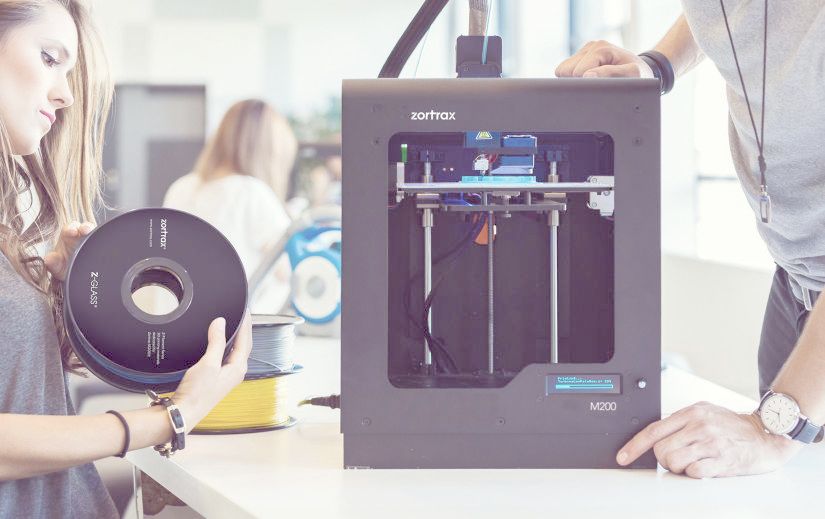
Polish 3D printer manufacturer Zortrax has taken the world by storm, winning international awards and tripling sales revenues year-on-year. Rafał Tomasiak, the CEO, tells WBJ Observer the story of the company, how it became the first Polish firm to successfully raise money on Kickstarter, and what the future holds
Interview by Wojciech Rylukowski
WBJ Observer: Zortrax is a fast developing, internationally recognized 3D printer manufacturer. Could you tell us about the beginnings of the company?
Rafał Tomasiak: Everything started in 2006-2007. We saw that a growing number of SMEs were in a need of 3D printers and we decided to buy our own machine to see how it works. It was an open-source kit that we had to assemble, so it took two or three months to put it together. We also spent some time learning how to master totally non-intuitive software, though we had experience in programming. After half a year of struggling to launch the device, we were extremely disappointed with the effect it produced. Sticky pieces of plastic weren’t what we were looking for. After doing some research, we realized that 3D printing was beyond the reach of the majority of firms worldwide, as the cost of professional devices started at a few hundred thousand dollars. It was then that we decided to make a 3D printer on our own – to develop firmware, electronics, etc. From the very beginning we had a clear idea, which we still hold to now, that we had to build a complete ecosystem, that we could offer a device that is almost ready to use out of the box.
Where did you get the money to finance the undertaking?
In the beginning, we financed the project from our own means, but the money quickly ran out, just when we had a product ready. We tried to look for an investor or a business angel, but at that stage of developing a start-up, the investment funds were too “bloodthirsty.” We turned to Kickstarter in hope of getting $100,000, and we managed to raise $180,000, thus we became the first Polish company to succeed in reaching its aim on that crowdfunding portal. The Kickstarter campaign gave us a lot of publicity, which turned out to be more valuable than the money we raised. The sum was only a drop in the ocean in terms of what was needed to launch production. Nonetheless, it allowed us to make a step forward. With all the publicity we got, we decided we needed to accelerate, and at the beginning of 2014 we issued unsecured bonds. We raised PLN 7.2 million, which was quite amazing since we’d only officially existed for a few months.
Your flagship printer – the M200 – won numerous international awards, including the best plug’n’play 3D printer according to users of the 3Dhubs.com portal. What’s the secret of its success?
There are many factors that contributed to this success – the ease of use, the short implementation time, low failure rate and very intuitive software. Companies don’t have to spend money on extra courses for employees; they can start using it after reading a two-page instruction booklet. The software “thinks for us” – it knows what a user wants to achieve after clicking a few simple buttons. But, the most important thing is the quality of the print. We offer one of the highest qualities, even compared with industrial printers, which are much more expensive than ours. The M200 is an all-in-one printer; it may be used in small companies, as well as in large corporations. It fits every segment of the market, whether it’s the defense sector, medicine, architecture, industrial design, the automotive or aviation sector. It’s universal.
The Polish economy is regarded, oftentimes rightly so, as not innovative.How do you see the success of your company in this setting? What kind of help do you expect from the state?
The Polish economy is not as backward in terms of innovation as it is painted to be. We are global leaders in certain segments, for example video games and software development. We have some of the best programmers and software developers in the world. When it comes to hardware, indeed, we are backward, but we are catching up. There are also other positive signs. Recently, Zortrax won a tender for the delivery of 180 3D printers for public utilities in the Mazowsze region. It shows that tenders organized by the state are designed to include innovation. Anyway, it’s not that bad, but one can always moan that progress is too slow or is heading in the wrong direction.
Could you tell me why public utilities in Mazowsze need 3D printers?
They are there to offer the possibility to become familiar with 3D printers. Small and medium-sized entrepreneurs may think that 3D printing technology exists and it may be useful for their company, but they never had a chance to see how it works. In this case, they can go to such a facility and check what’s in it for them.
The Zortrax Store in Warsaw plays a similar role. Are you planning to open them abroad?
Our Zortrax Store located in Warsaw on ul. Grzybowska is run by our reseller. Customers can become acquainted with our printers, buy one, or subscribe to various training courses. We do plan foreign openings but this is a long-term perspective. The opening of the store was a pilot program; we wanted to check how much money, work and resources it would take to launch it. We think it’s been a success in terms of our image and the education of the market about the technology and our products.
Zortrax is to be listed on the stock exchanged. When is it going to happen?
The size of the issue is still undetermined, it depends on how fast we evolve and what the market situation is at the time – as of now it’s not favorable. The WSE debut is not our strategic aim, it’s an added value, but we won’t push for it no matter what. The prospectus has been filed with the financial watchdog KNF and we want to be traded by the end of the year. The capitalization of the company amounted to PLN 225 million last year after a successful pre-IPO in July 2015. Since then, the company has developed; we recorded high revenues of PLN 37.6 million in 2015, and a net profit of PLN 8 million in 2015, so we more than tripled our results compared with 2014.
What are your aims for the future?
We want to grow even faster by introducing new devices; one or two of them will make an appearance later this year. There are some acquisitions on the horizon, but I can’t reveal any details at the moment. We want to be the leader in the segment of small and medium-sized enterprises, and our ambitions go beyond that – we want to be among the top three global leaders in 3D printing.
How do you see the future of the sector? Will it revolutionize our lives?
I keep opposing the idea of a 3D printer in every home. The devices were never addressed to private consumers because one has to know how to use professional 3D modeling software in order to enjoy its possibilities. I can’t imagine that an average user could learn modeling. And even if he masters it, what next? What will he design and print? Spare automotive parts? Would you use plastic brake pads in your car that you’d printed at home? Of course, you can print and replace handles, latches, and this kind of stuff, things that often break at home, but it’s way cheaper and easier to buy them at a store than to design and print them on your own. There were rumors that 3D printing would supersede manufacturing technologies. I strongly disagree with that. 3D printing was not invented for the mass production of things, but it is the missing link in the manufacturing chain. They are extremely useful when it comes to prototyping.


