



Managing emotions
13:57
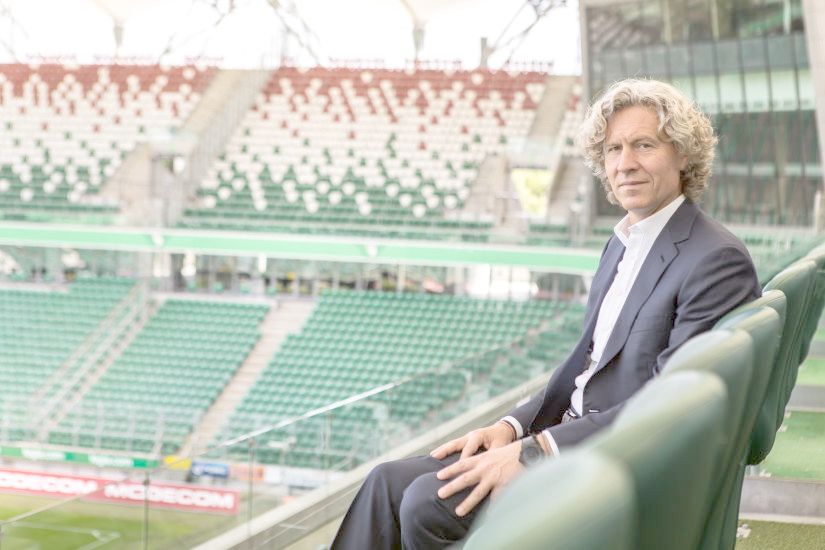
Dariusz Mioduski is a lawyer, who after years of working in construction and energy sectors, decided to switch to football. He talks about how difficult it is to manage such a polarizing brand as Legia and why, despite not making any money on it, he is loving it. He also talks about how he played basketball with Barack Obama and how he almost became a member of the government
Interview by Jacek Ciesnowski
WBJ Observer: Is it possible to profit from sport in Poland?
Dariusz Mioduski: From sport, maybe yes, but if you are asking if one can make a profit from owning a football club in Poland then my opinion is no. That is, of course, if your aim in owning the club is to improve its sporting performance, training and stadium facilities, and the quality of management and staff. Any increased revenues will have to be reinvested and the potential for substantial overall increase of revenues in the Polish football industry is also limited in the short term. In the long term, however, you can certainly increase the value of the club.
Then why even bother investing in sport?
I never looked at my investment in Legia from a pure business standpoint. Of course, I want to build the value of the club, but most of all, I want to make it much better. I believe that we can be one of the top 30–40 clubs in Europe. But Legia is also a chance to make an impact as a social project. We can positively affect the community, help others, make a difference in the lives of many young people. Finally, it is the fulfillment of my passions and dreams. All my life I have been close to sport.
How different is managing a sports club from managing a business in a more traditional sector, like banking or construction? In sport, there are so many factors that you cannot predict. You can buy a player for a million hoping you’ll sell him for much more in a few seasons, and that player can get seriously injured during his first training session.
Increasingly, managing a football club requires similar skills as managing a “normal” business. This is why in the top sports organizations in the world you see world class managers. However, the difference and difficulty of managing a sports club is that you can’t rely simply on your business and management skills. You have to realize that you are managing a business of emotions and unpredictability. A good business plan and good execution are not enough. The ability to deal with external pressure from fans and media and its effects not only on management, but on all parts of your organization is critical. Luck plays a huge part not only in winning matches, but also in avoiding injuries. Finally, the pressures and events of what is going on in society generally gets reflected in the stadiums and in emotions and the behavior of your fans, who for most part believe they know what to do better than you. This affects your decisions on a daily basis. No “normal” business has that.
Then why bother with football? You won’t make money on it, it’s unpredictable and can be very negative.
Because this is not only about making rational decisions, but also following your passions and doing what you love. And also because you realize how much good you can do through sport, particularly through such a strong brand like Legia, with millions of fans and followers, how much you can influence your community, how many young people you can help to make their lives better, how much joy you can help to give to all those, for whom Legia is one of most important things in their life. What can be better than that?
Do you ever see yourself not owning Legia?
Legia is the project of my life. It doesn’t have a timeline or deadline. As long as I feel that I can add value and as long as it gives me joy and satisfaction, I can’t see myself not owning it. However, I have learned over the years that life plays its own scripts. You may be forced to do things you don’t want to do. More realistically, I can imagine that in the future I could invite someone to join me if it might make the club significantly better.
Running Legia can be time consuming. Do you have time for anything else, business-wise?
Legia takes up much more of my time than I originally anticipated. Especially now, that I am leading the project of creating our new training and development center. I do find time for other business activities and I am involved in a few investment projects, but it is often at the expense of my family and personal time. Thankfully, now Legia is also a big part of our family life. My wife chairs Legia Foundation and it has become a full time job for her as well. She and the team are doing fantastic work with our community.
Your life has had many turning points. I’m sensing the most important period was your time spent at Harvard.
I guess I’m one example of the American dream. My family moved to the US when I was 17. We had nothing, and in a short time I had this rags to riches story of my own. From working at McDonalds to finishing the best school in America. Being an immigrant makes you humble, but on the other hand if you succeed, you can be sure that you can succeed anywhere. It also makes you grateful and you want to help others. On my path here I’ve met many people who’ve helped me, without them I wouldn't be here. That’s why I want to give something back.
During your time at Harvard you met US President Barack Obama.
A funny coincidence, but true. A few evenings a week a group of 20-30 of us would go to the gym to play pick up games. One of them was this tall, black young man, who became the US President. He was a year ahead of me but I remembered him not only because he was quite good, but also because someone told me that he was the President of Harvard’s Law Review (the oldest operating student-edited law review in the United States). You had to be the best student in your year to lead such an esteemed publication.
You were also close to entering politics.
During my university days I thought that one day I may decide to enter into politics. As an idealist I believed that this was the most effective way to change things for the better. Emigrating from a communist regime I was very conservative in my views. I even established a Republican Party club at my university and helped on a couple of congressional campaigns. But then, after a few years of work, I realized that there are other ways and politics was not the only way to effect change. After working for many years in the Polish energy sector, I did have a proposal to become a deputy Minister of Privatization responsible for the energy sector, but the partners in the London law firm, where I was working vetoed those plans. I think I was lucky again, as that government was dissolved after six months.


