Poland 2050 has a plan to recover state-owned companies
02:10
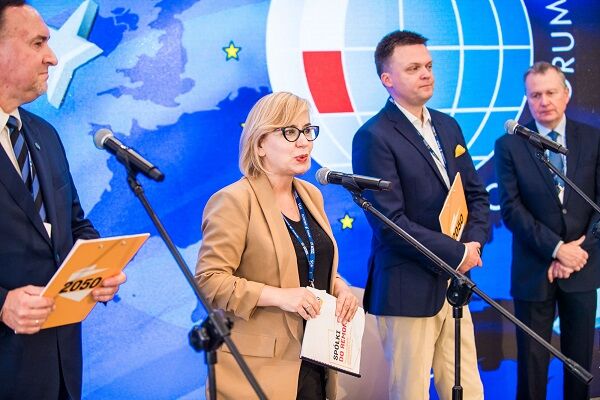
"We live in a country where the rulers think of state-owned companies as a private treasury full of jars with preserves distributed to their closest relatives. This has to be stopped," Szymon Hołownia, the leader of Poland 2050, alarmed.
"State-owned companies have become a tool for practicing politics by guys who buy votes by using their positions," Paulina Hennig-Kloska, MP of Poland, added.
In her opinion, such empowerment in state-owned companies may lead to disturbances and competition between entities, lowering the quality standards of public services and disturbing sovereignty.
Szymon Hołownia and Michał Kobosko presented several ideas for the healing of state-owned companies by Krzysztof Bolesta, Paulina Hennig-Kloski, Jakub Jakubowski, Andrzej Mierzwa, Ryszard Wojtkowski and Stanisław Zakroczymski.
"This disease has gone so far that one medicine is not enough to heal and function in the body that is our common property," Szymon Hołownia said.
In his opinion, it is necessary to create a National Register of Politically Exposed Persons and their families. As Szymon Hołownia pointed out, it should be a place where a database will be developed, allowing easy access to information about family ties with politicians.
"Finally, we need to introduce a transparent personnel policy in state-owned companies," the leader of Poland 2050 said.
In his opinion, deputies and senators should immediately be banned from holding functions in state-owned companies.
“This pathology cries out to heaven for vengeance. This provision will also apply to ministers and deputy ministers. It cannot be that someone deserved credit for the party in exchange for promises of a later transition to business and financial rebuilding, ” Szymon Hołownia emphasized.
Poland 2050 also proposes a radical increase in the participation of women in supervisory boards and management boards of state-owned companies. Within two or three years, the employment rate of women should increase to 40 percent in supervisory boards and at least one-third in the boards of state-owned companies.
Michał Kobosko emphasized that the Minister of State Assets should be obliged each year to present an annual report on the state of public property, from which the public will learn about the state of management of individual companies.
(WBJ)