



Post Election
12:40
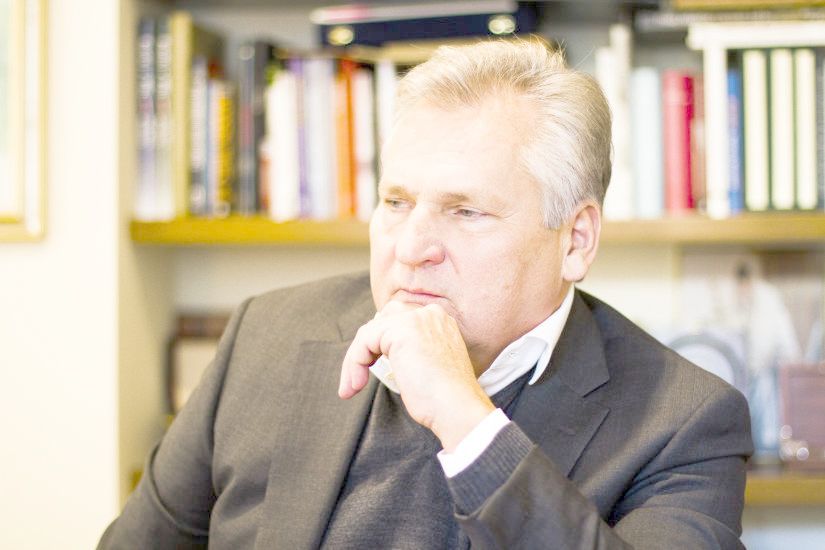
Aleksander Kwaśniewski sat down with WBJ Observer to analyze the political landscape in Poland after the parliamentary elections, the changes announced by the PiS government and the role of Civic Platform and other opposition parties
Interview by Ewa Boniecka
WBJ Observer: For the first time since 1989, one single party has won a majority in the Sejm and Senate, with the president also based in that party. Do you think that the PiS victory will result in fundamental, some say revolutionary, changes to Poland’s internal and foreign policy?
Aleksander Kwaśniewski: That is a very difficult question. I currently have difficulties in assessing PiS. I remember the party’s radical behavior when they were in government between 2005 and 2007. On the other hand, I have two election campaigns fresh in my memory. In both the presidential and parliamentary campaigns the party presented a much more moderate face, sending out many reassuring messages concerning domestic and foreign matters. For instance, PiS withdrew the issue of constitutional reform from their campaign, along with some other radical motions.
Saying that, I want to point out that it remains to be seen what PiS will do in practice while in government. But, in answer to your question concerning any potential changes, I think that the changes will be profound, because in my view the differences in ideology between PiS and Civic Platform are more significant than between American republicans and democrats, or between the German Christian democratic party and social democrats. Therefore, in that sense, the change of government in Poland will mean a sharp turn to the right in many domains, among others in justice, the economy, pensions and the education system. It is not the case that when one established party changes for another, the country continues to move in roughly the same direction which is normal in democratic countries. In Poland the differences between PO while in power and PiS when it was in opposition were acute, politically and ideologically. PiS promised to change Poland’s liberal democratic system from top to bottom.
Yet, having said that, I want to underline that the PiS victory was fully democratic, achieved with respect to all democratic procedures, so the election shows that the democratic system in Poland is working.
Concerning the matter of the constitution, you were the co-creator of the present constitution, created in 1997. Now there are some voices on the right, among others, Paweł Kukiz who are saying that it is time to change that constitution. What is your reaction to this?
Before I was elected president I was in parliament as the chairman of the constitutional commission. We worked very hard to achieve compromise while working on that constitution and later to get it approved. Next year the present constitution will celebrate its 20 year anniversary. It seems a long time but for a document such as a constitution it is still in its infancy and my opinion is that our constitution has proven itself well. After all those years, there is only one paragraph which may require alteration: that which states that the Złoty is our currency, so, when Poland approves the Euro it will have to be amended. However, in the coming 4 years the matter of approving the Euro will certainly not be on the agenda. As for the remaining constitutional articles, there is no need for any amendments. I’d say more, the stability of the constitution is of great value in itself. In a country such as Poland, where we have issues with law culture and where the constitutional tradition was shaken in our history, the stability of the constitution is vital for all institutions and citizens in terms of respecting the law. If the constitution were to be changed depending on the political setup, it would become one of many state laws and not the fundamental document that shapes the system of the country.
After the election result, Donald Tusk gave Civic Platform a few words of comfort. He pointed out that obtaining 24 percent of electoral votes is defeat, but not a disaster after 8 years in power. However, there is now a heated debate within Civic Platform about the responsibility for the defeat and questions are being raised about the leadership of Ewa Kopacz. I was in London during the last British parliamentary election and witnessed the resignation of Ed Miliband from the leadership of the Labour Party a few hours after his party’s defeat. Is that how it should be in Poland?
[caption id="attachment_85193" align="alignright" width="300"] Image: Jan Malinowski[/caption]
You are right to point out that in mature democracies the principle is clear: after losing an election the leader of the party takes responsibility for the defeat and opens the way for personal conclusions to be drawn. But, Poland is still a fledgling democracy and the practices are different. After the previous defeat, PiS did not change its leader, Jarosław Kaczyński and after a couple of years he has led his party to victory. Also, the SLD leader Leszek Miller did not resign after the party’s defeat in 2003. I do not want to comment on current practices within Civic Platform and the expected fight for its leadership. The most important thing for the party now is to heal its wounds and build unity, because the danger of its collapse is substantial.
How do you view the role of Civic Platform in opposition?
It has to be a strong, confident and pragmatic opposition. It will be up against a government with the comfort of a total majority, which no party has had before. PiS is governing without a coalition partner and it has the backing of the president. Civic Platform has to present a long term political scenario for Poland, based on understanding the changes that are going on in our country and in Europe, and be a viable political alternative to PiS. To achieve this PO must refresh its structure and identity, regardless of who its leader will be. It is the only way to preserve political balance in Poland, which has already been diminished to a conservative/nationalistic monopoly. But what political identity Civic Platform will develop and present is difficult to say. It will also be dependent on the shape of the future parliament, in a situation with the absence of a left-wing party, PO may be able to acquire some of their policies, especially concerning citizen’s liberty and the secularity of the state.
It will be difficult for PO to build a new identity, they have had to confront the various divisions within the party. The liberal/conservative/center/left mix has resulted in the lack of a clear vision and ideology. In a parliament where there will be a strong liberal showing from Ryszard Petru, the populist movement of Kukiz and no representatives from the Left, what stance will PO take on the opposition benches?
Firstly, a party’s identity is easier to build in opposition than in government because while ruling there is often the need for compromise and decisions to be made which go against ideological values. So, I think that now in opposition, Civic Platform should clearly define its message to voters, its identity as a center/conservative/liberal party, devote time to internal, content-related debates. I want to state here that in my opinion, many political parties in democratic states face program dilemmas because I think that traditional divisions on left and right, to which we became accustomed in the 20th century, are now much more complicated. It is associated with the technological revolution which has changed social structures and the strict divisions of social classes, the shape of the job markets and the form of public communication. Therefore, it is important how parties address such changeable societies with their political and economic policies. In Poland the situation is even more confused because PiS has a leftist social program while being very nationalistic and conservative in relation to ethical and moral issues such as in vitro, abortion and the role of the Church in political life. Civic Platform has a dilemma in terms of consolidating its conservative and liberal approach to policy, economy and ethical matters with sensitivity towards social issues. Maintaining such a balance was difficult when PO was in power and it will be just as difficult when it is in opposition. But, if PO were to turn more to the left, there would be the risk that the conservatives within the party would begin to flirt with PiS.
The Left coalition did not make it into parliament, how do you perceive its present and future fate?
I regret that the left coalition built by SLD and the Palikot party did not get into parliament, but the coalition was created much too late in the day, when both of those parties were already in crisis and I think that now that coalition will disband. Barbara Nowacka, as the face of the coalition, regardless of how hard she worked to convince the electorate of her leftist ideas, could not build a credible coalition with the burden of mistakes made in the past by the leaders of its founding parties. But, certainly the principle of a credible left is needed in Poland and they will not disappear. The social left movement, led by Adrian Zandberg, is attracting young, educated people with anti-establishment sentiments, which is interesting, but what will come of it is as yet unknown.
The scale of the PiS victory shows that a large section of Polish society is firmly conservative. In the opinions of many foreign commentators and also some Polish analysts, a strong nationalistic and conservative trend with euro-sceptic elements now prevails in the country. Do you agree with those opinions?
I have fundamental doubts. While it is obvious that after the PiS victory the country has turned to the right, I would not say that Polish society is now more conservative than 10 years ago. Just like in other European countries there is a process of modernization and secularization going on in Poland. So, to answer the question as to whether we are, as a nation, resolutely conservative, we should find one thing that proves it, or there should be a referendum on the subject. I am convinced that such a referendum would show that 60 percent of Poles are in favor of further modernization in all areas and 40 percent is staunchly conservative. That is only my intuition as I have no proof. But, generally I think that the success of PiS has many aspects. PiS has substantially softened its rhetoric and hid many elements of its nationalistic and conservative character during the presidential and parliamentary election campaigns. There were unofficial statements concerning the constitution, and ethical and moral issues were touched upon very carefully. PiS also kept its close ties with the Catholic Church subtly under wraps.
In choosing such tactics PiS was certain it would retain its core electorate. Approximately 30 percent of society has, for years, assured the party of its hard conservative, religious and nationalistic support. Therefore, PiS consciously choose to present a softer image during its campaign to win over the more moderate groups of conservative voters. That group had grown substantially because people from various political standpoints and economic interests had become disillusioned with Civic Platform and mainstream politics. Among them were new voters in their 20s, who were generally rebellious towards the political establishment and they had reasons to be angry. If young Poles cannot find work, as the best educated generation in our history, when they are employed on worthless contracts, they cry out for change. Furthermore, their votes for the populist Kukiz group, which won more than 40 seats in parliament, is another sign that young people are angry and frustrated.
We are in a very challenging international situation, how will the PiS government handle foreign policy?
First of all, I would like to make a general remark. I am less worried about the economic promises of PiS because when responsible, knowledgeable people determine financial policy their political views do not trouble me, as long as they don’t ruin the state budget. I am, however, concerned about the new government’s foreign policy. Having witnessed the proclamations of PiS politicians, I can foresee the situation that Poland, from its current position as an emerging power in the EU, could become a euro-sceptic member with a whole host of negative consequences for our country and the entire European Union. Poland taking a euro-sceptic position could become a serious problem, especially in the very difficult present situation in which the European Union is under significant pressure from many crises. There is the war in Ukraine, the matter of relations with Russia which will be problematic for years to come, there is the issue of Islamic State which could be a threat for the foreseeable future. There is the matter of refugees, also an issue that does not seem to have a quick solution. There is the matter of the referendum in Britain concerning its membership in the EU. There are also many other crises: the economic situation in Greece, the problem of the energy union and the climate program. There is also the problem of various populist and nationalistic parties gaining support in many EU countries. I would not want Poland to add to those problems.
PiS politicians have declared that there will be significant changes in Poland’s foreign policy and that Poland should not conduct its policy in the EU according to a ‘mainstream’ framework, i.e., “following Germany and France.” My answer is that if Poland has built close cooperation with those two countries we should be happy and strengthen that cooperation. If PiS wants to dismantle that partnership with Germany and France, the most important players in EU, by creating separate Polish policies based on close cooperation with members of the Visegrád Group, it is not realistic in the context of the political and economic conditions in the European Union. Plus, we differ from members of the Visegrád Group on many matters such as attitudes towards the Kremlin.
If PiS want to help maintain independence in Ukraine and its pro-Western policy, it should not be obstructive towards Germany as they are the main player in the EU in the process of achieving it. Poland could not do it alone, we must take care to strengthen relations with the countries which can help us in our policy towards Ukraine.
I hope that the facts that illustrate the interdependence of today’s world will get through to PiS leaders, and that the notion that Poland can stand alone and separate from the EU will be dispensed with.
How will the issue of refugees in Poland be resolved, considering that during the election campaign PiS leaders attacked prime minister Ewa Kopacz for accepting them?
Pacta sunt servanda. The present government has to accept the obligation made by the previous one. However, there is the more important issue that accepting refugees is an element of European solidarity and breaking our word would have its costs. If Poland refuses to accept refugees and later finds itself in the situation when we require the solidarity of the European Union, we may hear “we will not help the Poles.”
Finally, I would like to ask how you react to the comparison, made my some commentators, of Jarosław Kaczyński to Józef Piłsudski in terms of being the most powerful influence in shaping the country, but not holding any formal position and therefore being above constitutional responsibility?
The personalities of Józef Piłsudski and Jarosław Kaczyński are entirely different, as are their eras and roles in shaping Poland. Having said that, the fact that such comparisons are made reflects the situation in which the main center of power is located outside the realms of constitutional responsibility. I think that the role of king-maker suits Jarosław Kaczyński but I will not demonize it. I am convinced that in the 21st century, with the power of technological media and the internet and the strength of society, even a man who is outside formal structures but so strongly influences events, is under public control. And on my part, I would like to close our conversation by saying that I wish the government all the best because I wish nothing but the best for Poland.


