



Power for sale: Meet the next generation of private military contractors
14:03
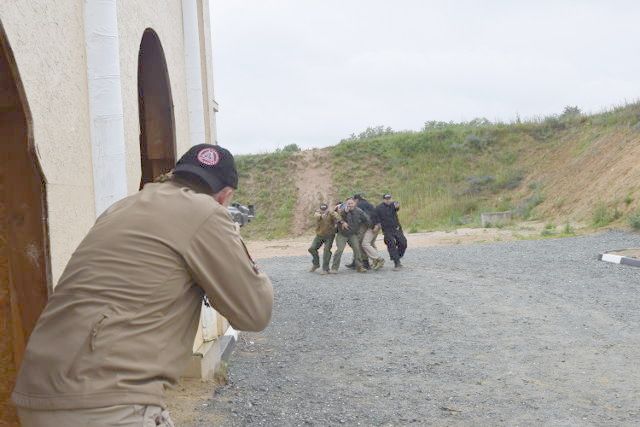
The WBJ Observer spent three days embedded with future private operators at the European Security Academy(ESA) in the small town of Włościejewki. These are their stories
By Santiago de la Presilla
Located roughly 45 km from Poznań and founded in 1992 by notorious military expert Andrzej Bryl (also founder of Wrocław-based Delta Security), the ESA is a private 5 sqkm complex that consists of several wooden-and-stone made small buildings.
The complex as it is: the main office at its entrance, the dining hall for instructors and trainees serving traditional Polish food, a windmill turned into a dorm and another small building that has the capacity of hosting 12 trainees. Roughly 600 meters down a road inside of the complex there is ‘Mogadishu.’ The ‘Mog,’ as some of the students call it, is a set of wooden buildings with signs in Arabic and roads full of rocks, designed to look exactly like the war-torn Somali capital.
The staff appeared very comfortable in front of cameras, yet all students but one requested their names to be changed and their faces blurred. The reason being “I don’t want my name popping up on Google if I’m being vetted for a job, PMCs don’t like it when their operators talk too much,” said Belgian bodyguard Sif.
It is no secret that private military companies (PMCs) have suffered from a bad reputation since the Nisour Square massacre in Baghdad, an incident that saw 17 civilians killed and 20 injured, as well as other famous occurrences, such as the British national and cofounder of the infamous PMC Executive Outcomes, Simon Mann, who was extradited to Equatorial Guinea after a failed coup attempt against the Equatoguinean dictator Teodoro Obiang. Unfortunately, these are not isolated incidents.
Managing director Bartosz Bryl discussed the background checks that the students have to go through before they set foot in the academy. With the current flight of foreign fighters joining the wars in Ukraine and all over the Middle East, “if we find out that somebody wants training to then join a foreign military-like force such as ISIS or the Kurdish peshmerga, we just tell them to go to another academy. We don’t deal with their kind,” said ESA’s managing director, while also emphasizing that taking sides is not good for business.
Close-Protection Training
Trainees were going through a two-week close protection-training course. Even though the course does not require any previous experience, the all male students were mostly former police or military.
The ambience was pretty relaxed, but at the end of the day one could see how demanding the training actually was. Some days, it came close to 12 hours of instruction, which also involves a solid amount of theory.
[negative]650-700 People attend ESA's courses each year[/negative]
The day of arrival, the students went through a class introducing them to the weapons close protection operators use, apart from pistols, they were instructed on submachine guns such as the German- made MP5 and MP5K, and the Swiss B&T APC. All deemed “personal defense weapons” or PDWs.
After two hours of technicalities, the students were taken into a tiny close-quarter underground shooting range, where each student got to fire 10 bullets from each weapon in a very disciplined manner. Then followed a two-hour close combat training session that included lessons on how to protect yourself from an attacker with a knife, “don’t be afraid to get cut. It is better to lose a finger than have your lung punctured,” repeated continuously the German instructor, Arik. The course tries to turn ex-soldiers from the combat mindset into more of a defensive stance even though the academy also offers courses that seem to be a lot more combat-orientated, such as the Private Military Contractor course, where the use of assault rifles is commonplace.
The final test of the Close Protection training was reported to look like this. It consisted of a simulation
[caption id="attachment_77458" align="alignright" width="300"] Image: Santiago de la Presilla[/caption]
where the students were in Poznań for 48 hours. This test had the students dressed in suits and ride in armored cars with radios so they could communicate between each squad within the convoy. An instructor role-played a VIP whom they were to protect. The test was to be as complicated as possible for the students, i.e. the VIP wanting to go to the movies or meeting friends on short-notice.
Maritime security, a perfect example of PMCs volatility
During the height of the Somali piracy years, a private operator “could get between €5,000-€6,000 per month” stated Konsta, an ex-Greek Special Forces soldier who was deployed to Kosovo and did security for the 2004 Summer Olympics in Athens. “Now it’s under a €1,000,” he stated angrily. He blamed the lack of large-scale piracy, as well as the fact that the maritime sector has been “bombarded” by non-Westerners that will settle for a lot less money than their Western counterparts. The drop of his salary happened in less than six months.
“When I started doing maritime security it was all Brits, ex-forces guys, then the Greeks came in, then the Indians, the Sri Lankans, the Nepalese, the Indonesians and now it’s got to the point where the Chinese will do the same job as us, and they’ll make nothing. They just settle for less,” said 28-year-old Jay, a South African national who served five years in the British Royal Marines and served seven months in Afghanistan, “the maritime threat is just not there anymore,” stated the ex-Marine.
“Money’s no good when you’re dead”
Demand rules this private military industry like any other, the more dangerous a job is, the more you’ll get paid. This is where the toughest decision-making takes place.
Alberto, a very friendly and bearded 37-year-old ex-Spanish soldier, said he served in Afghanistan and he had been doing private security for the past nine years in Spain, as well as being a bodyguard in Mexico and Honduras.
When asked about the money, he said, “the problem’s not the money. If you are in Spain as a soldier, you can make €1,000 a month. Once you are abroad, you can start making up to €4,000. The government can always help you; nobody is going to leave you behind. As a contractor however, you’re alone,” he continued, “Spain’s not taking care of a Spanish contractor captured by a Mexican cartel. You always have to ask yourself, ‘is it worth the money this time?’ ”
Alberto spent most of his time in Latin America due to his lack of English. When asked if he ever wanted to go back to Afghanistan as a private operator, he answered, “As a Spaniard, I wouldn’t go to Afghanistan for less than €5,000 per month, but you can find a Bulgarian that will do it for €1,500, so companies are hiring less qualified people. Which makes it extremely dangerous. Of course €1,500 in Bulgaria is a great wage, but in Spain it is not even enough for my mortgage.”
On why he would only go back to Afghanistan if the pay were substantial, “companies are competitive, they do not cooperate. It’s not like in Afghanistan with NATO soldiers where we used to get medevacs [medical evacuations] from French and American helicopters. There’s no cohesion amongst the private industry.”
Poland: a must for European PMCs
There were only three Poles out of 22 students in the Close Protection Training course. The rest mostly came from European countries, as well as Africa and Asia. Poland seems to be “cheaper and better” according to Polish London-based security guard, Tomasz. “You cannot get the type of weapon training we get here in France or in the UK,” the bodyguard said.
On the last day, the academy received around 12 French students who had done a two-week course in France, but since gun regulation in France is “draconian,” as some students called it, the bulk of their course is done in cooperation with the ESA in Poland.
[negative]PLN 4,500 is the cost of a one-week training course[/negative]
The students kept mentioning that the ESA was one of the few institutions that are accredited in order for them to get the Security Industry Authority (SIA) license; once they complete the course they are able to apply for this license. Even though there seems to be no American equivalent for the SIA, “European PMCs will not hire you without this license.”
Who fits the profile of a PMC?
Most of the current private operators I met during the course were guys who looked at their country’s armies as too ideological and just wanted to continue their lives related to the military without politics in the mix. Especially the Ukrainians: Sergei, a former Ukrainian army soldier who served for ten years, said he was “disappointed” by his country’s armed forces. His superiors ordered him to cut his soldiers’ wages to fix parts of the almost destroyed base his battalion was stationed at, when he refused he was swiftly forced to resign. He then told me that in less than a year his commander had found him a job in the private sector and he went to work in northern Iraq with a British company he didn’t want to disclose. The company helped him “improve” his English, and paid him more than a high-ranking officer in Ukraine “could make in his lifetime,” he said laughing.
Holding hands
The rumors of governments cutting their defense budgets at the expense of PMCs turned out to be untrue. A soldier in the Polish army, who chose not to disclose his name, said he had served for 18 years and planned to retire in two years, so he could get a good pension. When asked how he could pay for this course on a soldier’s paycheck, he answered “I’m sponsored by the army, they pay for most of the course.”
Jay also mentioned that the UK government has some sort of “resettlement package” that is supposed to help soldiers transitioning to civilian life, these credits can be used for private security training if the academy is accredited and even though Jay paid for the course out of his own pocket, the ESA is an accredited institution. That means that the tuition can be fully paid for by any government program around the world.
As the British Army plans to cut more than 42,000 jobs in the next four years, according to a report by the Royal United Services Institute, how will it protect its interests abroad? How does it maintain a noticeable presence in Afghanistan or Iraq? Leaving it to the private sector is the way governments stay out of the radar.
The question remains, is this what war will look like in the future?
In many ways, it is almost as if warfare was going back to the Middle Ages, where mercenaries dictate the aftermath of armed conflict. If you take a close look at modern warfare, the image of a uniformed soldier with a flag patch on their arm is fading by the day.


