



The paradox of owning an apartment
16:23
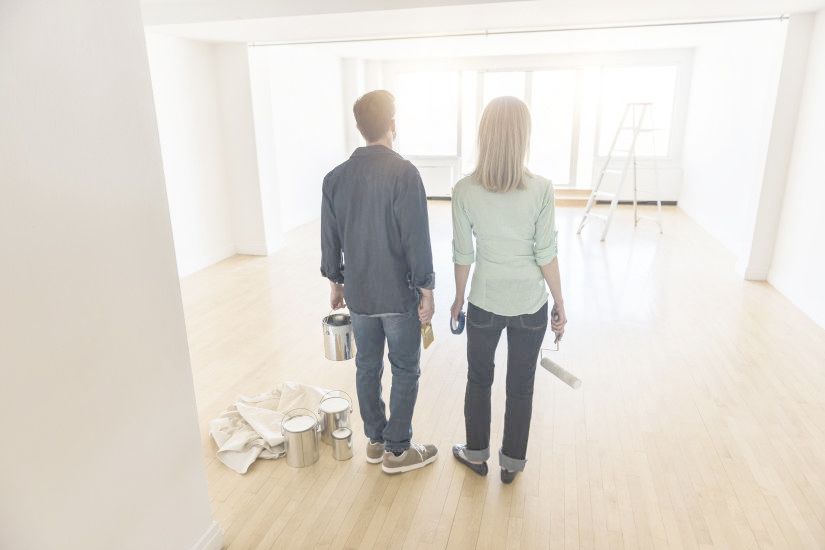
The prevailing belief in Poland is that an apartment should be owned and renting is considered a transitional period between moving out of your childhood home and buying your own apartment. However, recent research shows that this ‘ownership complex’ increases unemployment and hinders the rental market
By Sergiusz Prokurat
The average Polish family has assets amounting to a quarter of a million dollars, according to a report entitled “The wealth of households in Poland,” issued by the National Bank of Poland in November 2015. The figure takes into account all the actual owned properties, such as houses or apartments. Indeed, Poland has an exceptionally high percentage of people who own the house or apartment they live in (73 percent), compared to only 42 percent in Germany – as revealed in the report. It could very well be inferred that Poles are better-off than Germans.
Some analyses put the home ownership figure even higher. According to a report made by the Pew Research Center in 2011, as much as 82 percent of Poles own property, and barely 18 percent of the population are tenants. Furthermore, a deeper examination of the ownership structure of apartments in Poland shows that, in fact, only approximately 3 percent of Polish citizens lease their homes on a commercial basis. The remaining tenants live in “housing supported by the state,” which belong to municipalities (municipal housing), National Forests, PKP (Polish Railways), or the army. Eurostat considers all of these cases as leases administered at non-market prices.
[negative]The average real rate of return from owning a property was close to zero for the whole of the twentieth century[/negative]
A social stigma
In fact, Poland and other CEE countries have some of the highest rates of property ownership in the world. It is even higher than in the UK or the US, where about 60-65 percent of the population are property owners. On the other hand, in countries such as Switzerland, Austria and Germany, almost 60 percent of people are tenants and 40 percent are owners.
One reason why so many Poles decide to own rather than rent is that, unlike in Germany and Switzerland, living in a rented apartment is stigmatized as a way of life for the poor. If one can afford a loan, one takes it – in order not to “stuff the landlord’s pocket.”
Some say it is also a matter of common sense and prudence. A person earning Poland’s average monthly salary of PLN 4,000 will have as little as PLN 1,700 as a pensioner, according to OECD data. The average rent of a single-bedroom apartment rarely falls below PLN 1,000 in Poland’s major cities (in Warsaw it exceeds PLN 1,500). A Polish pensioner could hardly be expected to afford to rent an apartment at market prices.
[caption id="attachment_94478" align="alignleft" width="300"] Image: Shutterstock[/caption]
What’s wrong with this picture?
One could say it’s all for the best if Poles can be that frugal. After all, what could be wrong with having your own home? Proponents of having your own place say it facilitates the accumulation of assets and is useful both for individuals and for the entire economy as it enables and encourages people to save. However, in recent years there have been a lot of publications saying that there are also negative effects of an excessive percentage of property ownership.
When the majority of the population are property owners, it reflects on the labor market. For 20 years, a British economist, Andrew Oswald has been publishing papers which show that having your own home undermines people’s morale and hinders the mobility of employees, which in turn raises unemployment. The effect discovered by Oswald shows that each 5 percent increase in the possession of properties leads to a 1 percent increase in unemployment. His research was a snowball that prompted an avalanche of other studies, which largely confirmed his findings.
An overly high level of property ownership makes citizens less willing to move to areas where new jobs are created, increases commuting time and leads to a smaller number of new companies being created. Oswald’s observations are what the Austrian school of economics calls malinvestments that eventually result in higher unemployment rates in some regions of Europe. A good example of this phenomenon is Spain, which, not unlike Poland, has a high percentage of home owners compared to renters.
Legal shortcomings
Moreover, the emphasis put on owning a home in Poland makes the rental market underdeveloped and therefore less transparent. In Switzerland, a tenant may sue the owner and bring action against an unjustified rent increase – and he or she usually wins. Such things are unheard of in Poland.
Polish law only provisionally resolves the issues concerning a home lease, leaving both the tenant and the landlord exposed. For example, a renter can lose their home in a matter of a month, which is the standard notice period for most home leases. Packing up your belongings is relatively easy when all your stuff fits into a minivan, but as you grow older it becomes more and more of a nuisance. This is an important factor for families with children deciding to either rent an apartment or take out a home loan.
On the other hand, the law also fails to protect the interests of the landlord, who oftentimes has to cover the repairs to damaged property out of his own pocket. Not to mention, it can be a real problem if your tenants have the bad habit of failing to make rent payments. In recent years, a new regulation introduced the so-called “occasional lease,” which makes such tenants easier to evict, thus making home leases safer for the landlord. Still, “occasional leases” are meant to be short-term (they cannot be longer than 10 years), so the issues of long-term renters and their landlords remain unresolved.
If the rental market were more substantial, perhaps lawmakers would be under more pressure to provide stronger legal safeguards for both parties. Or maybe the opposite inference is true: if the legal aspects of home leases were better regulated, more people would decide on a long-term lease rather than taking out a loan to buy an apartment.
Commodity or investment?
When we look at the correlation of GDP per capita and the percentage of home owners we come to
[caption id="attachment_94476" align="alignright" width="300"] Image: shutterstock[/caption]
another interesting conclusion. It turns out that less developed countries have higher levels of property ownership. So associating economic development with high numbers of home owners turns out to be a pipe dream. It is quite the opposite in fact. In richer countries, the percentage of property owners decreases.
One reason for that could be that people in more developed countries tend to be more business-savvy and prefer to invest their money in developing their own company rather than acquiring real property. Certainly, owning an apartment can be a form of investment, but its return is only slightly better than a bank deposit.
As Adam Smith put it in his timeless treatise: An Inquiry Into the Nature and Causes of the Wealth of Nations, “A dwelling-house, as such, contributes nothing to the revenue of its inhabitant; and though it is, no doubt, extremely useful to him, it is as his clothes and household furniture are useful to him, which, however, makes a part of his expense, and not of his revenue.”
Property is therefore of illusory value and its capital characteristics are valid mainly in large and medium-sized cities. Smith’s conclusion is further legitimized by Robert Shiller, a well-known economist from Yale University, who notes that the average real rate of return from owning a property was close to zero for the whole of the twentieth century.
A 60/40 balance
Owning real estate of course has its advantages. The main arguments are of a social rather than economic nature. Real estate ownership motivates residents to create law-abiding local communities and care about the neighborhood, as well as social integration in a given area. Economists estimate that the optimal proportion of home owners to tenants is approximately 55-60 percent to 45-40 percent. Almost every country offers government programs to support people looking to buy an apartment, like the current MdM (Apartments for the Youth) subsidy program in Poland. Such programs are generally considered to be a positive stimulus for the market and thus for the entire economy. They have been known to jumpstart more than one sluggish economy and help its recovery after a downturn. However, many would say that the main beneficiaries of such policies are usually not buyers, but real estate developers.
So, if you’re deciding between buying and renting, and you wonder how your decision will affect the market, you’ll have a hard time reconciling the paradox: if you buy a home, you help the economy, but if you settle permanently in one place, you hurt it by limiting your mobility.


