Where opportunities abound
16:07

Poland’s retail map is still far from saturated. There are a number of niches that have yet to be filled in cities with less than 100,000 inhabitants, as well as in major agglomerations. They are up for the taking for those who understand the risks involved and the changes that retail is undergoing
Interview by Beata Socha
WBJ Observer: Is the retail market becoming saturated?
Marek Noetzel: The statement that the retail market is facing oversupply is exaggerated. There are markets that are quite saturated already, like Poznań and Wrocław. In spite of this, each of them has a major project in the pipeline.
Warsaw is still only moderately saturated. But it is the fastest-growing agglomeration and is improving its infrastructure: the ring road and the second subway are under construction. These developments are catalysts for other changes. With improved transport, catchment areas are getting larger. Infrastructure investments are what fuels retail. They open up new opportunities, even if not overnight.
Where in Warsaw do you see such opportunities?
For instance, on the eastern side of the River Vistula, in Wawer. There is also a planned GTC development in the southern Wilanów district as well as one in the northeastern Białołęka district. Another is to be developed in Młociny, a northern part of Warsaw. There are developments planned in Kabaty [southern end of the subway line] and in Piaseczno, south of Warsaw.
Warsaw has not seen a major shopping center open for quite some time now. Whereas all other major agglomerations have seen some spectacular launches recently: Riviera in Gdynia, Poznań City Center in Poznań, Galeria Katowicka in Katowice and Galeria Bronowice in Kraków.
Warsaw has low vacancies, while its demand for retail space is the highest out of all major cities. We can therefore expect something interesting to happen there.
Where is the demand coming from? Are there a lot of new players coming to the Polish market?
There are new brands considering entering the Polish market. Perhaps not dozens of them, but they are certainly large-space occupiers from the fashion industry. We can also see some brands returning to Poland. They used to have a presence here, through franchisees. Then they withdrew and are now coming back.
Outside of Warsaw, are there any more niches that can be filled? A lot is being built in smaller cities across Poland. Are these schemes considered risky?
If this is the only project being developed in a city and if it has the proper scale, it is not too risky. Such projects will likely close the market for a long time. The risk arises from the fact that a tenant’s aversion to risk is negatively correlated with the size of the city.
However, consumers from these smaller markets expect the retail to be closer to them. So, oftentimes, the new projects are not shopping malls but retail parks. They are cheaper to build and maintain and still offer modern tenants good space.
What will developers do once all the cities of between 100,000 and 200,000 residents are, as you said, “closed?”
There are still cities with less than 100,000 inhabitants. This year, together with our client, we have opened centers in Kutno and Ostrołęka. Next year we are opening one in Starogard Gdański. We’re working on projects in Głogów, Zawiercie and Kołobrzeg. These are all projects in cities with a population under 100,000. There is demand for space in these cities.
How close are we then to saturating the market?
People asked me that question five years ago and we are still seeing new developments. I remember that when Złote Tarasy opened soon after Arkadia people said that there is no room for two schemes of this magnitude. Not only was there room for these two, but there is probably room for a couple more.
The market is increasingly demanding. There is a great challenge standing before the owners of retail schemes in terms of expanding, refurbishing and redeveloping their property, as well as active asset management including redesigning their tenant mix. Many shopping malls will soon be 15-20 years old and will have to be modernized.
[negative]“Clients have fled to discount stores not because they are cheaper, but because shopping there is far less time-consuming.[/negative]
What can owners do apart from managing their tenant mix? It is said that entertainment is becoming increasingly important for all retail schemes.
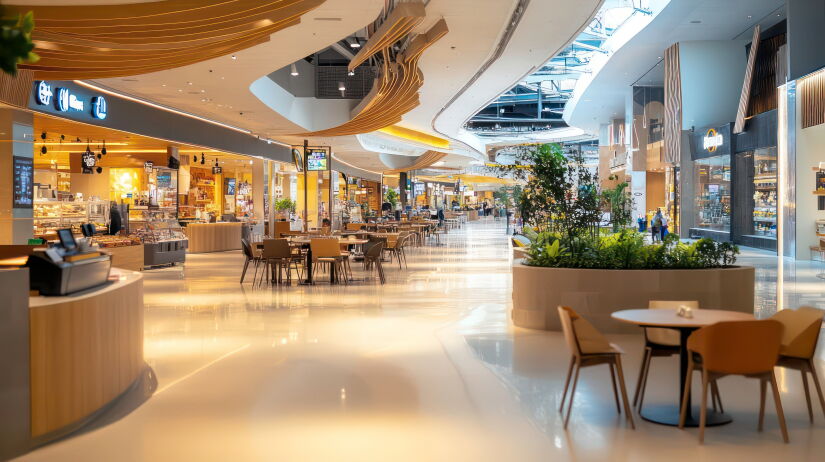
Yes, it is. Not only in terms of a cinema and a good food court, but also complimentary functions, such as fitness, a kids play area, etc. They all increase the dwell time of a client. The client then learns the layout of the mall and wants to return. And that’s the goal of any retail owner.
Are convenience stores, which are popping up all over Poland, threatening hypermarkets and supermarkets that have traditionally been the anchor of any mall?
Our shopping malls are and will continue to be defined by their food operator. In most cases it is still the main generator of the footfall. This industry also has had to face the strongest competition from convenience as well as discount stores. Because they usually occupy large spaces, managing them requires a much larger time frame.
Clients have fled to discount stores not because they are cheaper, but because shopping there is far less time-consuming. You drive up, have a quick run around the store and come out with two shopping bags. Meanwhile, shopping in a mall is more of a weekend venture.
Does this mean that all shopping centers get the bulk of their footfall during the weekend?
Not necessarily. Shopping malls located in the city center, in business centers, like Złote Tarasy, Arkadia, Galeria Katowicka, Poznań City Center and Stary Browar, are alive all week long. However, centers like Targówek or Blue City are definitely more weekend-oriented.
In the case of Złote Tarasy, Poznań City Center and Galeria Katowicka, the transport which is integrated with the mall probably also helps, doesn't it?
We are once again coming back to infrastructure. It is the shopping mall that is located next to the station and not the other way around. We will always use public transport, including railways, so there will always be a flow of passengers. Whether these passengers become clients is another story. Shopping malls located near transportation hubs definitely have lower conversion rates than destination shopping malls. But they do have much higher footfall.
Do you think there will be many more schemes built next to railway stations?
Hopefully yes. The development at Warszawa Zachodnia will soon be launched. Polish Railways are currently carrying out a tender for the redevelopment of Warszawa Główna.
Do you see e-commerce as a threat to traditional retail and to the real estate industry?
E-commerce has made its mark on retail, but it varies from one industry to another. Electronics seem to be more susceptible because the products are more standardized. What is important to remember is that you can’t operate only in brick-and-mortar stores or online. Clients expect retailers to offer them both and those chains that can balance the two channels will gain the most. Even Amazon, which grew up in the virtual world, is opening up a traditional store. So these two worlds are getting more and more intertwined.
Besides, customers now expect a lot more than just websites. They want mobile apps to help them with the shopping, by e.g. allowing them to compare prices and enhancing their shopping experience. That’s another source of opportunities for retailers.