



‘A GUARANTOR OF DEMOCRACY’
19:18
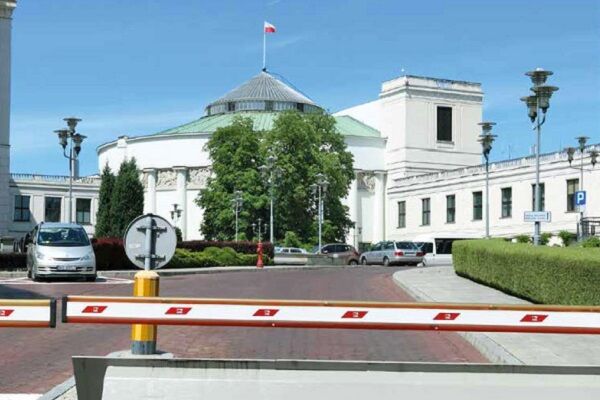
WBJ: Is Senat’s existence really necessary in the current Polish legal order? Or is it just an “experiment?"
Tomasz Grodzki: The upper chamber of the Polish parliament is not an experiment. It is one of the foundations of the tripartite division of power in Poland and a guarantor of our democracy. For over two years now, ever since the Senat has been in the hands of a democratic majority, it has also been a fuse of Polish democracy and the only institution fighting to uphold the rule of law, human rights, and inherent dignity of the human being.
It is a place where we listen to citizens, where we work on laws in-depth and do not pass them through some kind of quick legislative process, as it happens in the Sejm, lower house of the Polish parliament.
The upper house is inscribed in Polish history and tradition and only the communists had the courage to raise their hand against it in a falsified referendum. I am deeply convinced that if it were not for the Senat, much of the vile behavior of this compromised government would have never seen the light of day, as evidenced, for example, by the work of the special committee dealing with the Pegasus surveillance system.
The upper chamber does not have a decisive influence on politics in Poland today. Do you think that its prerogatives should be strengthened?
I fundamentally disagree with the opinion that we have no influence on politics. Thanks to us, the illegal “postal elections” led by Jacek Sasin were stopped. It was the Senat that rejected the original five animal protection laws package and as a consequence of our decision, this law did not enter into force in its original shape. It was thanks to us that the first media reform bill was rejected. Finally, it was the Senat that exposed the true intentions of the ruling party, when we proposed to allocate PLN 2 billion for oncology rather than for the [alleged government mouthpiece] TVP. But the Sejm did not agree to this — it preferred to finance propaganda instead.
But if you ask about the prerogatives of the upper house, yes, I believe that they should be strengthened, if only in terms of the legislative initiative of the parliamentary chamber. In the current term, we have sent to the lower house several dozen bills, which were put on the back burner by Sejm speaker Elżbieta Witek for political reasons.
When a bill comes from the lower chamber to the upper chamber, we have 30 days to deal with it. There should be the same symmetry for our legislative initiatives. At present we have such a situation that when the government finds our draft law convenient — for example in the case of pensions for people born in 1953 — they take it, add to it something of their own and then treat it as their own success. This should not be the case.
The same is true in the case of amendments to bills submitted by the upper house. There is no discussion on them in the lower house, they are often voted on as one block. The MPs don’t even have the time to analyze them — what counts are political considerations and not substantive ones. The Sejm should treat the works of the Senat with the same seriousness as we treat the bills that come to us from the Sejm.
Is there any figure or person in the history of the upper parliamentary chamber who is an authority for you?
It is an honor and pride for me to be able to head the upper house that in the past was led by such great figures as speaker Wojciech Trąmpczyński or Andrzej Stelmachowski — the first speaker of the Senat established in the aftermath of the free elections in 1989.
I treat their legacy as an obligation to work hard for the benefit of all senators. The upper house works in a radically different way than the lower house. Although the temperature of disputes is sometimes high, it never exceeds the limits of parliamentary culture. We argue, we discuss, we are open to arguments. Please note that many bills are passed in the Senat with 100 votes in favor [the upper chamber consists of 100 senators], so we are able to agree on many issues.
What are the competencies of the Senat chancellery?
The chancellery provides substantive, organizational, and technical support for senators and performs its tasks very well. Many people who work there created the office when the upper house was reborn after the elections in 1989 and they are very devoted and committed to it. Each office is made up of an excellent team of specialists, whether in legislation or international affairs. All are important to us. Senators are aware that with the support of such professionals, they can perform their mandate well.
Back in 1920, Poland became a member of the Inter-Parliamentary Union. Within its framework, the then upper chamber inaugurated international contacts. How are these contacts being developed today?
In the current term, for the first time, inter-senatorial cooperation groups were established: Polish-German and Polish-Czech, in addition to the already functioning inter-parliamentary groups involved in cooperation between Sejm deputies and senators. This proves how important relations with our neighbors and the upper houses of the parliaments of these countries are to us.
I am honored that I had the opportunity to talk to Roberta Metsola twice before she became president of the European Parliament. Many presidents or prime ministers visiting Poland also visit the upper chamber to get a different view of the situation in our country than that of the ruling party. Despite the raging pandemic, we managed to organize several visits at the highest level of parliamentary presidents. And the Polish-Lithuanian-Ukrainian parliamentary assembly deliberated in the Senat.
I have good and regular contacts with many ambassadors accredited to Poland. We also try, which is very important for us, to keep in touch with the Polish expatriate community, as the Senat has been the guardian of the Polish diaspora since 1989. And although the government has taken money away from us for this purpose, we try to support Polonia in other, non-material ways. I was particularly moved by the recent visit of a Senat delegation to Kazakhstan, where we met with Poles exiled to that country and their descendants. This is a very important part of our work.
Do you think, “the father of Polish democracy,” Andrzej Frycz Modrzewski’s views — honesty of manners, conscious social and political attitudes — haven’t lost any of their relevance in today's Poland?
Thank you for invoking Modrzewski, whose thoughts and legacy are particularly important to me. In my first speech just after I was elected speaker, I recalled his motto that "the Senat is what inspires other authorities to noble actions, dissuades them from dishonest ones, and cools their passions." Modrzewski was a visionary who was ahead of his time. His concern for the fate of the Republic should be a model for all, as love for one’s homeland is always the same, regardless of changing centuries, events, and historical circumstances.
In 1921, after regaining independence, the March Constitution restored the upper chamber, and in 1922, the head of state, Józef Piłsudski, performed its ceremonial inauguration. This year marks 100 years since that event. We have a lot to be proud of. And yet, the National Bank of Poland (NBP) refused to mint a commemorative coin for that occasion. Will the Senat be able to celebrate this anniversary?
We have already begun celebrations of this special anniversary, inaugurating them with a scholarly conference devoted to the place and role of the upper chamber in the evolution of the functions of the parliament — from tradition to the present day.
We are working on the next elements of this important year for us. Unfortunately, we are limited by the pandemic, so many events will probably be different from what we have planned. For the Senat, however, this will certainly be an exceptional time, full of pride in our predecessors and a feeling of honor that after 100 years we are fulfilling the mandate of senators of the Republic of Poland.
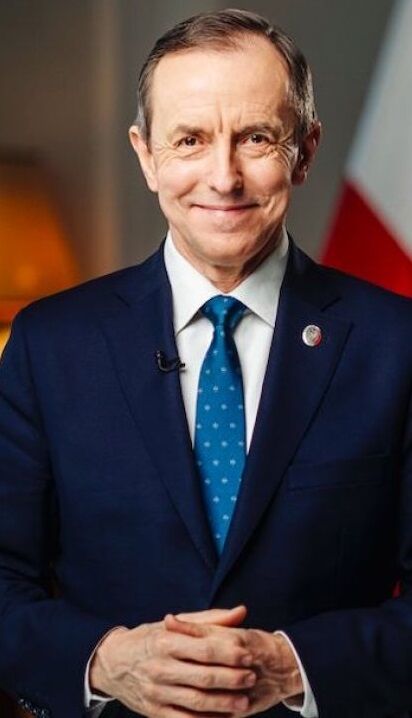
Tomasz Grodzki is a Polish politician and has served as the speaker (in Polish: marshal) of the upper house (Senat) of the Polish parliament since November 2019. He belongs to the Civic Coalition (KO), Poland’s largest opposition alliance.


