A new fitness routine
12:59

If your gym membership card was among the first things you dusted off once the pandemic limitations were lifted, you were not alone. Thousands of gym goers stormed their fitness centers once it became possible again, receiving a warm welcome from a somewhat reduced but nonetheless relieved staff.
The one thing that may have changed is the operator of the gym you’ve been a member of for years. While you were considering canceling your membership during the long months of covid lockdowns, the market underwent some significant changes. And more are happening now.
 A MASSIVE PUNCH
Within a year the number of gym memberships in Europe dropped by nearly 15%, from 65 million in 2019 to 55.2 million, according to Statista. Such a sweeping hit takes time to recover from. In 2021, the number of gym goers rose to levels from 2016. And they keep growing.
MARKET SHAKEUP AND NEWCOMERS
The market leader, Benefit Systems, acquired 16 Calypso Fitness clubs for a total of PLN 54 million in March of this year. The gyms Benefit acquired are located mostly in major cities: the Tri-City (7), Szczecin (4), Warsaw (2), Wrocław, Kraków and Częstochowa (one each). Additionally, Benefit Systems holds a third of Calypso shares. Before the Calypso acquisition, Benefit purchased six Saturn Fitness centers for almost PLN 27 million.
Although Benefit remains the undisputed leader, operating nearly 190 gyms under 10 brands, it has seen a rival emerge practically overnight that may soon threaten its position. And the contender to the fitness throne came from a different market altogether.
A CONTENDER WITH A BIG APPETITE
Medicover, a Swedish private healthcare network, took the fitness market by storm. Over the past two years the clinic chain spent €95 million (PLN 440 million) on gym acquisitions, taking over 10 fitness brands. In 2022 alone, Medicover acquired McFit Polska, Premium Fitness & Gym, Platinium Fitness, and Smart Gym.
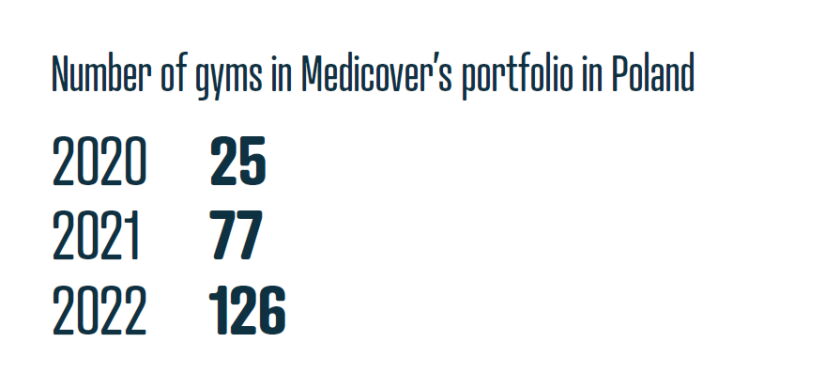
Within that time, the number of Medicover gyms rose from 25 in 2020, to 77 in 2021, and reached 126 by the end of 2022. With this fivefold expansion of its gym network over the past two years, Medicover has shifted its attention towards fostering organic growth in the fitness market.
“We intend to be anywhere where we can find potential customers. We still see white spots to be filled,” Justyna Gościńska, head of sport and fitness at Medicover told Puls Biznesu. “We don’t want to give numbers, but we have an appetite for more,” she added.
PAYING OFF DEBTS
The consolidation is hardly surprising, considering how deeply in trouble some gym operators found themselves during the pandemic. Two years of intermittent lockdowns weakened even large players, let alone smaller chains.
Notably, more than 60% of the amount paid by Benefit for Calypso gyms (amounting to PLN 34.3 million) was actually offset by overdue receivables owed to Benefit Systems by Calypso Fitness. Considering that the average debt of fitness centers reached approximately PLN 100,000 in 2022, the market was primed for major acquisitions.
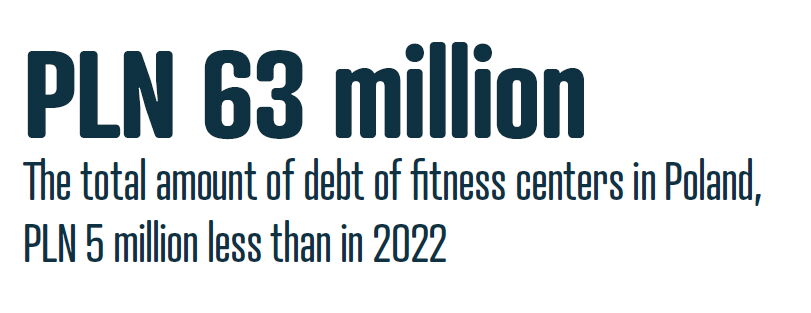
However, having survived the three-year downturn, the market is bouncing back stronger than expected. In fact, overdue payments from sports facilities, sports clubs, and fitness centers decreased by almost PLN 5 million in the last 12 months, to just under PLN 63 million, according to data from BIG InfoMonitor and the BIK database.
The data indicates that the sports industry is actually quite fit financially, despite its challenges during the pandemic. The average overdue payment for fitness centers exceeds PLN 94,000, while for sports facilities, it is around PLN 258,000, and for sports clubs, it is PLN 16,000.
TAKING THE MARKET’S TEMPERATURE
There are still fears that the lean years may be far from over. With a global slowdown (some predicting a major recession) looming, fitness spending may be among the first “fat” to be trimmed when austerity hits.
In fact, 45% of respondents to a survey conducted on behalf of BIG InfoMonitor said they are spending less on gym and sports activities now, while 41% of them decided to keep their spending at a similar level. But even if current gym goers are tightening their belts, the sheer numbers of fitness center clients keeps increasing, offsetting reductions in spending.
UNSEASONAL ACTIVITY
So far in Poland, health awareness seems to trump ongoing economic downturn and inflation-induced austerity. According to Tomasz Napiórkowski, the head of the Polish fitness industry employers association and owner of the consulting firm X-Sports Group International, fitness centers experienced strong growth last year up to June, which is quite unusual for the business. In most years leading up to the pandemic, numbers would rise in the September-November period, as well as between January and March, while the other months are usually relatively low in fitness activity, he told Forbes.
Benefit System board member Bartosz Józefiak agrees. “We are seeing the highest attendance in fitness clubs in ten years,” he told Rzeczpospolita. The company said that with nearly 1.2 million membership card holders at the end of 2022, it had surpassed the number of subscribers from before the pandemic. Over the course of last year, enrollment numbers grew by 345,000.
ROOM TO EXPAND
Market experts agree that Poland still has room to grow, pointing out that its fitness market has yet to achieve the size of its Scandinavian counterparts or even the average in Western European countries.
The increased activity in fitness centers is evidenced by the growing purchases of gym equipment. “We can see a marked revival in the market. Fitness club chains are planning new openings and are refurbishing existing ones,” said Sylwia Czepiżak, CEO of Olymp, a supplier of gym equipment for both Benefit Systems and Medicover.
According to Czepiżak, the fitness market is seeing increased spending not only in major cities, where the market leaders operate, but across smaller cities too. Olymp recently signed a deal with Best Gym, a gym network targeting smaller cities and towns. “We see a lot of potential in this cooperation because demand for fitness centers outside major agglomerations keeps growing,” she added.
THE FLIP SIDE
But the recent wave of takeovers could also paint a different picture. The fact that the largest and fittest survived the two-year pandemic turbulence is hardly shocking. But what if the reason for a continued market consolidation is the fact that the new, post-pandemic, high-inflation game can only be played by a handful of players with economies of scale they can leverage against the drop in customer spending? What if smaller players are no longer able to compete on price?
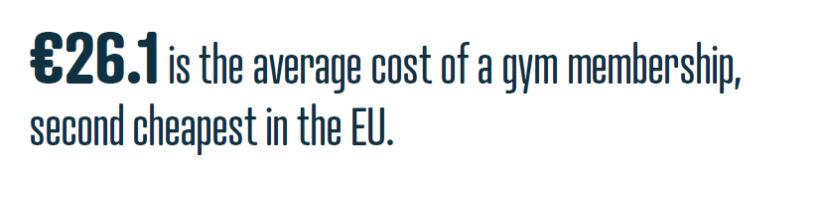
As it is, compared to other EU countries, Poland has the second cheapest average gym membership prices: a mere €26.1, surpassed only by Bulgaria. Meanwhile, the neighboring Czechs pay €41.4, according to data from Numbeo.
Despite the growth in the overall number of gyms and gym memberships, we may be witnessing a squeezing out of the competition. The struggle for survival in the fitness industry can be unforgiving, particularly when combined with intense price and cost competition, leading to a potential race to the bottom.
Where is the fitness market headed? Before the pandemic hit, Poland’s fitness market was the second fastest growing one in Central and Eastern Europe. But even with the record number of gym memberships and cheap subscription fees, Poles don’t frequent fitness centers nearly as often as other Europeans. Perhaps once this gap is addressed, Poland will not only see more gyms but also the greater health benefits that regular gym attendance brings.