



AI’s generational fault line
03:03
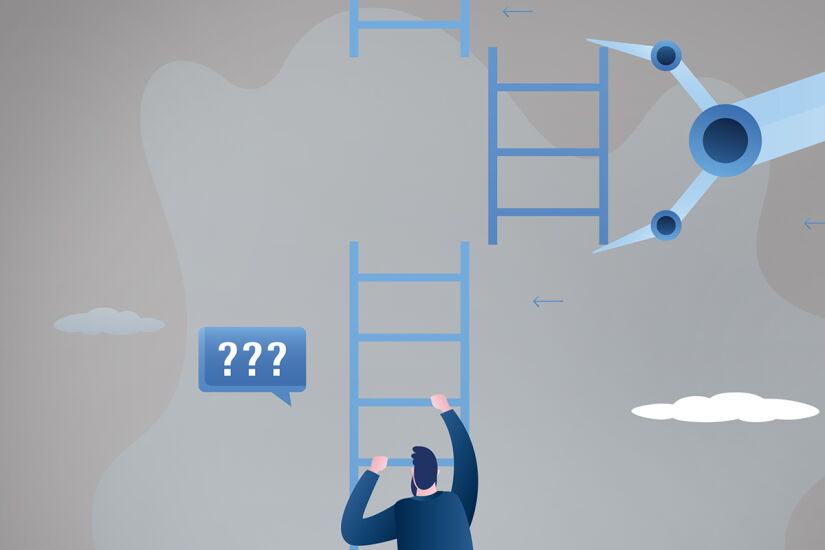
By Beata Socha
Poland is among the European economies with the greatest potential for automation. McKinsey Global Institute estimates that as much as 61% of working hours in Poland could technically be automated using technologies available today, higher than the 58% average across the ten European economies studied. This could potentially generate around $105 billion in additional economic value by 2030.
More than job loss
Yet the numbers do not point simply to mass replacement of people by machines. McKinsey estimates that 85% of the skills Polish employees use today will remain relevant, although many will be applied differently and increasingly with AI support. The emerging question is therefore not only which jobs disappear, but what happens inside the jobs that remain.
That distinction matters because automation is moving beyond repetitive administrative work and into cognitive, professional tasks. As it does, it is beginning to affect not only productivity but also how people enter professions, acquire experience and learn from those around them.
The missing first rung
AI adoption has accelerated rapidly. Between 2022 and 2025, the share of companies worldwide using AI in at least one business function rose from 55% to 88%, while use of generative AI increased from 33% to 79%. The effects are increasingly visible in knowledge-intensive professions that have traditionally provided career entry points for educated young workers.
In a recent study, Coface estimates that 17.5% of tasks in Poland are exposed to AI-driven automation, putting the country fifth among the economies assessed, alongside Germany and Australia.
“In the Polish economy, relatively high exposure to AI comes primarily from the legal and financial services sectors, as well as administration and management,” says Mateusz Dadej, Chief Economist at Coface in Poland and Central and Eastern Europe.
These are also sectors in which junior employees have traditionally learned through research, analysis, drafting and other relatively basic assignments. If AI performs more of those tasks, companies may not simply lose junior work. They may lose part of the process through which juniors become experienced professionals.
The generational divide
That shift arrives in workplaces where generational differences are already widely felt. According to an SW Research study conducted in March 2026, 82% of respondents notice differences between generations in their approach to work. Almost half point to differences in the pace of work and communication style, while more than two in five see differences in technological skills.
Almost one in three respondents also perceive generational differences in setting boundaries and in values. AI therefore enters an environment where employees may already work, communicate and define professional expectations differently.
Technology can magnify those differences. Younger employees entering the workforce with generative AI readily available may become exceptionally fast at producing an answer. Their more experienced colleagues, however, may be better equipped to judge whether that answer makes sense.
Who uses AI better?
That raises a less obvious question than who adopts AI first: who is actually better equipped to apply AI to the business context?
A junior employee may know the newest tools, experiment more readily and make AI an integral part of everyday work. A senior employee may be slower to adopt the technology but possess something harder to automate: a mental model of what good work looks like. Years of experience provide context for spotting implausible assumptions, weak conclusions or an output that is technically polished but fundamentally wrong.
The strongest model may therefore be neither the AI-native junior nor the experienced senior working alone. McKinsey expects agent-centric roles to become the largest category in Poland, accounting for 29% of jobs. In these roles, employees will work closely with AI agents, supervising their activity, interpreting results and making decisions.
Knowledge goes both ways
That makes intergenerational knowledge transfer more important, not less. But the direction of that transfer is changing.
“Mentoring has not disappeared, but the direction in which knowledge flows has changed. Today, it moves both ways. Senior managers share their decision-making experience, while younger people bring technological knowledge,” says Miłosz Omastka, entrepreneur, President of the Silesian Business Club and MBA ambassador at Humanitas University.
That distinction also exposes the limits of treating access to AI as equivalent to expertise. “Automation and AI can take over analytical tasks, but they cannot take responsibility for a decision or explain and defend that decision to a team,” Omastka says. When information can be generated in seconds, judgment, feedback and exposure to how experienced people think through ambiguous problems become more valuable rather than obsolete.
Companies aren’t ready
The transition is already creating a skills paradox. Only 25% of Polish companies say they have access to qualified IT staff capable of implementing and maintaining AI, while even among organizations already using the technology, 47% report a shortage of specialists. Employers cite candidates’ lack of experience (79%), inadequate education (75%) and skills mismatches (61%) as the main recruitment barriers.
Yet almost half of companies, 48%, are taking no action to address these shortages. For younger workers in particular, this creates an uncomfortable contradiction. Employers increasingly want AI fluency combined with experience and judgment, while automation may be removing precisely the basic assignments through which that experience was once accumulated.
Design the connection
The danger is therefore not simply a shortage of skills. It is a break in the mechanism through which skills, judgment and organizational knowledge move between people. The rift is already visible, as junior employees are becoming more reluctant to seek knowledge from older colleagues.
“Research suggests 46% of Gen Z employees would rather ask an AI tool a work-related question than a colleague or manager,” says Iga Pilewska, founder of Oneness UP and former Senior Principal at Gartner. AI is faster, always available and socially easier to approach. But every question redirected to a machine is also an interaction that does not happen between two colleagues.
Companies therefore face a choice in how they design AI-enabled work. Automation can separate generations, allowing younger employees to produce more without learning from experienced colleagues and leaving senior workers with fewer opportunities to pass on tacit knowledge. Or it can create time for a different kind of collaboration, in which technological fluency moves one way and experience, context and judgment move the other. The technology does not determine which of those futures emerges. Management does.
When AI replaces teaching moments
AI can strengthen collaboration across generations, but only if work is designed for it
By taking over routine work, AI can free people for the conversations where experience is shared and stronger working relationships are built. But that outcome is not automatic.
Traditionally, younger employees learned by doing relatively simple tasks: preparing a first draft, conducting routine research, or performing basic analysis, often sitting alongside a more experienced colleague. Their value was not only in the output. These tasks created proximity and gave junior employees a reason to ask questions, see how decisions were made, and build the organizational awareness no tool provides. As AI absorbs more of this work, those opportunities can disappear with it.
Research suggests that 46% of Gen Z employees would rather ask an AI tool a work-related question than a colleague or manager. It is faster and carries less social risk. But when the first question goes to a tool, the interaction that would have built trust and context may never happen.
I see the other side in the in-depth interviews I conduct during diagnostics. More experienced employees tell me they are increasingly not asked how they approached problems in the past. Younger colleagues may arrive with an answer already formed, or consult AI first. What some hear in that silence is that their expertise is no longer needed, and over time they hold back.
The cost is two-sided. Younger employees can become faster at execution without building the wider capabilities that come from working closely with others, while organizations risk losing tacit knowledge that is no longer shared. Mutual trust and proactive support across generations can suffer as a result, and over time this shows up in engagement and retention.
The answer is not another mentoring program added to a crowded calendar. It is about building relational intelligence in the flow of everyday work. For example, pair junior and senior colleagues on decisions where more than one view helps. Make asking a colleague as routine as asking a tool. Treat questions like “What did we learn as a team last time we faced something like this?” as part of the work, not a favor.
Done consistently, both generations contribute their different strengths while working towards a shared goal.
Whether AI creates more time for people to learn from each other, or quietly removes the opportunities for it, is ultimately a management decision.

Iga Pilewska
Founder of Oneness UP and former Senior Principal at Gartner


