Chocolate royalty
10:34
WBJ: Is the chocolate market in Poland still growing?
Maciej Herman: The chocolate market has reached maturity. In terms of volume, consumption is more or less stable, but in terms of value it increases by a few percent each year. In 2017, we recorded extraordinarily high growth of over 7 percent compared to 2016, which means that Poles spent almost PLN 1 billion more on candy. However, it was likely a one-off effect related to the introduction of additional social benefits.
How much chocolate do Poles consume each year?
On average, a Polish citizen consumes 4.7 kilograms of chocolate a year according to Nielsen data, which places us in 22nd spot in the world. By comparison, an average Swiss citizen consumes 9 kilograms, and a German citizen – 8 kilograms. Theoretically, this offers further potential for growth; however, in a longer perspective.
What are Poles’ preferences when it comes to chocolate?
The Polish market’s specialty is a very wide range of chocolate bars. The most popular type is milk chocolate bars, but we’ve also been observing a rapid increase in bitter chocolate sales. This is caused by the growing popularity of health awareness and functional foods.
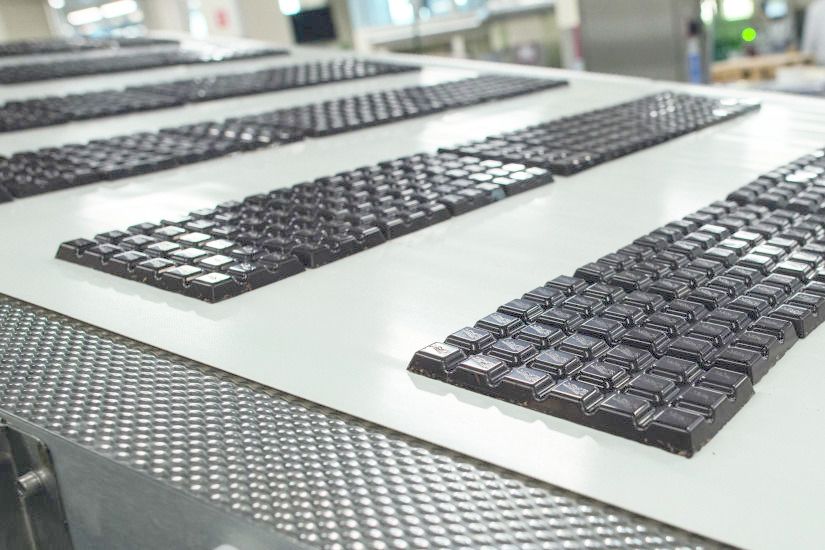
To meet the demands of our consumers, Wedel has introduced a new line of bitter chocolate containing 50 percent, 64 percent and even 80 percent cocoa. We’ve also noticed that with increasing average income, more and more Poles can afford a moment of pleasure and are buying more expensive products, but also their favorite ones.
We also consume a lot of chocolate-covered marshmallows. Ptasie Mleczko® is the market leader in this class, a product that is very regional, consumed mostly in Poland and eastern countries. In the West, the product is less well known. Pralines are also growing in popularity very quickly, but the market is still not as big as in Western countries.
Where is LOTTE Wedel in the Polish market?
In the chocolate market in Poland, there is no clear leader. There are three major players: Wedel, Mondelez and Ferrero, which altogether hold an almost 50-percent share of the market, followed by Polish companies Goplana and Wawel. LOTTE Wedel is the strongest chocolate brand in Poland, offering Poles and unforgettable chocolate experience for nearly 170 years.
How difficult is it to introduce a novelty in the market?
The candy market is highly fragmented, divided between international and domestic manufacturers. This creates room for portfolio diversification and introducing product innovations, which Poles seek out and to which they are open. It is novelties that drive the market segments, and that is why it is up to the key players to continue to come up with new solutions and to respond to consumer needs quickly – even anticipate them. The chocolate market values quality and innovation. On the one hand, we make sure our ingredients are of the highest quality: for example, we use cocoa seeds from Ghana, which give our chocolate a distinct taste, and we maintain traditional recipes. Jan Wedel created the perfect recipe for the Ptasie Mleczko® mousses way back in 1936! On the other hand, we keep looking for new solutions that are attractive for younger consumers. Here, a good example would be decorated Ptasie Mleczko®, chocolate tubes and Wedel creams.
What are your plans for further development?
For nearly 170 years Wedel has been synonymous with innovation, which I think is the right direction for the company. We’ve been watching the market and introducing novelties that meet current customer needs. Producing new categories of products means we have to adapt our solutions to new challenges and expanding our portfolio, and we’ve recently completed a major investment in a production plant which has increased our production capacity and warehousing space.
What novelties are you introducing?
Recently, we entered entirely new categories, which I believe is a very promising direction for us. Since July, the Żabka chain stores carry Wedel’s Ptasie Mleczko® vanilla ice cream, a groundbreaking product and the first of this kind in our portfolio. While creating the recipe, we wanted the ice cream to reflect the taste and the look of the classic Ptasie Mleczko® marshmallows. We put great care into ensuring the ice cream and the chocolate cover formed a perfect combination creating a unique whole.
Another innovation we introduced are functional chocolate bars called TAK PROSTO (Eng. “So Simple”), based on sesame seeds and Wedel bitter chocolate, combined with delicious and healthy ingredients such as cranberry, quinoa, sunflower and pumpkin seeds. The bars are a natural source of magnesium, fiber and unsaturated fat, which makes them an ideal snack. Wedel also offers jelly beans and hard candy for kids, as well as limited editions of our bestsellers, e.g. the summer version of the Ptasie Mleczko® marshmallows: mango and coconut covered with white chocolate.
Poland is not immediately synonymous with chocolate but it does have strong export products. What does LOTTE Wedel export the most and where to?
Poland is the 8th largest exporter of candy in the world, with a share of 4.8 percent, according to a PKO study. Wedel’s expansion to international markets is possible, as our offer and packaging are compatible with the regulations of individual countries. Wedel’s chocolate can be found all over the world, and we export our products to over 60 countries, including: Australia, New Zealand, Russia, Ukraine, Ireland, Germany, the Netherlands, Bosnia, Greece, the UAE, Qatar and Mexico. The key markets for LOTTE Wedel are the US, Canada and the UK. Our exports to Russia, Ukraine, Uruguay, the Philippines, Chile and Brazil are also growing rapidly. It’s also noteworthy that we do not target stores frequented by the Polish diaspora, but also widespread distribution in cooperation with local retail chains.
We export Wedel’s classics, which in our opinion should already be familiar not only among Poles, but also to people across the world: Ptasie Mleczko®, Torcik Wedlowski and various versions of Wedel’s chocolate. We are also present at international food fairs such as: Anuga in Cologne, ISM in Cologne, Gulfood in Dubai, Alimentaria in Barcelona and FHA in Singapore.
The employee’s market is affecting practically every industry. Is the employee shortage also an issue for LOTTE Wedel? How is the company attracting and retaining employees?
It’s true that employee shortage has become one of the major and significant problems and barriers for growth. Unfortunately, for us too. We source employees from abroad, although they are also scarce. We are, however, a responsible employer and we follow the mission set out by Jan Wedel (one of the company’s founders), who took great care of his employees. It is so until this very day. LOTTE Wedel is unlike any other organization in the Polish market. On the one hand, we are a company with a long tradition, on the other, a company that has operated within the structures of several global corporate giants (Pepsico, Cadbury, Kraft). Now, for the past eight years, we have gone back to local management, with strong capital support from the LOTTE group. The nature of the relationship is based on partnership, which is related to the Japanese culture that is an integral part of our owner’s strategy.
We have strong process base and work standards of some of the best international organizations. Wedel is a unique combination of autonomy that works in a specific market, based on the best international practices. It is also joy, akin to childlike joy, which we emphasize not only in our campaigns but also in everything we do. That is why the working atmosphere is so special: it combines the faith in cooperation between different departments as well as great pride of our brand and the history behind it.
We invest in Research & Development in our organization, we continue to work on innovations, and we look for highly-qualified employees. At the same time, as a modern company, we try to automate processes wherever possible (some of our products are made by hand and we do not intend to change that). We are open to young people, we hold recruitment programs for people straight out of college with no practical experience. For a few years, we’ve been carrying out a program called CzekoStart, which offers 15-month internships in different departments across our company.
The production department is an integral part of our activity. We appreciate them for their involvement and input in the company’s development. Production employees are with us for many years and in many instances are continuing a family trade, which shows us that Wedel is an extraordinary brand that brings joy at every step of the process.