ENERGY TRANSFORMATION CHALLENGES
21:09
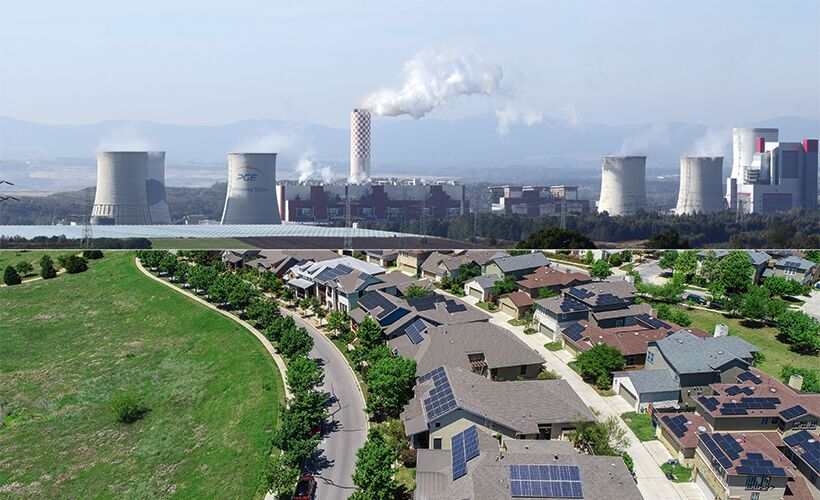
There are many great, innovative technologies in the renewable energy sector, such as the quantum dot patented by ML System from Rzeszów, which is a very small element consisting of a few atoms and mounted directly in glass panes. Thanks to its small size, the atomic attraction is much smaller and it is easier to obtain free electrons, which are later removed from the layers of quantum dots to the outer electrode. This invention makes it possible to obtain free energy from seemingly ordinary glass panes, which are in any case constantly heated by the sun. An additional advantage of such glass panes is their increased thermal insulation properties. Installing such glass in both buildings and vehicles also solves the problem of space needed to place these sources, which, among other things, arises in the case of photovoltaic or wind farms.
Another noteworthy invention is flexible photovoltaic cells produced by Saule Technologies in Wrocław. Perovskites, as they are referred to, are minerals with a crystalline structure and properties to absorb sunlight, conductive, also obtained by synthesis. Their advantage over traditional silicon cells is both easier production process, lower weight and above all incredible flexibility. Perovskite cells are printed on PET films which gives a huge field of application and the possibility to cover practically any available surface.
A LOT OF POTENTIAL
It is undeniable that all these technologies have the potential to transform the renewable energy sector. We have already had some success in this area, being at the forefront of EU countries and generating as much as 10% of Polish energy from renewable sources in June and 5% in July. However, the fact that we generate something is one thing, but the second issue is how quickly it can be implemented. Talking about technical possibilities only leads to the conclusion that there are plenty of technologies available in the world today and the above-mentioned solutions are a very narrow fragment of what mankind has already managed to produce in this time. However, producing it, commercializing and applying it in practice shows that there are years of work involved in it.
Let's also look at it from a different perspective. If we want to produce green hydrogen, we need to create an installation and infrastructure for this, and think about what we want to do with it: whether we want to charge cars or whether we want to use it in some other way, for example, in the household environment, or maybe in industries to power various types of energy sources. It's a bit like straits — you can't sail an infinite number of ships through a strait.
It is not art to produce something and push it out of the gate of the factory where it is produced. The world has been able to roughly handle all of that so far. The trick is to do it in a circular economic way, in a subscription or rental method, which could deliver this type of asset to the market and allow it to be managed throughout the life cycle of this product. The option of renting a photovoltaic panel means that, firstly, this panel can be used a lot, and secondly, we know to whom it will return after the period of renting. Of course, at this stage of development, it does not determine whether it will be recycled or used in some other way, but we know that it will not end up in a dumpster. Instead, the panel may land in a company that deals with this professionally or that can reuse the raw materials that are sewn into the panel. And that too is an important issue of conscious and responsible use of Earth’s resources.
TECHNOLOGICAL LEAP
Change is possible. It is a matter of modifying the approach and thinking, which is not being done in Poland. We focus mainly on narrative, on talking about technologies while doing very little. And in a situation where there is neither a support system nor an understanding that actions speak louder than words, we really won't make that leap. An interesting example of this is Toyota, which decided to make a technological leap and went into the production of hydrogen cars while completely excluding the introduction of electrics into their lineup.
Regulatory issues are far-reaching when it comes to our reality because we actually have an obligation to buy back what is produced from renewable sources. On the one hand, that obligation exists, but on the other hand, the system does not have the capacity to absorb that energy into its grid. So it's easier to produce energy locally and consume it at the plant or at home than to produce it at this house or this plant and let that energy into the system, when the sun is shining, for example, because the system is already full. Photovoltaic panels on each roof should be functionally connected with energy storage.
MODERNIZATION FUNDS
We have to find an effective way the European Union funds are spent. Poland received almost PLN 50 billion for energy modernization. Namely, the support system looks as if it only supports the purchase of equipment for generating alternative energy. But it doesn't talk about how to optimize from the system side what we need to use these available solutions. Maybe if someone is more aware he will buy some energy storage, integrate something or invest in an electric car. For example, the support for hydrogen technology is that the city has to buy hydrogen buses, while the city is only supposed to provide its inhabitants with mobility, which means getting around. Of course, this also creates jobs. But maybe this should work in such a way that the money is used to provide these assets, in some financial way, but not to buy them directly, because we don't really need these assets. We just need to use them over time and thus support and create leverage for the developmental leap forward with these funds.
What is currently in the regulations is defined in a rather strict way. The question may also arise whether the energy transformation will cost us another dispute after Turów. Is it still a path of evolution or maybe already a revolution? A change of mentality is already taking place and it is a revolutionary change. However, as far as Turów is concerned, it is a kind of game of interests and greater/lesser ability to understand which stakeholders are involved in it, what they are playing for, what should result from it and what can help to bring such issues to a solution. There may be more and more such situations, mainly because there are many issues that may create such conflicts, e.g. the issue of resources, access, electricity prices, gas prices, etc. Such situations arise from the following: we treat each other like two tribes, sitting on two sides of a forest. And while one attacks the other for eating "their" berries, no one thinks about the fact that soon there will be neither forest nor berries. Therefore, thinking in terms of conflict rather than cooperation will lead us to such situations. Perhaps, our leaders will be confronted with such situations until they understand that the way to solve such situations is to seek agreement and cooperation and not to go into conflict.
Currently, the most important hindrances to energy transformation are:
• mental blockade
• game of interests of entities who are market players
• lack of a holistic view of the energy sector, not only in the context of thinking about our security but thinking on a much broader scale.
Because we can continue to burn coal in our stoves and we can still mine coal, does not solve the problem in the perspective of a decade or two. Not to mention that it completely lacks thinking about our children. New technologies can be developed when you have the comfort of the fact that they don't necessarily have to be profitable the first time they are used.
Family Business Initiative Association (IFR) is a Warsaw-based alliance that groups entrepreneurs who own family businesses, as well as experts and scientists who support this community. Robert Mikulski, attorney at law, managing partner of BRILLAW and IFR expert, has been supporting the energy sector for almost 10 years.