Europe's military powerhouse
12:06
The ongoing war in Ukraine has made Russia’s President Vladimir Putin a significant player in arms sales in Europe, but he has also become persona non grata in most of the democratic world. To counter Russia’s appetite for western expansion, NATO has expedited its efforts to accumulate equipment. European countries are concerned about their own munitions stockpiles, and in conjunction with Ukraine’s increasing requests for more, the situation is worsening. As a result, weapons companies are seeing a surge in their shares on the stock market as governments within Russia’s reach are forced to rethink their defense budgets.
THE FIRST TIER
To safeguard Europe from Russian aggression, Warsaw and its NATO allies have increased their military arms procurement. At the NATO headquarters in Brussels, leaders have suggested implementing multiple levels of readiness, with a first tier consisting of approximately 100,000 soldiers ready to mobilize at ten days’ notice. Poland, Norway, Estonia, Latvia, and Lithuania are among the countries that could contribute soldiers to the first tier.
Poland’s location has always put it in the crosshairs between the East and the West and the country has historically suffered at the hands of neighboring superpowers. While having powerful allies is crucial, it is no surprise that the country’s leaders have determined that possessing a formidable army is equally vital.
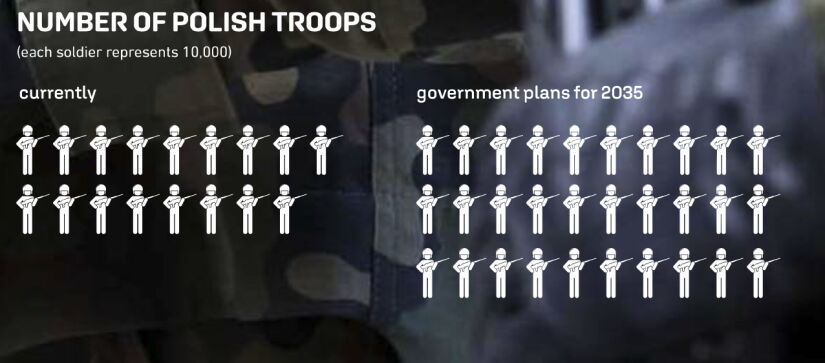
In the wake of Russian aggression against Ukraine, the Polish government announced it plans to increase its troops nearly two-fold over the next decade from 170,000 currently to 300,000 by 2035.
Prime Minister Mateusz Morawiecki stated in January, “The war in Ukraine forces us to arm even faster, which is why this year we will allocate 4% of GDP to military needs.” He added that it would probably be the highest percentage among all NATO countries.
A SPENDING SPREE
Poland has invested heavily in new tanks to modernize its military arsenal. In the spring of 2022, Warsaw ordered 250 American Abrams tanks to replace outdated Soviet-era tanks, which it had rushed over the border to aid Ukraine in the early days of the war.
But the real shopping spree came in late 2022, when Poland signed armament contracts with South Korean company Hyundai Rotem to deliver tanks. As a result, the K2 tanks and K9 self-propelled howitzers have become part of the first delivery of South Korean weapons purchased by Poland. The entire contract is worth $3.37 billion.
The country will spend an additional $2.4 billion on tracked self-propelled howitzers from another Korean weapons manufacturer, Hanwha Defense. Altogether, Poland will receive 189 tanks and 212 howitzers.
MORE IS BETTER
The Korean equipment offers Poland excellent value for its money as it quickly expands its defense capabilities. "The war of attrition in Ukraine has shown how important it is to have a large quantity of low-cost equipment," Frederic Mauro of the Institute of International Relations (IRIS) told Le Figaro.
Having the most technologically advanced weapons is good, but having access to a lot of equipment quickly is better when facing an enemy with vast manpower reserves. According to the paper, once all the ordered tanks are delivered, Warsaw will have four times the number of tanks as the French army.
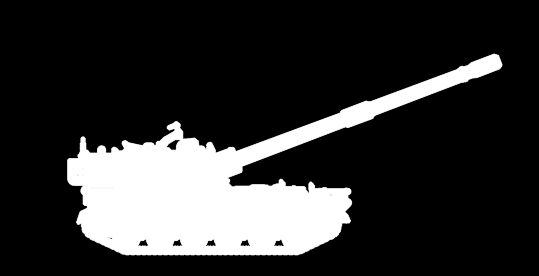
The K9 Thunder weighs 47 tons and is armed with a 155mm gun produced by Hyundai with a barrel length of 52 calibers, which has a range of 30 to over 50 km depending on the ammunition used. The vehicle is powered by a 735 kW (1000 HP) engine produced under German license.
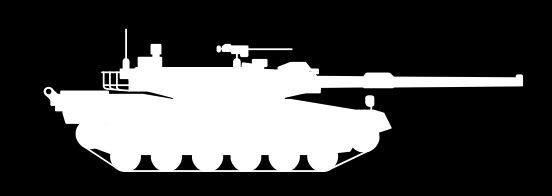
The K2 Black Panther tank is armed with a smoothbore 120mm gun and weighs 55 tons. The crew consists of three people (commander, gunner, and driver), and the vehicle’s suspension allows for ground clearance adjustments. Power from the Korean diesel engine is transmitted by a German transmission. In the K2PL version, the tank also has reinforced armor, an all-round observation system, and an active protection system.
AIR, LAND, AND SEA
Poland still has gaps in both air and sea capabilities compared to the French and British armies. However, the country is also modernizing these branches of its armed forces by signing contracts for the delivery of F-35 fighter jets and FA-50 aircraft. It has also signed a contract for three British frigates and two spy ships with the Swedish company Saab.
These moves underscore Poland’s efforts to strengthen its military capabilities in all areas, including air and sea power, and position itself as a significant regional player.
HEREDITARY ENEMY
Poland’s incremental rise in military significance could not have gone unnoticed. Until recently, the object of derisive accusations by EU bureaucrats, twhe country is now a leading power in Europe. Ivor Roberts, former British ambassador to Yugoslavia, Ireland, and Italy, wrote recently in the Daily Telegraph that it wasn’t long ago when Poland was considered a problem child in the EU. At one point, its constitutional court ruled that fundamental parts of EU law were no more important than its national constitution. “How different it is now that Poland has assumed the role of a bastion of Western defense – a key nation on the front line of the fight against Putin’s Russia,” Roberts stressed. “Warsaw is invariably at the forefront in supporting Kyiv: diplomatically, militarily, and morally, as it deals with the largest number of Ukrainian refugees.”
Former director of the European Defense Agency, Claude-France Arnould, explains that the threat from Russia has always existed for Poles and will remain a long-term concern. “Already at the NATO summit in Bucharest in 2008, the Poles were on alert. Historically, Russia is their hereditary enemy,” Arnould added.
DEMOCRATIC ENCIRCLEMENT
The incursion into Ukraine clearly demonstrated Russia’s territorial aspirations, evident throughout its history, including the annexation of Crimea in 2014, its longstanding meddling in Georgia (Abkhazia and South Ossetia) in 2008, and Chechnya in 1999. These actions highlight the extent to which Russian President Vladimir Putin is prepared to go in his efforts to revive a Russian empire and counteract what he sees as a “democratic encirclement,” as pointed out by Professor Hein Goemans from the University of Rochester.
Putin’s political future relies on preserving secure borders and establishing a circle of obedient allies reminiscent of the Soviet Union and its satellite states. To achieve this, Russia must prevent encirclement by antagonistic democratic governments, a threat that it chose to “counteract” by launching military operations that cost approximately $900 million per day in Ukraine alone.
Over a year into the conflict, the consequences of Putin’s aspirations may well have wider social and political implications for all parties involved - Russia, Ukraine, and Europe. Russia’s clear miscalculation as to the determination of the West could potentially result in its downfall.
“UNCLE VANYA”
Russia has suffered from sanctions and condemnation worldwide due to the detrimental effects of the invasion. The departure of more than 300 foreign companies from the nation has prompted some amusing resourcefulness among Russians, who have renamed abandoned Mc-Donald’s branches as "Uncle Vanya.”
The West hoped that the void of departing corporate investment might compel Russia to engage in peace negotiations with Ukraine. Instead, the Russians weather the storm of international condemnation via backdoor deals and discounted petroleum to nations like India, as well as backup routes to sell sanctioned Russian crude oil through Iran.
In February of this year, oil and gas condensate production in Russia returned to pre-sanction levels of 1.508 million tons per day, aided in part by President Putin’s decree that prohibited domestic oil exporters and customs bodies from adhering to Western-imposed price caps on Russian crude.
NOT ENOUGH?
Trade experts have acknowledged the effectiveness of multinational cooperation in imposing sanctions, but it remains uncertain whether Russia will succumb to economic pressure, particularly in light of the opposition from its allies that undermines international efforts.
As a result of the military operations conducted by Putin’s troops, which have involved multiple violations of the laws of war, the International Criminal Court has issued a warrant for the arrest of the Russian president. The bombing of civilian areas, executions, and violence are the hallmarks of Putin’s military actions. Consequently, the civilian death toll in Ukraine has exceeded 8,000, while the number of injured is more than 13,000.