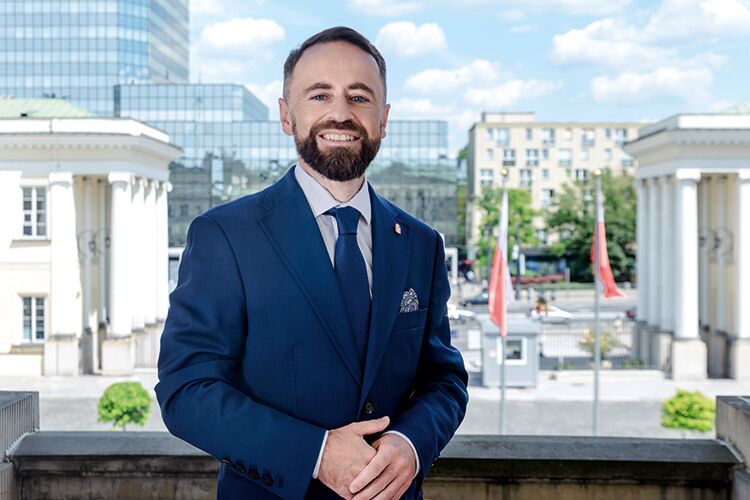
Five questions for... Michał Olszewski Deputy Mayor of the Capital City of Warsaw
10:32
1
Your normal workday and the city plan must have gone to pieces since February 24?
Yes, on February 25 we forgot about everything “normal.” We are now living in a different reality and the scale of the challenge we are facing in our current work is huge. Today we have over 300,000 new city users. Based on the estimation from the statistical office and our data, we worked with an assumption that Warsaw will grow as a city by 250,000 inhabitants in 25 years. The current status shows what kind of miscalculation we have now in the strategy and what kind of miscalculation also will exist in the local economy assumption for this year.
2
What other consequences will this have for Warsaw and its residents?
We didn't calculate, for example, the crisis we will have in housing. We have a reserve for 350,000 inhabitants without changing our strategy, though. This means that if we unblock, from the property point of view, every plot, which is in the city, which is already covered by the master plan, then we can construct apartments for 350,000 new residents. But the real potential of the construction market per year is 20,000 units (apartments).
3
So far during this crisis Poland has shown an amazing and welcoming attitude – a little unusual – is it sustainable?
I am analyzing data about the crisis. Before the war, we were on the 101st spot on the list of countries accepting refugees. This is data from UNHCR. On March 15, we were in the third position! Only Turkey has a bigger number of refugees than we do, those fleeing Syria, and the US. But the US is a country of emigrants, so it is a tradition for this country. In Europe, we’re an exception.
4
Do you think it is realistic that we can handle the situation?
It's something that is not very obvious. Because frankly speaking, this is an abnormal size of crisis — hard to handle. Of course, I am optimistic so I believe we can handle it. The question though is time and the costs which we (and humanity) are paying for the crisis. Of course, nobody wanted to have such a crisis and nobody wanted to have a war. Everybody knew that Russia might occupy the southeastern Ukrainian regions of Donetsk and Luhansk, but I think nobody could imagine that this crisis will develop in such a way.
5
Are you receiving any support and financial help?
We have to spend a huge part of our reserves as a city. But we must also praise the help. I believe there is no other place in the world like this. We have been offered great assistance by private companies. The list comprises thousands of the companies that offered abandoned buildings, office buildings, mattresses, beds, food and so on. We sometimes readied buildings in two days and turned them into accommodation centers. It shows that sometimes this collaboration in business is not about money but about resources.