From a LUXURY to a MUST-HAVE
18:18
ESG performance includes the impact of a company on the planet, employees, customers and communities. It turned into a necessity as investment funds consider ESG criteria when building portfolios. Major lenders are phasing out financing for dirty energy and regulators globally are working on ESG guidelines.
Even though the ESG topic has been high on the agenda for months or even years, many companies and business leaders still do not have a comprehensive idea of what it is. “ESG is a bit like the Yeti — everyone talks about it but no one has seen it in its entirety yet,” Tomasz Kassel, partner at PwC and leader of ESG initiatives in Poland, said. This is why we will go brick by brick.
“E” stands for the environment and includes activities such as cutting emissions, managing waste and using recycled materials, nature conservation and protecting biodiversity. This is probably the most measured area.
“S” is the social aspect. It focuses on how a company manages its relationships with employees, what the labor conditions are, and whether products and services impose safety risks. Although a social factor may appear hard to measure at the first sight, the market will tend to reward the companies, which minimize their exposure to controversial products, S&P points out in a publication.
Finally, the letter "G" is about corporate governance. This aspect is often overlooked amid climate and social issues. However, understanding governance risks is critical as poor practices in this area have stood at the core of some of the biggest corporate scandals. For example, Facebook’s misuse of data has cost the company billions of dollars.
The companies, which do not develop a sustainability strategy risk losing both investors and customers in the long term. According to Capgemini’s research, as many as 79% of consumers are changing their purchase preferences based on social responsibility, inclusiveness or environmental impact. Moreover, Covid-19 has increased consumer awareness and commitment to buying sustainably. As many as 58% of Poles surveyed by Deloitte say that they choose products of brands, which take actions for sustainable development. Every second respondent checks whether pro-ecological declarations are consistent with reality, Deloitte’s survey “Climate Sentiment Index” shows.
“The time has come not only for industry and sector leaders but also for the majority of business entities to take on the obligations in this area. Brands and products that do it sluggishly will lose customers and their producers will lose employees,” said Irena Pichola, partner at Deloitte and leader of the sustainable development team in Poland and Central Europe.
In Poland, ordinary people are less concerned about sustainability issues than globally but the trend is gaining pace. As demography changes, the income of younger consumers who want to buy green products is growing and raising awareness of the population. And that, in turn, gets transformed into more pro-ecological attitudes. Around the world, 69% of consumers believe that known brands have a responsibility to work on sustainable development, while in Poland this figure stands at 60%. On the bright side, about half of consumers globally are ready to pay a higher price for a product, which has a positive impact on the environment and society, according to ING Bank and EY Polska report “Business for the Climate.”
At the same time, the number of investors in the Polish market who don’t take non-financial elements into account when building portfolio in two years is expected to drop to just 3% from the current 20%, the PwC publication entitled “ESG — the sword of Damocles or a chance for a strategic change?” reveals.
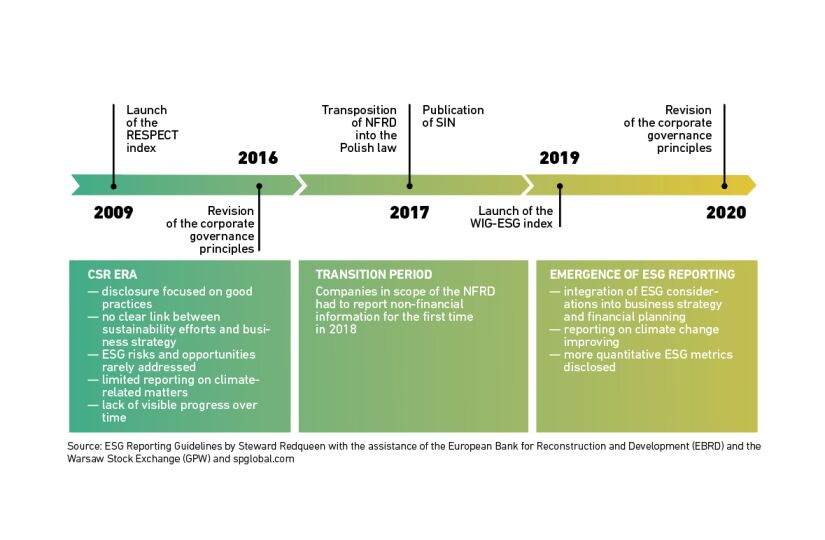
In May, consultancy Steward Redqueen jointly with the European Bank for Reconstruction and Development (EBRD) and the Warsaw Stock Exchange (GPW) published ESG reporting guidelines. “By disclosing the data investors seek, issuers can provide reassurance that they are effectively managing business risks and identifying opportunities,” the organizations stated.
LONG-TERM TREND
Many companies in Poland have been publishing sustainability reports for years. However, even though the concept is not novel, the requirements have changed. Firms used to disclose good practices, known as Corporate Social Responsibility (CSR) but a clear link between sustainability efforts and business strategy was often missing. In addition, ESG is more heavily measured.
In 2018, the EU Non-Financial Reporting Directive (NFRD) introduced obligations for large European companies to disclose information on their sustainability risks and impacts. It requires disclosure in four sustainability areas: environment, social and employee issues, human rights, and bribery and corruption.
In March this year, European Union’s Sustainable Finance Disclosure Regulation (SFDR) came into force to encourage sustainable investing. Under the SFDR, all EU asset managers are asked to disclose their approach to incorporating sustainability considerations in their investment decisions. The initiative supports the European Green Deal that aims to make the EU carbon neutral by 2050.
The report by Steward Redqueen consultancy suggests three ways of ESG disclosure. The first is the inclusion of ESG issues in an annual report. The second is producing a standalone publication. And finally, there is an option for the integrated document. Regardless of the chosen approach, it outlines key requirements for reporting. The information should be material, clear, objective, comparable, forward-looking and verifiable.
However, for about half of the firms surveyed by PwC, the preparation of a sustainability report is a compliance action. Przemysław Paprotny, a partner at PwC, warns against such an approach as ESG issues impact the availability of financing and its cost. The banking sector already takes ESG aspects into account when giving loans with more banks restricting lending to projects harmful to the environment.
Still, only 43% of the companies say that they have an integrated business and sustainable development strategy. On top of that, 62% of investors expressed the opinion that companies in Poland are moderately or poorly prepared to provide required ESG information.
When evaluating a company, investors look at its carbon footprint, climate and environmental policy with measurable goals and indicators related to the amount of energy consumed. Almost one-third are willing to lower their valuation or withdraw if ESG risks are too high.
GREEN FINANCING
Sustainability is relevant for every industry, but the financial sector is treated as a catalyst for green transformation. Even though banks don’t have a significant share in CO2 emissions, their financing defines the development of other industries. This is why they have tools to encourage firms to introduce environmentally friendly solutions.
As many as 80% of commercial banks have already introduced elements of sustainable financing in their business strategies and product offering, according to PwC survey “Green Finance in Poland. How will ESG change the banking sector and corporate financing?” However, 43% of banks have not yet carried analysis of their loan portfolio in terms of ESG criteria.
Moody’s recent analysis shows that climate risk is likely to have a major influence on banks’ loan quality. Depending on how climate change unfolds and on the policy response to it, the losses that ensue could be substantial, Moody’s said. Even though now Polish banks do not have a unified approach to ESG in their lending policy, ING Bank and EY Polska expect the sustainability element to be crucial for getting financing in a five-year perspective, and companies with the biggest carbon footprint will face losses.
Major banks in Poland have already devoted themselves to sustainability targets. In June, Poland’s second-largest lender Pekao announced its ESG strategy for 2021-2024, revealing plans to invest more than PLN 30 billion in financing for new sustainable projects over the period. It also committed to limiting high-carbon financing to less than 1% of the bank’s balance sheet portfolio by 2024.
The country’s biggest bank PKO BP in July said it would entirely eliminate exposure to the coal mining sector by 2030 and increase green financing by at least 5% on a year-on-year basis.
COSTS AND BENEFITS
In Poland, which still depends on coal for 70% of its energy needs, the green transformation requires drastic changes and it is still not clear who will bear the costs. However, the government’s commitment to phase out coal by 2049 and environmentalists’ criticism over the deadline, show that the change is inevitable. Poland’s expenses to reach “Fit for 55” targets are expected to exceed €300 billion in the next ten years, of which only about PLN 60 billion to 70 billion are public money and European funds, said Wojciech Hann, president of the management board at Bank Ochrony Środowiska.
The “Fit for 55” climate proposals plan to reduce net greenhouse gas emissions by at least 55% by 2030 (compared to 1990 levels) has added pressure to the chemical and energy industries. Chemical industry transformation processes are complex, capital intensive and long-lasting, according to Piotr Kołodziej, from the corporate finance department at Grupa Azoty, cited by ING and EY. This is why the players that do not take timely actions risk receiving penalties from regulators and losing customers in the future.
“The (group) owners are not only ready to accept costs of implementation of changes and lower results of Grupa Azoty today, having in mind the prospect of future benefits but even expect specific actions for the group transformation. Without them, the future of the group would be under a question mark,” Kołodziej said.
Ciech, once Poland’s largest chemicals maker, committed to abandon coal-based energy production by 2033 and reach climate neutrality by 2040 through the use of thermal recycling as an energy source for production plants in Poland. The group already employs such a solution in Germany. Ciech CEO Dawid Jakubowicz said at the European Economic Congress that 2021 is expected to be a “breakthrough year” for climate protection in the world but it is not a big turning point for the group, which has been working on the decarbonization strategy for years.
For companies, which have not introduced ESG policy yet, the deadline is approaching. Market players will have time until 2023 to adapt to the requirements of non-financial reporting. By then, the importance of non-financial criteria will grow drastically among investors, according to PwC. The next two years will require companies to work not only in terms of compliance but above all in outlining the strategy and introducing ESG practices.
KEY CHARACTERISTICS OF INVESTOR-ORIENTED ESG REPORTING
As ESG disclosure is increasingly demanded by analysts and capital market participants, it is important for issuers to respond to these information needs accordingly. Decision-useful ESG disclosure has several key characteristics. It should be:
Material
Materiality is perhaps the single most important factor to consider when preparing ESG disclosures. Applying a rigorous materiality process helps identify relevant ESG issues and prioritize them according to the likelihood and magnitude of their potential impact on company operations. Section 5.1 provides further details.
Objective
Disclosure should be objective and balanced, including both positive and negative developments. Any misstatements or omissions of material information should be avoided. Companies should explain the scope and boundaries of the reported information, especially when certain information pertains only to some (but not all) of its activities or subsidiaries.
Strategic and forward-looking
Generic, “boiler-plate” disclosure is of limited use to investors and analysts. Disclosure on material ESG issues should be aligned with strategic information necessary for investment decision-making, such as the description of relevant risks and opportunities as well as a process for managing them. It is also important for the disclosure to be forward-looking, such as linking quantitative ESG metrics and targets to the company strategy
Clear and concise
ESG reporting should be presented in a clear and concise manner and for a specific period, usually a given reporting year. Reporting excessive or irrelevant information can lead to confusion and obscure key messages.
Comparable and reliable
Prioritizing quantitative data facilitates peer comparison by investors and analysts. Reported KPIs should be linked to the company's business strategy and present the company’s performance in key ESG areas. A narrative description providing additional context is also important and helps explain the numbers and how the company is progressing.
Verifiable
External assurance of reported data helps to increase its credibility, allowing for more effective integration by investors.