Grid for all weather
12:41

The doom and gloom drumbeat, punctuated with stories of weather catastrophes around the world, more persistent with every news cycle, leave no room for doubt: the effects of climate change are here. The World Meteorological Organization (WMO), a United Nations agency, now says there is a 66 percent probability that global temperatures will surpass the 1.5°C threshold, in at least one of the next five years. This is a significant increase from the WMO’s previous estimate of 48 percent just a year ago. Even if the 1.5°C target is not exceeded, the WMO predicts with virtual certainty that one of the next five years will be the hottest ever recorded in human history. In essence, the urgency to reduce emissions should have been addressed approximately three decades ago. Which is why many stragglers, like Poland, have now taken a full steam ahead approach to switching to green energy.
Solar PV now covers nearly 10% of Poland’s electricity demand, a meteoric rise from less than 1% just three years ago.
From 0 to 100
In Poland, the availability of solar panel subsidies has led to a remarkable increase in prosumer installations over the past years. As of the end of August 2022, the country had installed over 20 GW of renewable energy, with 11 GW specifically generated from solar photovoltaic (PV) installations. This represents an impressive year-on-year growth of over 80 percent, considering that by the end of August 2021, the total solar capacity stood at 6 GW.
Solar PV now covers nearly 10 percent of Poland’s electricity demand, a meteoric rise from less than 1 percent just three years ago. The Energy Market Agency’s data reveals that as of August 2022, there were 1,131,973 photovoltaic micro-installations under 50 kW in the country, thanks to favorable financial conditions for prosumers. Under Poland’s net-metering scheme, prosumers with systems up to 10 kW could supply 1 kWh to the grid and receive 0.8 kWh in return for free, while larger installations above 10 kW had a ratio of 1 to 0.7. Additionally, prosumers were exempt from paying distribution fees for grid usage.
New metering
As of April 1, 2022, the net-metering system in Poland was replaced with a net-billing system. Under this new system, the amount of electricity injected into and retrieved from the grid is balanced through hourly settlement using a metering system. Prosumers are now rewarded for any surplus energy they feed into the grid at the wholesale price, while they pay for the consumed energy on par with other consumers.
A public opinion survey commissioned by the Polish Photovoltaic Association, conducted in May 2022, revealed significant public support for solar energy. Solar PV emerged as the most favored technology among the respondents, indicating favorability towards solar installations in their neighborhoods.
In 2022, renewables produced 36.8 terawatt hours (TWh) of electricity, 20% more than in 2021. Production from photovoltaics increased by 4 TWh, up by 102% and onshore wind by 3 TWh, up by 19%.
Winds of change
While wind energy, both onshore and offshore, may have faced some challenges, the Polish Energy Policy (PEP) Road Map 2040 incorporates offshore wind plans as part of Poland’s energy goals by 2027. Some initial advanced projects have already emerged or are expected to be completed by 2024.
The strategic plans envision the potential for generating 10.3 GW of power, made possible by a law enacted on January 21, 2021. This law allows companies, some under the control of the Polish State Treasury, to develop offshore wind farms. Polish Energy Group (PGE and their Danish partner, Ørsted, intend to erect wind farms with 2.5 GW on the Baltic Sea. PKN Orlen, has concessions to construct a 1.2 GW offshore wind farm.
The Polish Wind Energy Association (PSEW) estimates that the Polish energy system will require 1,000MW of wind energy capacity each year to comply with EU targets. Meanwhile, state-owned lender BGK projects that investments in offshore wind farms under Polish jurisdiction in the Baltic Sea could reach PLN 130 billion over the next decade.
Too noisy and too close?
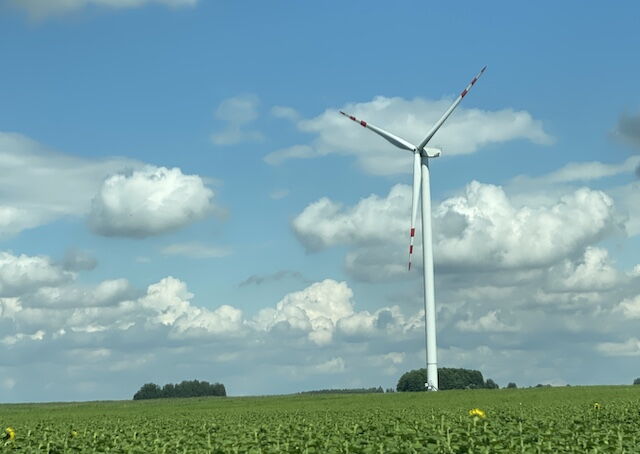
Nonetheless, there are concerns raised about the visual and acoustic impact of wind turbines, at least in their current design. A recent article on DW.com highlighted complaints against companies such as Energia Eco and Enerco, which operate wind farms along the Baltic coast, for their alleged lack of consideration in turbine placement. However, there is a 2016 law, commonly known as the “10H rule,” which mandates that the distance between a wind turbine and the closest residential house or nature reserve must be at least ten times the height of the turbine.
As a result of the 2016 law, future wind turbine permits will likely require construction offshore or in remote areas. However, there have been efforts to find a compromise by legally reducing the required distance between turbines, houses, or nature reserves to 500 meters. While a slight extension to 700 meters could still enable some projects to proceed, it would severely limit the capacity to generate green energy. Damian Babka from the renewable energy producer Qair Group expressed concerns that such a restriction would significantly hamper the potential for green energy generation.
Changeable weather
Other than the less-than-stable legislation on power generation in Poland, what’s holding back the transition to renewables? In part, the weather itself. The sun does not always shine, nor does the wind always blow. To offset the uncertainty ingrained in Intermittent renewable energy sources (IRES), Poland looks to implement a nuclear power strategy in the next few decades.
Altogether, it aims to have approximately 73 percent of renewables and nuclear power in its energy mix by 2040, according to Climate and Environment Minister Anna Moskwa. The country expects to invest around PLN 726 billion in new capacities by 2040, with 60 percent of the investments going into renewable energy sources. Nuclear power is projected to account for 26 percent of the total investment.
Limited storage
While production of energy ramps up, there are issues with storage. Insufficient power generation is one problem, usually solved by importing power from abroad. But overgeneration is a different problem altogether, and even if the solution is symmetrical, it may not always be possible to find a willing electricity consumer next door to offload the excess.
Back in late April, the national power grid operator PSE had to cut off some of its renewable energy generation capacity, and for the first time this fate fell not only on wind farms, but also solar power producers.
Poland currently has a limited capacity of energy storage, primarily consisting of pumped hydro, with 1.7 GW and 7.6 GWh in 2020. Battery storage deployment is also limited, with a total capacity of around 9 MW and 33 MWh in 2020, mainly used for voltage stabilization in the distribution system.
However, Poland aims to increase its energy storage capacity to support the integration of variable generation and enhance system flexibility. State-owned power company PGE plans to build 0.8 GW of energy storage by 2030, and the Energy Policy of Poland 2040 targets approximately 1.0 GW of energy storage (excluding pumped storage) by 2040.
Recent regulatory amendments have been made to support energy storage, including establishing a licensing process and regulatory status for battery storage, eliminating double tariffs for charging and discharging, providing discounts on grid connection fees, and allowing storage participation in renewable energy support schemes. Distribution system operators are now permitted to include electricity storage in their investment plans and recover storage costs through tariffs if justified by a cost-benefit analysis.
Or no storage at all?
Another possible solution is to make the grid more resilient and efficient to power generation fluctuations, by turning the knobs on power usage when necessary. A UK-based tech company Oaktree Power, is looking to partner up with Polish large real estate portfolio managers and implement solutions they have already figured out on their domestic grid, arguably 10-15 years more advanced than the rest of Europe, according to Michael Cox, director of corporate partnerships, at Oaktree Power.
“We look to optimize a customer or site’s energy usage and we do that by monitoring electrical usage and modulating or reducing large assets on that site,” Cox said. “It works quietly and intelligently in the background and users should not be aware it is happening. We are therefore able to maximize savings for the building,” he added.
While it may seem counterintuitive, buildings could save even when they need to ramp up their energy consumption – after all, relieving the grid of excess power is a value in and of itself. By plugging into both the grid and the consumer, it is possible to modulate and mitigate power surplus as well as dips in power generation, when the skies are gray.
Heaps of coal
Even as the renewable energy industry develops in Poland, the country’s power and heat production is still dominated by coal and forms the biggest contribution to its emissions, according to a report by the Polish think tank Forum Energii. Coal, while reduced in its role in energy production, still accounted for almost three-quarters (70.7%) of power generation in 2022, while a fifth (20.6%) came from renewables.
Overall, in 2022, renewables produced 36.8 terawatt hours (TWh) of electricity, 20 percent more than in 2021. Production from photovoltaics increased by 4 TWh, up by 102 percent and onshore wind by 3 TWh, up by 19 percent.
The country plans to gradually transition away from coal by 2049, but aims to maintain support for coal-fired units after 2025 to ensure energy system security.
Growing margins
The profits of the four largest energy companies amounted to nearly PLN 4.5 billion in the first quarter, a 50 percent increase compared to the previous year. However, production, consumption, and energy sales were lower during this period. The Clean Dark Spread (CDS), which represents the unit margins of energy producers, showed a significant increase in the first quarter. The forecast suggests that the margins of energy producers will continue to rise until the end of 2023.