



Has the pandemicalready moved shopping to the online world?
07:35

How has the pandemic affected the consumption basket?
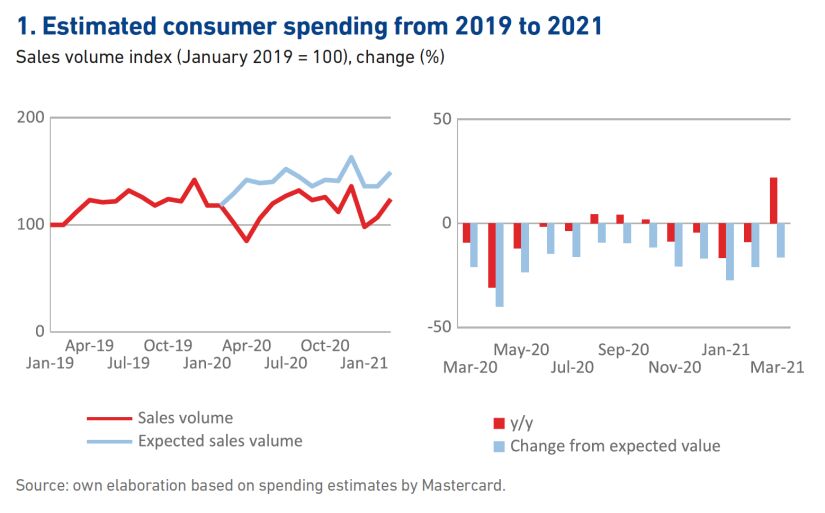
According to estimates of spending by Mastercard, in spring 2020, total spending was 40% lower than expected (resulting
from natural dynamics and seasonality of trade) and more than 30% lower than in the same period of the previous year. During the subsequent trade restrictions (November- December), we saw a smaller impact on consumption — there was a slowdown (about 15-20%) compared to the expected values [3].
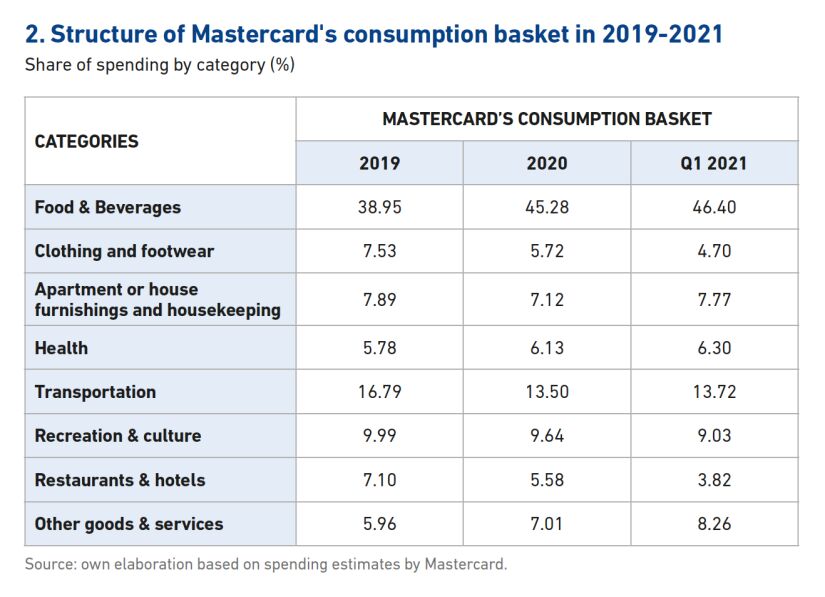
The pandemic in 2020 has changed consumers’ shopping habits. Poles increased the share of basic needs categories in total expenditures, including groceries (+6.3 pp y/y).
On the other hand, we saw a decline in clothing purchases (-1.8 pp.) and spending on restaurants and hotels (-3.3 pp.). The largest reductions were seen in categories related to travel and entertainment. These are characteristic changes in times of crisis. The results of the August 2020 PIE survey indicated that 80% of consumers attended cultural and entertainment events less frequently. In addition, 68% of respondents reduced going to restaurants and pubs, and 58% reduced going to supermarkets and shopping malls [4].
The response of the economy during each successive wave of the pandemic was different, with less disruption to the pattern of purchases.
Additionally, the easing of restrictions at the beginning of Q2 2021 triggered the gradual realization of deferred demand. In June this year, spending on accommodation and food service was higher than at the peak of the previous 2020 holiday season, when restrictions were also loosened.
How have sales channels changed in the last year?
The share of online sales in retail sales in April in Poland rose to 10.8% from 9.5% in March and 8.6% in February [2]. Estimated spending by Mastercard shows a clear movement between sales channels — the rapid e-commerce growth was driven by introduced restrictions. These changes were not long-term at first, but we see e-commerce strengthening in 2021.
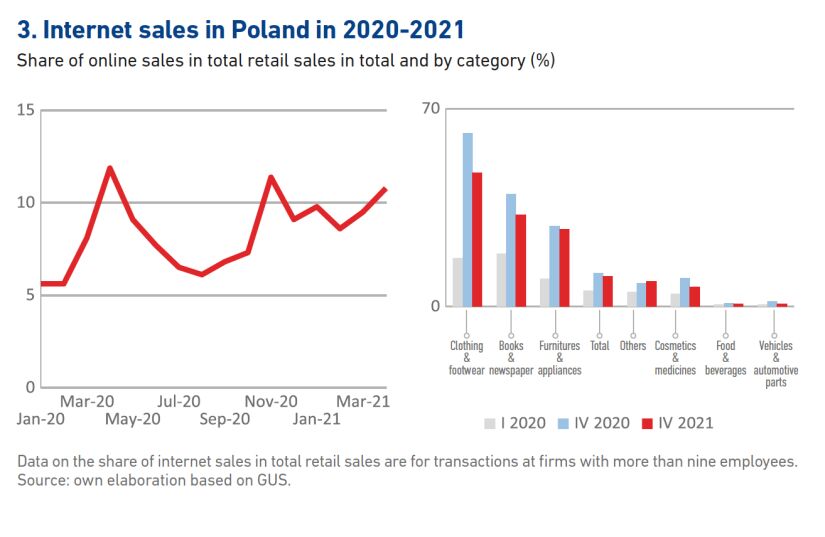
The pandemic has accelerated the growth of online sales.
There are industries in which e-commerce has grown a lot and those in which it has grown less. Somewhere it was resilient and somewhere else it was dependent on the opening of retail and service establishments. In general, the annual dynamics of growth in online sales in April this year was on average in the EU about 18%. Despite a high reference point, a higher result was achieved than the average annual pace in previous years (about 10%). In Poland, the growth rate was less than 14%, but with a much higher base of 60-65% in the same period of the previous year [1]. According to analysts, this indicates an increased companies’ and consumers’ capacity to carry out transactions online [5].
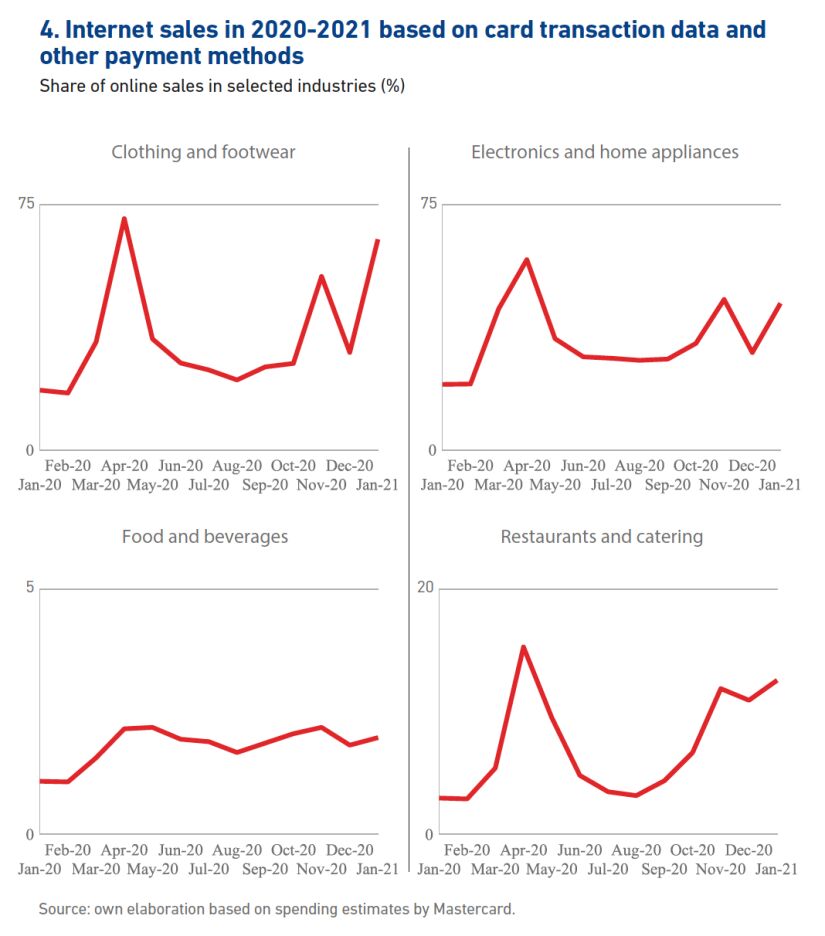
Mastercard spending estimates show that online sales volume in the clothing and footwear sector nearly doubled y/y in early 2021.
E-commerce accounted for 65% of all sales in the industry, higher than official GUS data indicated. Online sales of electronics and home appliances were influenced by the degree of trade closures. However, the volume increased by 2.5 times during the year [3].
Has e-commerce reached its peak yet?
After the surges of the first lockdown and the return to stationary stores in the 2020 holiday season, it seemed that the high share of e-commerce would be short-lived. In 2021, we saw steady growth in online sales despite open stores and services.
According to a McKinsey study, 9 out of 10 Europeans will continue e-shopping even after the pandemic. The lasting nature of the changes in Poland was also noted by PwC. The company’s report indicates that nearly 85% of Poles do not intend to reduce the frequency of shopping online after the end of the pandemic, while 82% will spend the same or more on e-shopping this year compared to 2020 [6]. SpotData and Mazars estimated that the growth rate of e-commerce in Poland will be close to 15% in the coming years [7].
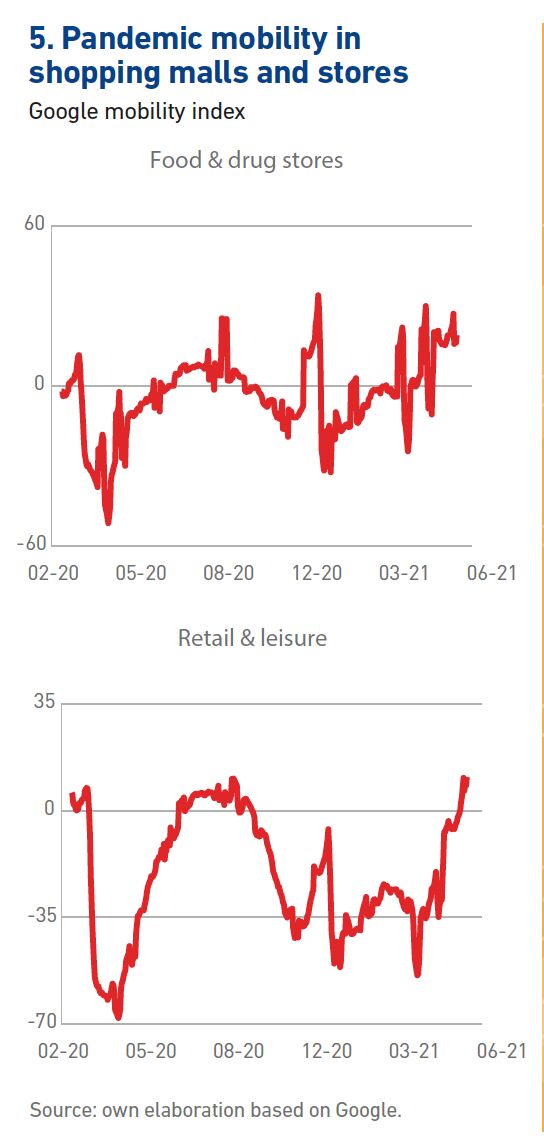
Google mobility data shows that retail traffic is returning to pre-pandemic levels [8]. According to EY, Mastercard and TOP-KEY, turnover in shopping malls fell faster than traffic during the first lockdown, then came back faster. It indicates that the style of visiting stationary stores has changed [9]. Although shopping malls and stores are now open, we have not given up on e-shopping. The share of online sales is growing and this will not change soon.
Maciej Miniszewski
The Polish Economic Institute (PIE) is a Warsaw-headquartered public economic think-tank dating back to 1928. Maciej Miniszewski is a senior analyst at the institute in the field of strategy and macroeconomics.
Sources:
[1] Eurostat (2021), E-commerce statistics.
[2] GUS (2021), Udział sprzedaży przez Internet w sprzedaży detalicznej, Główny Urząd Statystyczny, Warsaw.
[3] Miniszewski, M. (2021), Konsumpcja w pandemii, Dębkowska, K., Kolano, M., Śliwowski, P. (współpr.), Polish Economic Institute, Warsaw.
[4] PIE (2020), Pandemia zmieniła zwyczaje konsumenckie Polaków, https://pie.net.pl/ pandemia-zmienila-zwyczaje-konsumenckiepolakow/.
[5] Konczewski, J., Morawski, I. (2021), Firmy i konsumenci uczą się e-commerce, Puls Biznesu, https://www.pb.pl/firmy-i-konsumenci-ucza-siee-commerce-1118719. [6] PwC (2021), Strategie, które wygrywają. Liderzy e-commerce o rozwoju handlu cyfrowego.
[7] Mazars, Noerr, SpotData (2021), E-commerce w Polsce: strategie rozwoju firm.
[8] Google (2021), COVID-19 – raporty na temat przemieszczania się.
[9] EY, Mastercard, TOP-KEY (2020), Czy w pandemii centra są handlowe? Analiza obrotów, odwiedzalności i ich wzajemnych zależności w obiektach handlowych w Polsce. spend the same or more on e-shopping this year compared to 2020 [6]. SpotData and Mazars estimated that the growth rate of e-commerce in Poland will be close to 15% in the coming years [7]. Google mobility data shows that retail traffic is returning to pre-pandemic levels [8]. According to EY, Mastercard and TOP-KEY, turnover in shopping malls fell faster than traffic during the first lockdown, then came back faster. It indicates that the style of visiting stationary stores has changed [9]. Although shopping malls and stores are now open, we have not given up on e-shopping. The share of online sales is growing and this will not change soon.
Legal Disclaimer: The information/data in this report/deliverable provided by Mastercard do not in any way: a) contain, reflect, indicate or relate to actual Mastercard performance, and/or b) constitute or include Mastercard data. The information/data in this report/deliverable is only Mastercard estimation of the entire market. The information/data, including all forecasts, projections, or indications of financial opportunities are provided to you on an “AS IS” basis for use at your own risk. Mastercard will not be responsible for any action you take as a result of this report/deliverable, or any inaccuracies, inconsistencies, formatting errors, or omissions in this report/deliverable. Mastercard makes no representations or warranties, express or implied, as to the accuracy or completeness of the information/data contained herein, and Mastercard will not have any liability to you or any other person resulting from the use of such information/data by you or any of your representatives


