Kyiv calling
21:52
Over the past decade, the relations between Ukraine and Poland have been getting stronger leading to Poland becoming Ukraine’s key EU trading partner. Globally, Poland remains Ukraine’s fourth-largest trading partner after China, Russia and Germany, with bilateral trade worth $7.4 billion in 2019.
In terms of investments, during the first half of 2020, the FDI inflow from Poland to Ukraine reached $662.2 million. Poland occupies the 7th place among EU countries by the volume of FDIs to Ukraine and 10th place globally. Currently, there are nearly 3,000 Polish companies successfully operating in Ukraine. Among the largest ones are Cersanit (ceramics), Barlinek (production of wooden floors), Can-Pack (packaging), Inter-Groclin (manufacturer of automobile equipment and accessories), Nowy Styl and Black Red White (furniture manufacturers), Śnieżka (paints and varnishes), PZU (insurance industry), Kredobank and Getin Holding’s Idea Bank.
Despite the vigorous pace of strengthening bilateral relations between the two nations, there remains huge scope for further extension, particularly in the sphere of infrastructure, energy, IT, and manufacturing.
USE THE POTENTIAL
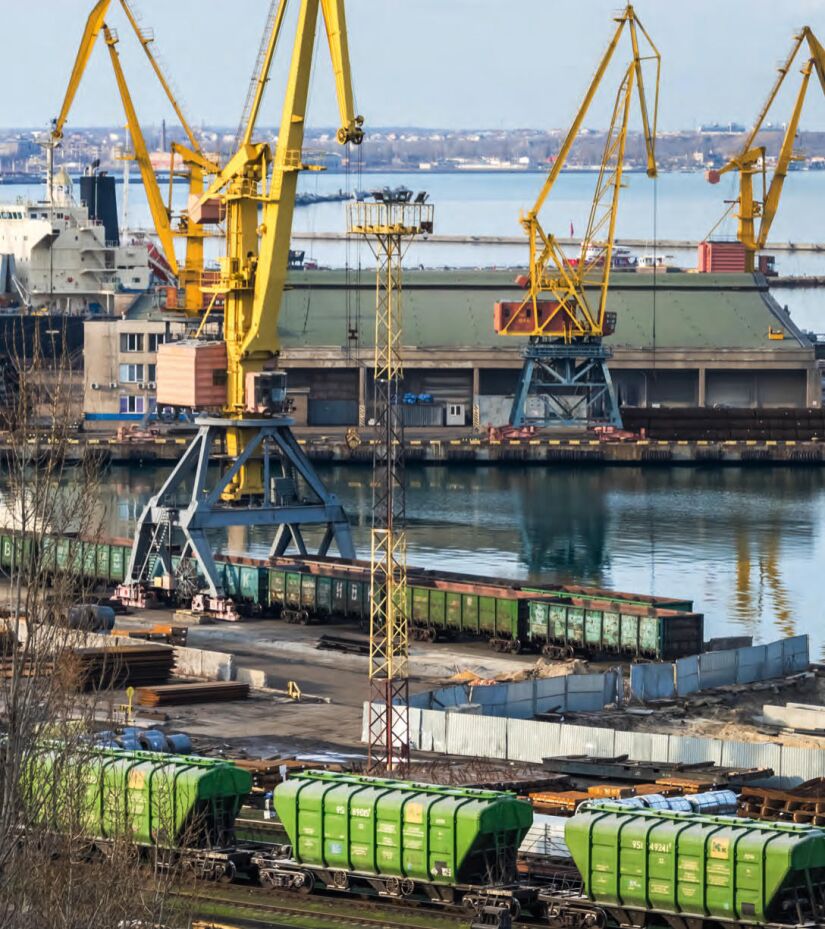
Ukraine is an important transit corridor for trade and travel between Europe, Asia and the Middle East. The country has extensive railway and highway networks, sea and river ports (terminals), airports and a wide network of air destinations, freight and customs terminals. Although the country has a broad transport infrastructure, it needs to be modernized and extended and the quality of services improved through gradual alignment with European standards. This creates a lot of opportunities for private investments and public-private partnerships (PPPs).
In the following years, Ukraine aims to attract more players through a transparent procurement process in the infrastructure sector. Namely, there are three concession projects for seaports – a ferry terminal in Chornomorsk seaport, a container terminal in Chornomorsk seaport and a passenger complex in Odesa seaport – six roads, four airports and three railway concessions. These projects are planned for 2021-2022 and at an estimated cost of $1.7 billion.
Ukraine’s unique location on the crossroads of the main trade routes between Europe, Asia and the Middle East makes the country a major logistics hub. Recently, Ukraine and Poland signed a memorandum of intent on cooperation between the ports of Gdańsk and Odessa. This step allows the creation of the intermodal transport corridor and will give the impetus for further development of logistics and transport, expanding the geography of container traffic from China through Ukraine to Poland and Europe and back using different types of transport without stops.
NEW OPPORTUNITIES
Traditionally, Ukraine has a powerful and developed energy sector, including gas, electricity, hydro, coal and nuclear. Ukraine’s way to energy independence – according to the Energy Strategy of Ukraine 2035 and recent reforms in the energy sector – opens new opportunities for global energy players and small investors in Ukraine.
Given Ukraine’s current natural gas production, the proved reserves base is underutilized. The government’s recent deregulation efforts in the gas sector and the launch of open auctions of special permits for oil and gas extraction attract more private companies with advanced technologies and boost gas production in Ukraine.
For instance, in October, PGNiG, a Polish state-run gas giant, signed an investment agreement with Energy Resources of Ukraine (ERU) on a joint exploration and production project in Ukraine. This is a step toward the launch of joint operations in the area located close to the Polish border with a strong production potential as the previous geological surveys conducted by PGNiG showed a correlation of its geological structures with Przemyśl – Poland’s largest natural gas field. The company plans to launch a natural gas exploration program in Ukraine in the first half of 2021. Ukraine and Poland are consistently looking for the diversification of gas supply sources and such a project seems beneficial for both parties as well as contributes to energy market integration and strengthening energy security across the region.
PROMINENT IT SECTOR
The IT industry is among the country’s fastest-growing industries and a major driving force of Ukraine’s economy. This is the only sector in the Ukrainian economy that has shown immunity to political and economic fluctuations and demonstrated steady growth by nearly 40 times over the last fifteen years: from $110 million in 2003 to an estimated $5 billion in 2019. Ukraine is on its way to becoming the leading tech hub. The Ukrainian IT industry consists of over 4,000 local IT service companies. More than 110 leading global companies have subsidiaries in the country. Samsung, Microsoft, Ring, Snap, Magento, Plarium, Boeing, Siemens, Ericsson – all have established their R&D centers in Ukraine.
A MANUFACTURING BASE
With a highly-skilled and cost-competitive workforce and a wide selection of greenfields and brownfields, Ukraine is just the right place for launching manufacturing facilities.
Polish companies have already benefited from investing in Ukraine’s manufacturing sector including Barlinek, which became one of the largest manufacturers of three-layer fabricated woodblock flooring in Ukraine. The company started its operation in 2017 and invested about $75 million into the plant construction in Vinnytsia.
There is also a huge potential for joint venture projects in agri-food processing which will bring Ukraine up to a new level in the global food supply chains.
By renewing the installment scheme for settlement of VAT duties on imports of manufacturing equipment, favorable conditions for the growth of light metal-processing and other industries have been created. Ukraine also launched the abolition of the state monopoly on spirits production and liberalized ethanol exports. Thus, the investment in ethanol production has been unlocked and eight distilled spirits plants have already been auctioned through the transparent privatization process attracting in total UAH 477 million (less than $17 million).
LONG-TERM SUCCESS
Ukraine has already made a great leap forward in the privatization of state-owned enterprises by introducing the transparent system of online auctions. Of 3,733 state-owned enterprises (SOEs) in Ukraine, nearly 1,000 will be auctioned, while 1,261 are to be liquidated. Polish companies have a unique opportunity to scale and diversify their businesses by acquiring those assets and pave the way for future successful operation in Ukraine.
And we already witnessed the successful and transparent privatization of the Dnipro Hotel. The starting price increased 13 times reaching $41 million and 29 investors took part in the bidding. The winner is the private real estate company Smartland and Alexander Kokhanovskyy, the founder of the country’s most successful e-sports organization, Natus Vincere, the former co-owner of ESforce and the founder of DreamTeam startup.
It is obvious that nowadays countries have to compete globally for investors by offering them better conditions for doing business and lucrative incentives. With the introduced draft law “On state support for investment projects with significant investments,” Ukraine suggests such incentives as corporate tax exemption, no import duty or VAT on equipment, reduced land tax and provision with developed infrastructure and utilities, and will arrange a personal advisor from the government if the investors commit to €20 million investment.
Ukraine is also moving toward providing incentives for industrial park operators and residents. The two draft laws aimed at developing the manufacturing and R&D sectors have already been registered in the Ukrainian parliament. Such a step will allow increasing Ukraine’s investment attractiveness on one hand and providing benefits for the companies on the other. In particular, businesses based in an industrial park will receive tax holidays for five years.
The recently-released UkraineInvest Guide (ukraineinvest.govua/guide/) contains much broader information about Ukraine’s potential and analytical data from various industries. It could also become a starting point for Polish investors to enter the Ukrainian market since the guide provides the business with up-to-date information in the regulatory policy as well as includes the most attractive investment projects including PPPs and privatization.
There is indeed a huge potential for further development of Ukrainian-Polish economic and investment relations. This is especially true in the realm of investments in the infrastructure, logistics and energy sectors as it would also bring great value to strengthening strategic cooperation between two countries.
 Sergiy Tsivkach
is a Ukrainian- and UK-qualified commercial lawyer with over 20 years of professional experience, and executive director, UkraineInvest – a Kyiv-based independent investment advisory body.