



Mercedes-Benz’s Green Deal
16:24
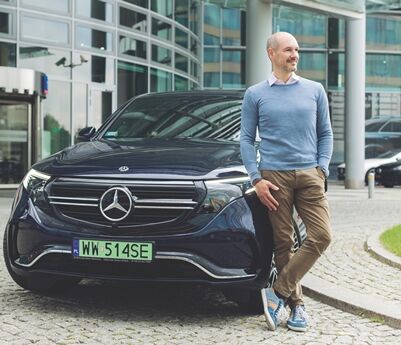
WBJ: The coronavirus has had a very negative impact on the automotive industry. Is Mercedes, therefore, planning changes in its strategy? Will you abandon the difficult topic of e-mobility in favor of expensive and high-income combustion engine cars?
Wolfgang Bremm von Kleinsorgen: Absolutely not! The foundations of our strategy remain the same: CASE (Connected/Autonomous/Shared/Electric) and Ambition 2039 – a strategy that foresees that by the end of 2039 we will offer exclusively non-emission cars. Which fits harmoniously into the EU Green Deal. Of course, the pandemic has had an impact on the whole industry, but in terms of electromobility, paradoxically it can help.
How come?
Analyses show that the electric car market will be relatively less affected by the pandemic than the combustion car market. For example, Frost & Sullivan [a Texas-headquartered market research company] forecasts that car production in Europe this year will fall by as much as 33.9 percent compared to plans before the pandemic. The forecast predicts that at the same time, sales of electric cars will fall by at most a dozen or so percent in comparison with plans. But it will be still a rise compared to 2019. It means that the percentage of electric cars on European streets will increase.
Nevertheless, electric car users still have many barriers in Poland…
We’re aware of that. When talking about electromobility the first advantage you think of would probably be ecology. But it also stands for modernity and fun of driving. Once you have experienced the silent driving with, parallel, extreme boost when accelerating, you know what I mean. And of course, cost efficiency: driving 100 km with an EQC [Mercedes-Benz’s first fully electric vehicle] costs about PLN 14. For that much, we will buy less than three liters of fuel, even at today’s prices. But we also know the drawback, for example, insufficient charging infrastructure or a higher price. Fortunately, this is changing, and we support our customers by overcoming these barriers during the transition period. An example is the mobility packages with FREE NOW that we have just introduced.
What is your cooperation with FREE NOW about?
Every customer who orders EQC by the end of the year will receive an inclusive taxi package from our sister company, FREE NOW. The logic is very simple. For example, the customer drives from Wrocław to Kraków (271 km). Returning on the same day requires recharging the vehicle (EQC has a range of 414 km WLTP). Therefore, the driver can charge the car in a parking lot and meanwhile do their business in the city by taking free taxis. By the way, the traffic in the city center will fall by one car. [The WLTP procedure (world harmonized light-duty vehicles test procedure) determines the range of fully electric vehicles].
But you are not limiting your strategy to the promotion of EQC?
Absolutely not. This year we launch the electric van EQV and early next year we will present our compact models: EQA and EQB. At the end of the year, we will also offer several dozen plug-in hybrid models. And let’s not forget about our urban baby, smart EQ. Did you know that this is the first car brand that has completely abandoned combustion engines in favor of electric ones?


