OPEN TO ALL
15:58
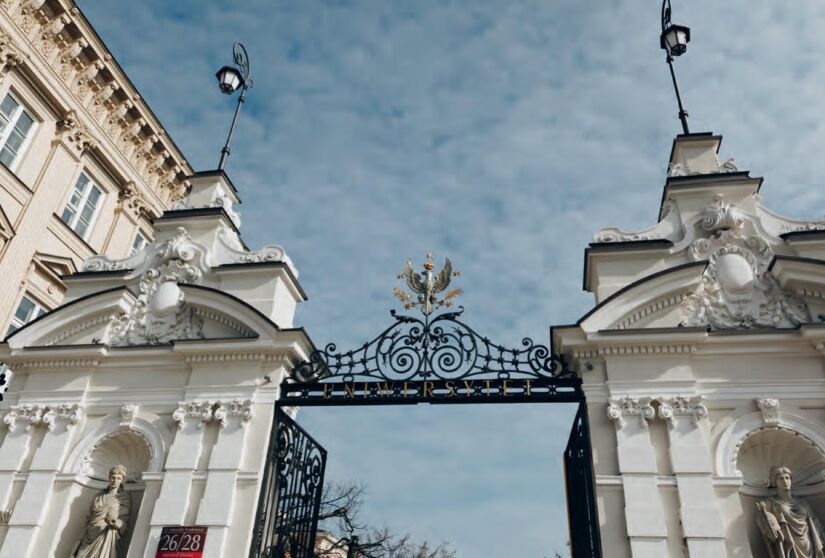
WBJ: Many scientists are worried that the government is exerting political pressure on educational institutions and on their employees. So, bearing in mind the present difficult situation, how do you see your role as rector of Warsaw University, which has so many outstanding Polish and foreign scientists and where so many young people want to study?
Rector Prof. Alojzy Zbigniew Nowak: Addressing your question regarding concerns about political pressures being exerted on educational institutions, I have never felt any pressure. I don’t know whether this depends on my personality, position or some other factors, but I see myself as an independent and unconstrained rector, who is responsible for managing the work of the whole university and who in turn serves all university employees and students — those from Poland and from abroad alike. I wish to stress that I always have and will continue to pursue effective cooperation with all those who desire it — all institutions, organizations and the entire society. In Warsaw, we accommodate 2,500 students in six dormitories many of whom are foreign students. Our office and university facilities are accessible to people and students with disabilities. Thus we are open to all who want to interact with us. As a rector, I am fully accountable for the functioning of our university: the activity of professors of all specialties, the works of our laboratories and all other facilities. Of course, the coronavirus pandemic is a difficult time for us, the professors are conducting remote teachings and the functioning of laboratories is challenging. This demanding period has lasted for some time now, but the economy and the business sector based on the interaction of science and university teaching will always need well-educated people. As an economist, I am doing everything I can to enable our university to develop the best technologies and economic relations to effectively cooperate with the world economy, business and trade, both in Poland and abroad. With that concept in mind, our university aims to encourage a science-based economy to gain a new stronger meaning and generate more profits.
It does seem to me though, that scientific institutions are under some form of political pressure. The superintendent of education from Kraków called the Jagiellonian University, which is the oldest higher educational institution in Poland, with a renowned academic staff and well-known graduates, an “escort agency.” Her attack on the university and its students for taking part in a questionnaire, in which they were asked to define their sex from a set of options, which included “woman,” “man,” “transgender woman” and “transgender man” constitutes an example of outside interference in the life of a university, which has nothing to do with scientific arguments. The incident evoked outrage among university staff and not only in Kraków, as it was viewed as political pressure on students and an attack on the university itself. What is your reaction to this?
As the rector of Warsaw University, I take notice of it. We are taking action against all forms of discrimination. Our student admissions office has adopted a plan for the equality of sexes and we fully accept our university community in all its diversity. Our current and prospective university students understand this and they feel free, welcomed and accepted.
Poles have believed that the power of science and the activity of that university will help to create a free and modern Poland and to develop a better life and world. Is this vision still guiding Warsaw University in its development and does the university still wish to build a better world in the 21st century and beyond?
Yes, after several difficult periods in our history, the scientific pursuit of our university is now developing rapidly. As a professor of economy, I have dedicated many years to focus on international economic relations and also contributed to managing the financial markets. Currently, as a university rector, I oversee management and administration to ensure that our university works together with the Polish economy and foreign market actors, as we are witnessing a dynamic development of knowledge and a science-based economy. We strive to promote new technologies in our institutes and laboratories and to teach our students how to effectively employ them. At the same time, we also want our students to understand the global history and modern culture as we believe that in our era such knowledge aids them to successfully conduct their future professions and to embrace modern ways of life.
Is Warsaw University preparing scientists to get involved and respond to the new demands for dealing with climate change, which will affect all sectors of production, trade, science, the economy and technology in many years to come?
Yes, but the implementation of the Green Deal program will take many years and will require action from the governments in all countries, as well as, efforts from businesses, industries, public organizations, scientists and universities to develop new technologies. We will engage our institutes and other sections of our university in the development of these new technologies and the transformation of our way of life, yet we need to recognize that the history of new developing civilizations tells us that programs that aspire to change the lifestyle of populations take years to realize. Consequently, the revolution in the technology of production will also take time and will require a lot of cooperative effort from scientists, industries and businesses alike. The implementation of the Green Deal will also require universities to prepare their graduates for new demands in the working environment and style of living in the next century.
 Alojzy Zbigniew Nowak is a Polish economist. In 2020, he was elected rector of the University of Warsaw. The university established in 1816, is the largest university in Poland.