



PART 2 - CREATING THE FUTURE (OF IMPACTFUL TEAMS)
17:17
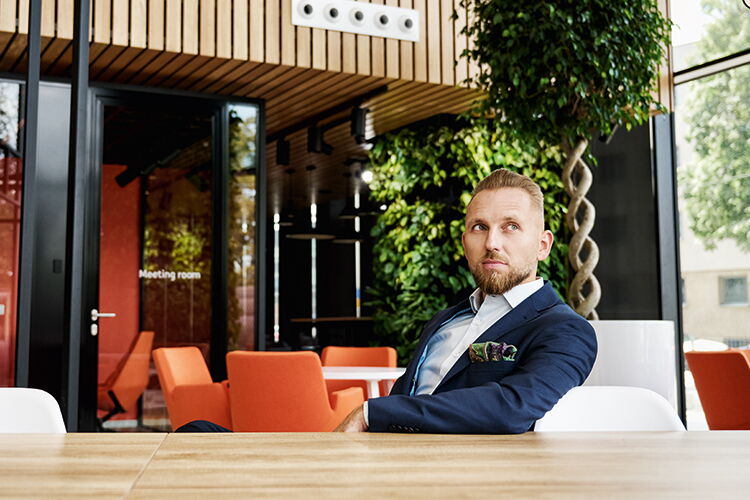
Mariusz Sosna, tribe lead, Business Support Tribe
Mariusz is a senior manager with many years of experience and is currently a management team member at ING Hubs Poland, responsible for the work of over 450 people, in diverse teams from the IT and support areas.
How do ING Hubs Poland employees currently work?
Let’s start from the beginning. The pandemic started a sort of transformation that had never been planned. We had all sorts of crisis committees and we had to make a lot of decisions but when I look at it from a different perspective and compare it to what I’ve seen elsewhere, I think we did well. We quickly decided to start working from home. We had the tools we needed. We did not experience any serious issues with continuity or loss of productivity; also thanks to our employees who simply stood up to the challenge.
We quickly adapted to recruiting people in a new way. I think we overcame all of the challenges and the processes we had in place, and that, in turn, allowed us to gain some advantage in the market. We recruited heavily — 1,000 people during the first year of the pandemic. It was the biggest recruitment drive we have ever had. It was not the effect of the pandemic, but it was a time of delivering huge projects that required many people. In addition, employee turnover was really low throughout the first two years of the pandemic. People were probably not that willing to change jobs and wanted some security in their lives. Yet, on the other hand, we were recruiting heavily, so some were still looking for a change.
Any consequences of this transformation?
During the second year of the pandemic, the IT sector started to see some serious issues with the way the world had changed. The fact that all our employees were working from home and that our offices were largely empty seemed like a disadvantage. Something had changed. The first thing was the problem of increasing employee turnover in the sector. The problems we faced were how to properly introduce the employees when we don't have them or their team members next to us, how to instill a sense of belonging among them, what the company stands for, its culture, and what is expected of the newcomers.
Employees staying at home and in solitude for long periods of time has its consequences and affects their condition not only physically but also mentally. This was another major setback, as a result of which we are witnessing a decline in innovation. Companies weren’t really sharing the negative impact of the whole situation, but for us it was evident. If you want to innovate you need to have people working closely together. Finally, when we did open the office, we realized people had already gotten used to staying and working from home.
That meant a lot of explaining and discussing, building new ways of working, and understanding how we could combine the expectations of employees with those of the company.
Let’s start with the newcomers. Imagine you start a new job at a company you don’t know. Day 1: Your manager spends 1-2 hours with you, tells you what the company does and what your job will entail, and then leaves you. You stay at home, at the same desk that you had been working at for your previous company, and you don’t know a lot about your new workplace. It will take you months to pick up small details during remote meetings. Some people are good at it. They reach out to their new colleagues and arrange a virtual coffee and ask around. They learn quickly and build connections. But not many people have such skills. So what is your solution to this challenging situation?
We want to build teams. We are against the remote-only work solution. This is a paradigm that we want to stay with and this is at the center of our discussion. Not only for the newcomers but also for the growth of our people, for building a culture, an understanding of a common goal. And if you want to build teams it is not enough to have people working scattered across countries or cities. Some teams work remotely and work well. I have seen that and know it is possible. However, many of those are experienced teams, built over long periods and they work efficiently together. I’ve seen teams, maybe a group of teams, but I haven’t seen a big structure, like over 100 people, that was effective while working fully remotely. I know it is possible but extremely hard to do and replicate. Another issue a lot of companies face is when they get employees to come to the office once in a while because they want their people to be part of the company. However, when they choose to come in on different days, there is no integration.
This is not how it should be done. We have told everyone that we do not want our employees to come to the office just for the sake of being there. Instead, we expect employees to find reasons for coming to the office and what will be productive for them. It can be, for example, scrum rituals or project planning, team meetings, onboarding of new colleagues, training, celebration, and face-to-face meetings with management or peers. We give our teams a lot of freedom. They define the reasons to meet in the office. They need to plan when to do it and trust that everyone will be there to make use of the fact that they can make direct exchanges. We expect every team to find a solution for their way of working in a hybrid model.
A challenging model that works from the bottom up is the core of our approach.
How is ING Hubs Poland unique? What are the recruitment challenges?
For me finding people and retaining them is like the bloodstream of our company. Everything we do heavily relies on finding and keeping the right people. Sure, on the one hand, right now it is getting harder but, on the other hand, we have been delivering really good results when it comes to recruitment in the last couple of years. Also keeping our talents in now more important than it ever was. One of the pillars of our culture is listening to people. We host all kinds of open question sessions and we always end big meetings with the option of asking or commenting anonymously to get honest questions and feedback.
Our employees tell us a lot, which can often be challenging, but we get plenty of feedback from them in terms of when their expectations change:: that they have opportunities to change companies, work remotely or abroad. And some also tell us that the work strategy that we have adopted is not the one they like. It is important to get these responses because then you can actually have a dialogue. I see that there are many people who are supportive of our approach. Also, a lot of them want to work for a company that has an office, a strategy, and a culture, where you meet people and make friends. An important aspect of people staying with us was always the culture of our company, and it still is. Our greatest job is to make sure we do not lose it, especially with the growth we have.
We want to have a solid proposition of compensation and benefits, but in the end, I think people also stay with us because they simply like the company and enjoy working here. They can be part of a global team. We have roles and functions that are truly global and the importance of our teams and our people has grown steadily over the years.
How do you integrate your employees and create the right culture?
Culture is very difficult to describe. Some say it is what people do when nobody is watching. I feel that the people are at the heart of our culture but it’s also about how we build our teams and how important the people are in the strategy. We believe that employee growth is more important than delivering business goals because if we help people grow and allow them to be successful, they will deliver the business results.
We nurture our leadership team, our middle managers, and product owners. We want to make sure that they take care of other people in the company and also build teams. I know there are many people who stay with us because they simply want to grow and learn. Something I like to look at is simply the smile on people’s faces. That for me is like a KPI. I see it a lot, especially now in our new offices. I get a lot of positive energy when I see employees enjoying and spending time with their teams.
How are the new offices built? How are they different from the old offices?
It’s been a challenge. We started construction just before the pandemic hit Poland. So we had to change the entire approach along the way. We knew we didn’t need the office as we did before. We decided to put a very strong emphasis on collaboration. I have seen a lot of great offices with collaboration zones, something you will see increasingly more of, especially in Warsaw. We have pushed it a bit further, once you enter the office you step into a huge space (2,000 sqm) which we call “gravity point” and it is an open space for everyone. It is like a huge café where you can spend your whole day working but you can also organize a meeting or invite somebody from outside, bring your kids, take your dog — anything is possible! There are no desks.
Feedback is even better than I expected! I was expecting it to be positive but people are complimenting it a lot. The new office has been a huge success since its opening. For the first time in two years, almost all the parking spaces are taken. We have to queue to get coffee — it’s proof that people enjoy this.
But it’s not like the old office. There are no desks foreveryone. How does that work?
Yes, in the previous office everyone had their own station. Some people still need to go through that transformation as they loved their desks. They had their cups and photos and stickers on them. The office space is now comprised of collaboration zones. These could be all sorts. It could be a fun zone, a “library” (a quiet zone), a collaborative chilling spot, or the gravity point on the ground floor.
Before the pandemic, company benefits focused on food days or sporting activities. Is it less important now?
I think it is still important. We care about the wellness of our employees and especially now. Throughout the pandemic, we have been studying how much of a negative impact it has had, not only for people infected by Covid and struggling to recover but also with mental health issues. Not everyone enjoys sports but for those who do, we would like to get the message out there that we can help and connect them with others. The biggest events we take part in are the business runs. We also sponsor one of them — we have more than 100 teams and roughly 500 participants.
We also support employees with a “Mental Helpline,” a series of workshops on wellbeing, and an active “BeWell” community that monitors the situation and prepares solutions to respond to the current needs.
We want our employees to be active. In addition to the sport card benefit that we offer, this year we launched a more inclusive proposition and employees can choose how they want this benefit to be delivered.
Again, this involves more belief in people and the fact that they are capable of organizing themselves. We, as a company, just need to help them and give them the opportunity to, for example, rent a football court or connect people with each other. We also encourage good examples such as coming to the office by bike.
Any last thoughts on transformation?
One more thing to mention is that I really feel we are in the middle of the transformation, not even close to the end. It is a huge discussion in our company still. Like I said before, there are people who simply say they don’t like it and want to work remotely. To some extent, we allow it. It’s a fraction of the company. But I think it is key to acknowledge that this is a transformation that is taking place and we need to monitor it, observe it, and make decisions as we go.


