



Poland’s Food Hall Boom: Europe’s New Model for Dining and Community
11:12
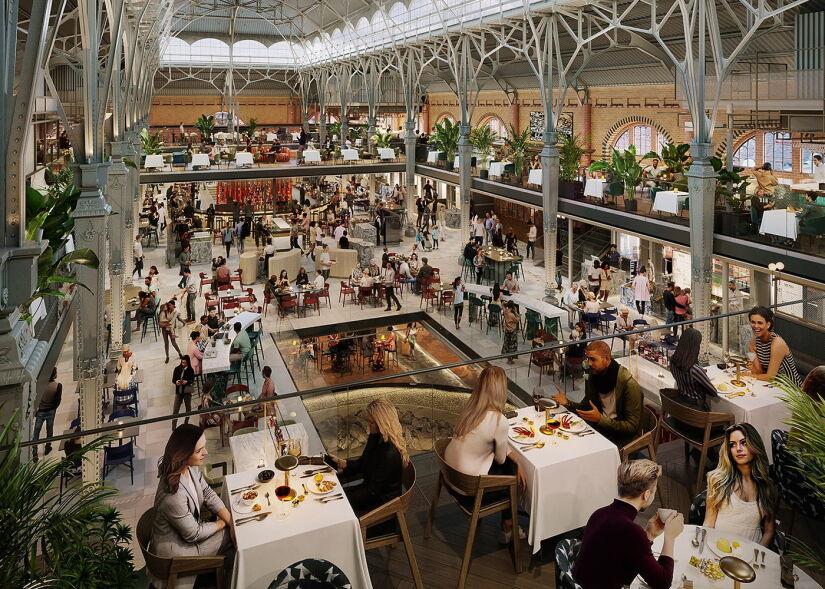
(Main image: visualization of Hala Targowa in Gdańsk)
The opening of Hala Koszyki in 2016 sparked an innovative new era for food halls and community hubs in Poland. Food halls are thriving across Europe because they offer exactly what consumers want: high-quality street food, diverse cuisines, a strong bar offering, and a lively, social vibe. Outside the UK, Poland boasts the most dynamic food hall industry in all of Europe. Real estate developers and food hall operators now travel to Warsaw for inspiration. Clearly, the industry at a very interesting stage of growth, one that will bring impressive innovation while also seeing its share of unsuccessful attempts at cracking the code of “building community.”
Given the success and growth of the sector, we are now seeing food hall operator expansion, such as the Food Town team, who operate both Food Town in Warsaw’s Fabryka Norblina and Stacja Food Hall in Gdansk. The Likus family behind the Browary Warszawski food hall will soon announce their new hall in Katowice, and the Apsys real estate group, which operates Food Fyrtel in Poznan will soon start construction on their premium-positioned Hala Targowa in Gdansk. The Globalworth team behind Hala Koszyki, has opened a food hall (Pedet) in Wroclaw and plans to open another hall in their Supersam shopping center in Katowice. Finally, the team behind Słony Spichlerz in Gdansk has announced a September opening for their Kulinarna Kamienica food hall – the second food hall to open in Poznan.
The more exciting food halls in the pipeline include the much-anticipated Stara Rzeznia project, being developed by Vastint in Poznan and the Magazyn Bawełny project developed by the Majsterek family (A&A Real Estate) in Lodz. These halls are notable because they will be “more than” food and drink, offering additional entertainment and leisure options to attract broader audiences.
Clearly, Poland’s food hall market is on fire.
Not only are we seeing multi-unit food hall operators, but we are also now seeing the evolution of food hall restaurant chains. The most notable are The Fry (9 units), Curry Leaves (11 units), and the new guys—or rather, brothers—on the block, Pita Bros. (9 units), all of which have locations throughout Poland’s food hall network. Each of these restaurant brands are backed by extremely passionate entrepreneurs who are laser-focused on providing delicious and authentic street food. Naturally, we are seeing these brands grow outside of the halls with Curry Leaves opening a unit in the Zloty Tarasy shopping center and Pita Bros. already present on Warsaw’s high streets with three such locations. The Fry has expanded with an innovative stand-alone container outside of Arkadia Shopping Center. Don’t be surprised to see one (or all) of these entrepreneurs hit 50 units around Poland soon.

For over 30 years, John Gabrovic has been influential in Poland’s restaurant and real estate industries creating successful dining and leisure brands, food halls, and also helping international real estate developers “create community” within their mixed-use and retail assets.


