Polish enterprises under lockdown: How Poland has come through the crises?
13:09

The Polish Economic Institute is a public economic think tank dating back to 1928. Its research focuses on trade, macroeconomics, energy and the digital economy, with strategic analysis on key areas of social and public life in Poland. The Institute provides expertise for implementing the Strategy for Responsible Development and helps popularize Polish economic and social research in the country and abroad.
Business surveys on the situation of Polish enterprises conducted for the Polish Economic Institute (PIE) and the Polish Development Fund (in Polish: Polski Fundusz Rozwoju, or PFR for short) were carried out in the period from early April to early July 2020 in six survey measurements (six waves). Every survey concerned a representative sample of 400 enterprises of varying size (micro-, small-, medium-sized and large enterprises) and from different economic sectors (trade, services and production). In order to summarize the opinions of undertakings expressed during the six survey waves, a composite Business Sentiment Index (BSI) was built to reflect opinions on the value of sales, the number of new orders, subjective assessment of liquidity and planned changes in employment and pay. Changes in business sentiment, shown through the BSI computed for all the survey waves, are presented against the backdrop of the dates of introducing subsequent solutions under “anti-crisis shields” and of freezing and unfreezing the economy (Chart 1).
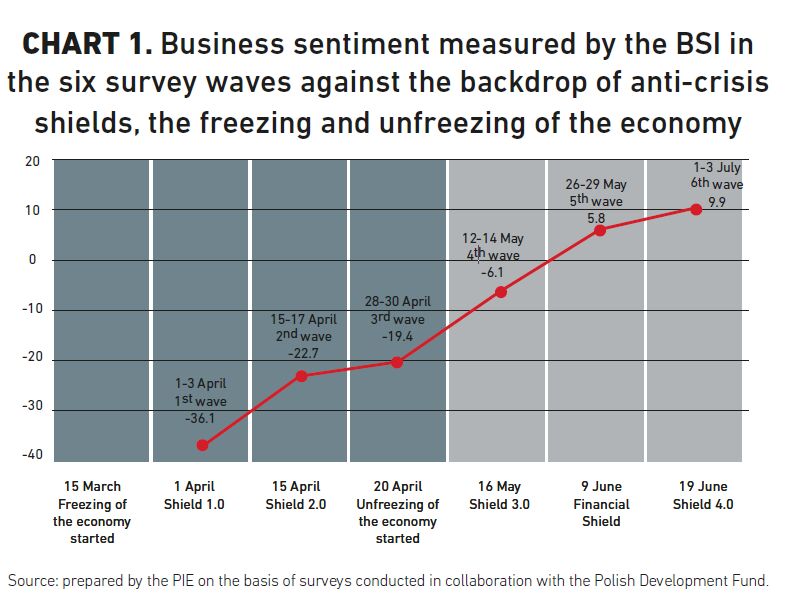 The BSI values determined for each of the six survey waves clearly show an improvement in business sentiment in the period covered. In particular, a marked change in business sentiment can be observed from mid-May when further stages of unfreezing the economy allowed undertakings to restore economic activities. The improvement in business sentiment was also closely related to the aid measures introduced by the Polish government in the form of “anti-crisis shields” and the “Financial Shield.” Further changes and extensions of the adopted solutions allowed a greater number of enterprises to benefit from real assistance, which translated into better self-assessments of the business situation in subsequent survey waves. The BSI shows that large- and medium-sized undertakings have coped with the crisis better than small and micro-enterprises. In the case of larger firms, the BSI indicated better business sentiment for large undertakings in each of the survey waves. A marked improvement in sentiment for production enterprises could be seen in May, whereas for commercial entities – as late as June.
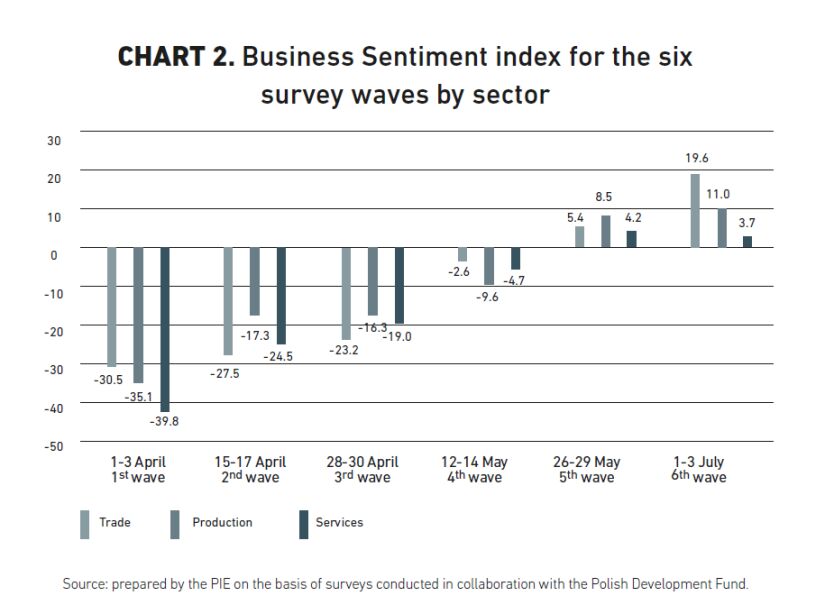
Broken down by sector (Chart 2), the surveyed enterprises showed gradually improving business sentiment and from the fifth wave, the BSI values turned from negative to positive.Interestingly, a clear improvement in business sentiment for production enterprises could be seen from the fifth wave (the data cited in the report is without seasonal or calendar adjustment), and for commercial undertakings – as late as the sixth wave. The abolition of the limit on the number of shoppers in the last phase of the unfreezing of the economy brought about a further significant improvement in business sentiment in trade and made it markedly better than in production and services.
The value of sales in the surveyed enterprises: the worst situation was observed in late April when more than two-thirds of firms noted decreases in sales, whereas merely 7 percent had registered increases in the previous month. In May, due to the unfreezing of the economy and the implementation of subsequent “anti-crisis shields,” the situation began to improve.
 In late May, 43 percent of firms declared a fall in sales, whereas 20 percent reported an increase. Early July witnessed further improvement. The share of entities indicating decreases in sales dropped to 36 percent, whereas it was 57 percent in early April.
Subjective assessments of liquidity: the worst situation was observed in mid and late April when 1 out of 10 firms declared having no financial reserves, whereas only 4 out of 10 estimated to have funds sufficient for more than three months. In late May, only 5 percent of the firms assessed stated that they had no funds, whereas the proportion of those who believed they would be able to survive for a period exceeding three months rose to 54 percent. The worst self-assessments of the financial situation were declared by micro- and small enterprises, whereas large entities were the most optimistic.
Planned personnel changes: in subsequent survey waves, there was a steady decline in the share of firms planning to cut employment – from 28 percent in early April to 6 percent in early July. In late May, no large firm was planning to reduce employment, although in the first wave such measures were indicated by as many as 20 percent of large enterprises. The percentage of entities planning employment reductions was pushed down by the introduction of solutions under “anti-crisis shields,” comprising financial and liquidity instruments subject to efforts by enterprises to maintain employment.
Planned employee remuneration changes: in early April, half of the undertakings planned pay cuts, but in early July such plans were only expressed by 12 percent of entities. Plans of enterprises with regard to salaries and wages suggest that the labor market situation has started to normalize. In early July 2020, for the first time since the outbreak of the pandemic, more firms were planning pay rises (14 percent) than pay cuts (12 percent).
The survey of entrepreneurs’ sentiment was completed this summer, the question remains how the sentiment of entrepreneurs will look in the fall, as the number of infections increases. It is true that we do not expect complete freezing of the economy, but will the epidemiological conditions allow companies to operate freely in the coming months? We will try to answer this question by continuing our research in the near future. More information from the research can be found in the report entitled “The economy under lockdown. Poland compared to the rest of Europe.” Copyright owned by Polish Economic Institute, Warsaw, August 2020. Visit pie.net.pl for more.