



Road to redemption
08:00
IN THE LAST FEW MONTHS, tensions have been heating up for Poland, as the country faces an increasing international furor at its seemingly lackluster response to climate issues. Amid a flurry of headlines reproaching Poland for a heavy reliance on coal – the fossil fuel provides around 80 percent of the country’s power – and extreme levels of pollution, in December, Poland became the only country to be excluded from the EU’s 2050 climate targets. Prime Minister Mateusz Morawiecki argued at the time that this was because the country wanted to reach climate neutrality “at its own pace”. It’s a move which might also spell bad news for Poland in the next MFF budget, as its share of the Just Transition Fund could be set to be slashed as a penalty for refusing to sign up to the EU’s targets. [The multiannual financial framework (MFF) is the EU’s long-term budget. It sets the limits for EU spending – as a whole and also for different areas of activity – over a period of at least five years. Recent MFFs usually covered seven years.]
There is no question that large-scale measures to tackle climate change in Poland are failing to work quickly enough, despite the creation of a new climate ministry in a cabinet shakeup after the October parliamentary elections. According to a recent report by Swiss air monitoring platform IQAir, 29 of Europe’s 100 worst cities for air quality are in Poland. But amidst the controversy and condemnation, some smaller-scale initiatives are trying to clean up the country’s act on climate issues. A week after Poland was exempted from EU pledges, the mayors of Visegrád Four capitals signed a “Pact of Free Cities” to promote common values and take the fight against climate change to the local level. [The Visegrád Four is a cultural and political alliance of four Central European countries – Poland, the Czech Republic, Hungary and Slovakia, that are members of the EU and NATO – for the purposes of advancing military, economic and energy cooperation with one another along with furthering their integration in the EU.]
ELECTRIC VEHICLE BOOM
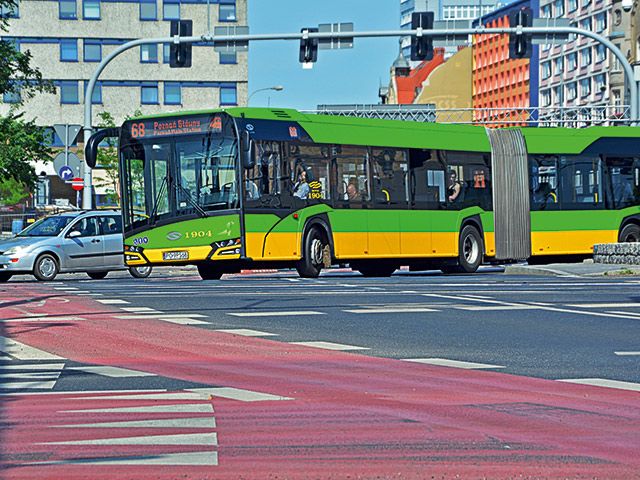
Meanwhile, an Electromobility Development Plan adopted in Poland in March 2017 pledged that one million electric vehicles could be on Polish roads by 2025. Crucially, the plan also encourages municipal governments to improve their fleets. Poland is already experiencing an electric vehicle boom, particularly in public transport. In October, Eurostat revealed that Poland has the highest percentage of alternative fuel cars in the EU – at 15 percent – with more than every third electric bus in the EU built in Poland. And one of the most famous faces of greener initiatives in Poland is the electric bus company Solaris, which has been leading the electromobility sector for 20 years. The increasing successes of the firm – including winning one of the largest tenders for electric buses in Europe last year – are also having an impact on Polish habits, thinks Mateusz Figaszewski, director for E-mobility Development and PR at the company based near Poznań in western Poland and fully-owned since July 2018 by CAF, a Spanish railway-vehicle manufacturing giant. “The activities of Polish local governments which we can observe in recent years, undoubtedly show positive changes taking place in the area of care for the environment,” he says. “We are proud to say that Solaris is an important pillar of ecological changes that we observe lately in Poland.” Solaris is currently implementing deliveries of 130 modern, emission-free Solaris Urbino 18 electric buses to Warsaw, a city that is planning for one-third of its bus fleet to be zero-emission by 2022, as well as supplying electric buses to other Polish cities in recent years. Figaszewski says local governments in Poland order battery buses most often – though the fleet is growing across Europe too. “So far, Solaris has already delivered or contracted almost 900 electrically powered vehicles,” he explains. “Solaris has been repeatedly awarded in Poland and abroad for its activities and innovative products, including the prestigious ‘Bus of The Year 2017’ award for its ecological Urbino 12 electric bus.”
Despite the rising prominence of Solaris, Poland’s own electromobility target is still a high one, with statistics reporting only 9,000 electric vehicles in the country so far. Last year, the government’s ambitious plans for one million electric vehicles by 2025 began to disintegrate, shriveling to a more modest 600,000 electric vehicles by 2030. A key stumbling block has come in the form of promised subsidies to go toward the purchase of electric vehicles. Recently, these were also reported to be smaller than expected. In 2019, Bloomberg reported forecasts from the Polish Alternative Fuels Association, which estimated that without government subsidies, the country would have about 60,000 electric cars by 2025, though five times as many could be achieved with incentives. The association also emphasized that the target of a million would not be possible before 2030, and only then with tax cuts, or other measures.
‘LESS ENVIRONMENTALLY INVASIVE’
Nevertheless, other firms are investing in electromobility, to help Poland face a greener future. One is Rafako, a Polish power plant supplier that was inspired to move into the production of electric vehicles after becoming more aware of the need for environmental protection. Project coordinator Marek Marczak said that they felt eco-transport was an important step in achieving climate goals. “Its consistent implementation is an obligation arising from concern for our environment, for how the world will look in the future,” he says. “The movement started in large cities [in Poland] with strong environmental awareness but the escalation to the rest of Poland has been noticeable for a long time.” According to him, one of Rafako’s unique initiatives intends to help smaller localities, where they aim to modernize the transportation of children to schools. Old combustion buses are currently being used but he says that replacing these with electric buses could also help increase environmental awareness in a new generation. Rafako is the only company which offers electric buses which are adapted for the transportation of children – and it is projects like this which could help the company improve its standing in an already crowded electromobility market. “Poland is an ambitious country with great technical potential,” Marczak adds. “There are several reasons why the development of electric public transport must be continued. It brings environmental benefits, the total costs of fleet operation (TCO) are low. The effective stimulation of the development of the electromobility program in Poland has made us one of the markets with the greatest experience in Europe and this experience will certainly be used in the coming years.”
This is a message shared by Solaris: Figaszewski feels that tenders announced by Polish cities will “accelerate the transformation of public transport into something less environmentally invasive,” and therefore reduce emissions. This may be only one sector, but its impact could help the country work toward climate targets.
Large-scale developments might be too challenging to achieve at this stage, but if Poland focuses on local-level improvements, it could still be on the road towards a greener future.


