Significant disinflation likely in 2023
12:55

WBJ: The macroeconomic indicator that will attract the greatest attention from both entrepreneurs and consumers in 2023 is inflation. At the end of 2022, we recorded a slight decrease in price growth dynamics. Is this a trend that will continue into 2023?
Piotr Bujak: It is widely expected that 2023 will bring significant disinflation both globally and in Poland. A drop in energy commodity costs and global food prices will signal this shift. A lagged effect from the tightening of the monetary policy by major central banks and the Polish Monetary Policy Council will also accompany it. Interest rate hikes in Poland between October 2021 and September 2022 were the largest and quickest in over 20 years. This has already cooled lending activity, especially in the households segment, while the narrow money supply has plummeted.
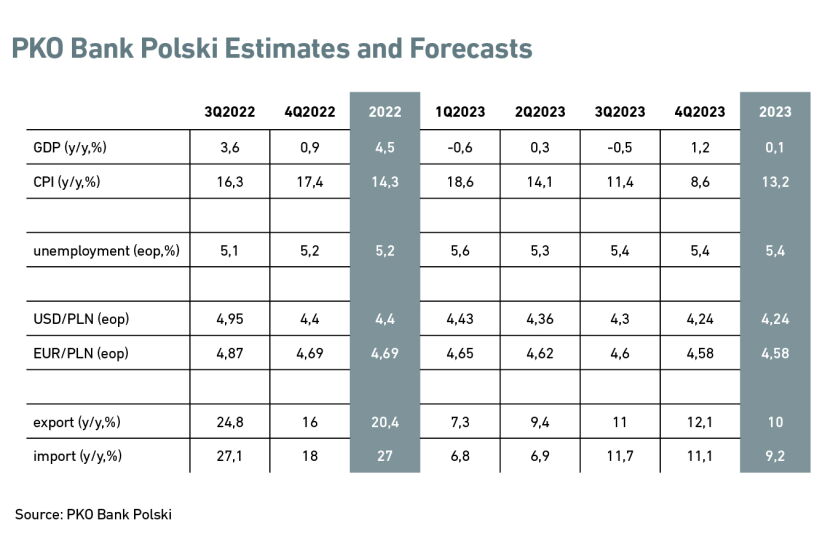
The annual average CPI inflation in 2023 will be similar to the one in 2022–above 10%. However, inflation will decline this year, a distinct change from last year’s upward trend. We will start the year at a high inflation level of close to 20% y/y in January-February due to increased tariffs on energy. As the year progresses, however, the headline inflation rate will decline.
What factors will have the greatest impact on price growth? Can the government or the National Bank of Poland regulate inflation? To what extent are external factors important?
A big part of the current inflation shock abroad and in Poland is an inflationary impulse related to the war in Ukraine that triggered a spike in energy costs and food prices. One must remember that Russian actions led to a drastic rise in energy commodities prices in 2021, many months before the full-scale invasion of Ukraine in February 2022. Without that, inflation in European economies, including Poland, would be much lower, and not at the highest levels in many decades. They would still be at excessively high levels much above the central bank’s targets, however. The significant and underlying reason for the elevated inflation was strong demand related to economic stimulation on an unprecedented scale by major central banks during the pandemic. However, the stimulus was not halted in time, and it has fueled inflationary pressures in the global economy.
In Poland, additional price pressure is connected with a very tight labor market, the second lowest unemployment rate in the EU, and double-digit wage growth. The sharp increase in National Bank of Poland interest rates is directed at the domestic sources of inflationary pressures. In conjunction with external disinflation trends, inflation normalization in Poland should occur within 2-3 years.
What is the impact on Poland’s inflation of about 2 million consumers from Ukraine? Does the sudden increase in demand for many products from an extra 2 million people really impact prices?
A massive inflow of refugees to Poland has increased the country’s population by around 5%. This is significant, and it has increased consumption demand and pushed prices upwards, far beyond the inflationary effects of the war experienced by other countries. Without a large number of Ukrainian refugees, consumption demand in Poland – especially for basic goods such as foodstuffs, fuel or pharmaceuticals – would have been less.
Let's move on to the issue of economic growth. 2021 was like a roller-coaster–from negative GDP to over 11% growth. That base effect made a huge impact on GDP values in 2022. So what level are we entering in 2023?
Large fluctuations of economic activity triggered by the pandemic and the war in Ukraine still persist. While annual GDP growth rates in 2021-2022 were positively affected by a low base effect related to the recession in 2020, the statistical effect will become negative in 2023. Even if GDP growth in 2023 will be close to zero, one should remember that it means the economy is holding on to strong gains from the depth of the pandemic recession. Normalization of Poland’s economic growth, and a return to 3-4% GDP growth, is widely expected for 2024-2025.
What factors will have the greatest impact on the Polish economy in 2023? Which components of GDP will “pull” the GDP result downwards and which upwards in 2023?
The main drag on overall economic activity will be the decline in private consumption, especially in the first half of 2023. Consumers are burdened with substantially increased debt servicing costs and their purchasing power has been considerably eroded by elevated inflation. Fixed investments should keep growing on a moderate scale, supported by the strengthening of public investment activity. The investment boom in the public sector expected this year is connected with the election calendar – parliamentary elections in late 2023 and municipal elections in early 2024 – and the fact that 2023 is the last year to use EU funds from the “old” multi-year financial framework for 2014-2020.
An outperformer on the demand side of the economy is going to be net exports as Polish exports remain resilient despite the global slowdown. Imports growth will be constrained thanks to a decline in energy commodity prices. Deterioration of export prices in relation to import prices will become far less negative than during the shock induced by outbreak of the war in Ukraine.
What are the forecasts for the labor market, the unemployment rate and wages? Will the "employee's market" and pressure for wage increases prevail?
The Polish labor market cooled a bit in late 2022 as the number of new jobs slumped and the number of liquidated jobs started to rise. However, vacancies are still high and the unemployment rate has not grown at all. Even in a moderate recession, the unemployment rate should remain broadly stable. Overall, labor market conditions will stay tight as a few structural factors that were non-existent in previous episodes of economic downturn in Poland will absorb a decline in the demand for labor. Firstly, the nearly record number of vacancies at the starting point of the slowdown. Second, the declining working-age population. Third, a very high number of short-term immigrant workers. Fourth, employers are likely to hoard well-skilled employees as they are aware of the deepening labor force shortage in Poland in the long term. It is more reasonable to reduce labor costs by slashing bonuses than by laying off specialists that will be hard to find and employ in a few quarters when an economic recovery starts.
Last year's economic and political unrest boosted the value of the dollar. Is there a risk that the dollar will cost more than PLN 5 this year?
Given the relatively strong fundamentals of the Polish economy, for example, the country’s better fiscal situation and balance of payments position than the other major economies in the CEE region, and assuming that the Federal Reserve will end the monetary policy tightening within the next few months, our strategists expect the zloty will appreciate during 2023. There will be periods of increased volatility, of course. However, at the end of the year EUR/PLN rate should be below 4.60 while the USD/PLN rate should be around 4.20.
And finally, a question about Polish exports and imports. What about the trade balance? And how will the situation in the East, and broken supply chains to Europe from Asia, impact Polish exports?
Polish exports have proved surprisingly resilient to a global slowdown. As a result, Poland is also the first major economy in the CEE region that has already started to experience an improvement in its trade balance and the whole current account of the balance of payments.
We believe that the Polish export sector's underlying strength is the still strong competitiveness of the domestic economy–mainly due to a relative drop in unit labor costs over the past few years. This, in turn, translates into still more competitive prices of products and services than in the West. A record strong inflow of foreign direct investments in recent years confirms the importance of lower labor costs.
It is important to note that these positive trends for Poland’s export potential and the overall performance of the Polish economy has been reinforced thanks to global reshoring intensified by serious supply chain disruptions and by geopolitical shifts that accompanied the pandemic. This means that production of goods ultimately destined for Western European markets can be transferred from Asia to Europe, including Poland.
According to a recently published study prepared by global logistics giant Maersk together with the Reuters agency, Poland is seen by European companies as the most attractive location for reshoring. Thus the golden age of the Polish economy may persist, but the country has to avoid serious mistakes in macroeconomic policy and it has to tackle the challenge of energy transition.