



Social capital deficit
23:16
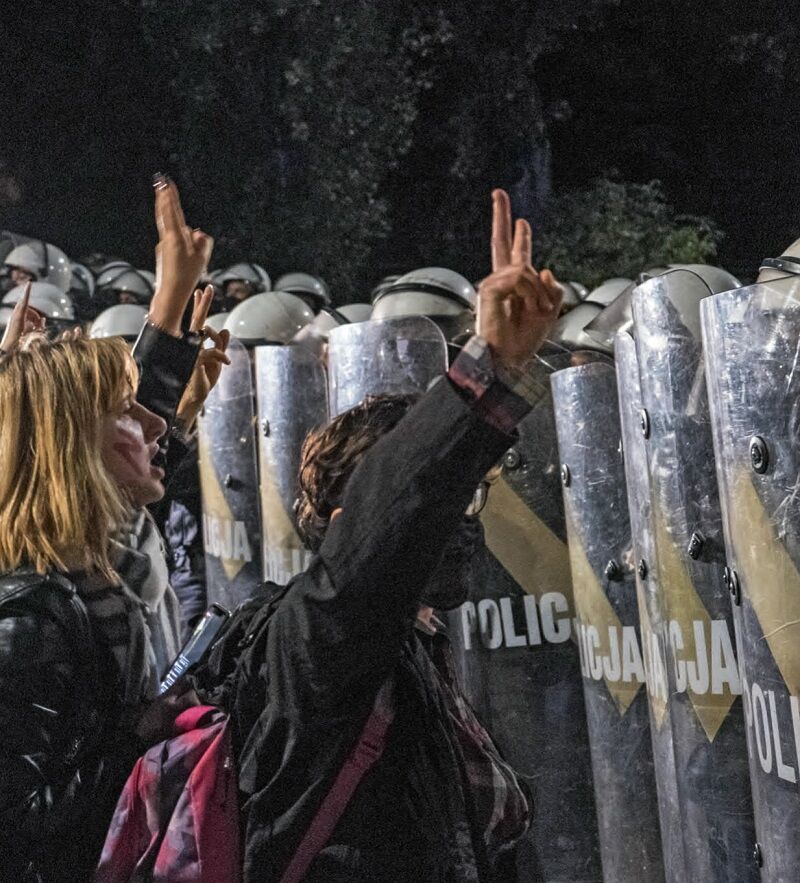
The belief that the economy and the red-hot conflict in our society are not related is completely wrong. Conflicts have infected all areas of our lives. However, there are no signals from the political scene that politicians are noticing this fact. I do not know of any of their statements, regardless of the political stripe, in which conflicts are directly linked to the destruction of the economy.
However, citizens understand this very well. The Research Institute for Economic Development of the Warsaw School of Economics, in its cyclical survey of the sentiments of households, conducted jointly with the Association of Financial Companies (ZPF), recently asked respondents exactly about this relationship. The latest results are devastating. However, they do not yet take into account the protests following Poland’s top court’s (Constitutional Tribunal) ruling on eugenic abortion. Almost 90 percent of our society believes that widespread political conflict has a negative impact on social confidence and thus is a barrier to Poland’s economic development and a barrier to catching up with the richest and most modern economies in Europe and in the world.
This opinion is shared by all social groups, from left to right. The greatest concerns about the impact of political conflict on the economy were recorded in Podlaskie province (94 percent). Fears were also higher than the average in Małopolskie, as well as in Łódzkie and Zachodniopomorskie (all 91 percent). But generally, all over Poland, the public sees the problem that strong conflict is a barrier to economic development.
SOCIAL CAPITAL – TO BE OR NOT TO BE OF THE ECONOMY
The rulers are worried about investments. They want to implement ambitious programs stimulating the expansion of production assets and infrastructure. They talk about increasing the efficiency of production factors and employee qualifications. So, they throw on the agenda the so-called fixed capital and human capital.
But they completely forgot about one more important production factor determining the development of our economy, i.e., social capital. This concept is well known in economics. It refers to social relations and the mutual trust of economic agents. This trust is essential to developing the market exchange and achieving the benefits from it. Both from an economic and social point of view.
Let us take an example that will explain what we are talking about. Many volleyball teams reach the so-called world level in the game. They are characterized by a high and similar level of physicality, efficiency, technicality and equipment. However, to achieve the highest goals, to be at the forefront, team-work is necessary – the teamwork of all players, regardless of what club they come from, trust and understanding and common goals –which in the economy we call social capital.
Economic research clearly shows that countries with a high level of social capital (trust) have managed to overcome the middle-income trap, record-high economic growth and are technologically advanced. To reach the level of the most-developed innovative economies require acceleration of the accumulated social capital in Poland.
Since the beginning of the economic transformation in Poland, the level of social capital has been very low. This has been shown by numerous studies. And for several years we have been reducing it additionally. Social dialogue and public debate are being destroyed. Socio-political conflicts are constantly heated and they depreciate this capital even more.
AN ECONOMIC ROAD TO NOWHERE
The Polish economy faces huge challenges. Over the coming decades, demographic changes will negatively affect economic potential. The aging process of Polish society is one of the fastest in Europe. It is a demographic crisis or even catastrophic. The working-age population will decrease by about 10 million people in several decades. Negative trends will be hard to stop. The European Commission forecasts that by 2070 the real GDP growth rate of Poland may drop even below 1 percent. The Polish finance ministry is optimistic that this rate will amount to 1.7 percent in the long-term (against 4-5 percent in recent years). According to these forecasts, Polish GDP per capita by 2070 will not exceed the EU average (it will still be 10 percent below), and as compared to Germany’s GDP per capita, it will be lower by up to 20 percent.
If we cannot radically stop demographic trends, opportunities lie in increasing the economic activity of the population and a comprehensive migration policy. Meanwhile, in Poland, surprisingly, the retirement age has been lowered and there has been no migration policy for years. The last hope is, therefore, technological progress, the development of entrepreneurship and the absorption of innovation. However, as scientific research shows, in the conditions of undeveloped social capital, innovation grows less or is not widely implemented (in particular in SMEs).
Social capital is also a lifeline during sudden crises. Such as a pandemic. If Poland had high social capital and trust, we would have been able to prepare much better aid packages. In countries with high social capital, aid instruments came in quickly and smoothly. There is simply a great deal of trust between the company and administration and employees and administration. And this made operation in crisis conditions much easier.
In Poland, everything is given a political label. If someone disagrees with economic policy decisions, they are doing politics. If they disagree with epidemic management decisions, they are doing politics. Everything is subordinated to the media and PR narrative. Hence, all projects and activities are hidden until the very end, without the participation of external experts or social partners. We can only dream of transparency. Lack of trust makes decisions worse than optimal because they do not take into account the whole picture, all opinions.
WITHOUT SOCIAL CAPITAL, WE WILL NOT REDUCE THE TAX GAP
I do not know if the finance ministry is aware that the scale of fraud and tax avoidance (the so-called tax gap) is very low only in countries with high social capital. As the data for 2019 shows, in the case of reducing the VAT gap in Poland, we have already reached the wall. Unfortunately, the VAT gap increased from 9.9 percent to 10.2 percent, and in 2020 it may increase by a further 5 percentage points and will be above the European average. Economists agree on the causes. The lowest-growing fruit has already been harvested and “simple reserves” have been exhausted. We banished t she mafias from Poland and the biggest frauds were reduced. Now, the reduction of the VAT gap must apply to small transactions, the so-called shadow economy. And it is not that simple anymore, because it concerns many transactions, many small entities and individual taxpayers. It is impossible to eliminate the shadow economy by oppressive and police methods, and it generates huge costs, including political ones.
The only way is to raise civic awareness about the dangers of tax evasion, etc. This awareness is called “tax morality.” Research for Spain (Alm, Gomez [2008]) shows a strong, positive relationship between the level of social capital and “tax morality.” Numerous studies (including Torgler, Benno [2007], Torgler [2011], Alm [2012], Molero, Pujol [2012], Saad [2014]) show “tax morality” as an important factor determining the degree of tax compliance.
Today Poland needs social capital more than ever. It is an essential fuel to support the development of the economy and ensure the economic security of all citizens. Unfortunately, it cannot be bought. Nor can it be prescribed by law. It can only be collected in small chunks in the course of the government’s current relations with society, of the relations of particular social groups. We need to start aggregating it immediately. It is already late; Poland has suffered losses. We have wasted our time. However, we will waste more – all of Poland – if we do not rebuild social and civic ties, as well as mutual trust and trust in the state. The ultimate goal must be cooperation and transparency. It is impossible to build a modern, social and civic economy on conflict.

Sławomir Dudek, PhD
The chief economist of Employers of Poland (EoP). Established in 1989, EoP is the oldest and the largest organization of employers in Poland representing 19,000 companies and employing over five million people.


