



Teleworking – a temporary band-aid or a long-term cure?
12:00

When the news of the coronavirus first shook our reality, companies scrambled to protect their employees, as well as their business. Almost overnight, in sync with the government closing down schools, restaurants and banning all public gatherings to curtail the spread of the pandemic, many firms closed down their offices and switched to working from home.
Tech companies responded first by introducing new unlimited home office rules, which allowed entire families to self-quarantine. Others followed suit quickly realizing the gravity of the situation. Since then, Zoom, Skype and Microsoft Teams have become the new watercooler, where people meet, socialize, exchange gossip and the latest Covid-relates facts and figures.
Even though it has been technically possible to work remotely for decades now, telecommuting did not revolutionize work culture as quickly as many have expected. Granted, it’s been growing in popularity, but at an uneven pace. In the EU, the percentage of people who telecommute occasionally increased over the past decade – from 7.7 percent in 2008 to 9.6 percent in 2017 – according to Eurostat, the EU’s statistical office. The increase was slightly less pronounced for employees doing the majority of their work from home – from 4.7 percent in 2008 to 5.1 percent in 2018. Naturally, remote work is much more common for self-employed people (18.1 percent) than employees (2.8 percent).
Law, discipline and productivity
The reasons why telecommuting has enjoyed limited success among corporations are manifold. First, there’s the law. For instance, the Polish law allows for contract employees to telecommute, but the time of teleworking has to be specified in the contract. If an employee wants to work Fridays and Mondays from home, that’s perfectly fine, but they cannot simply switch to Tuesdays and Wednesdays without signing an annex to the agreement.
Still, most of the reasons why telecommuting didn’t take the world by storm after the internet became commonplace, or even when cloud computing allowed for practically all applications to be accessed remotely, had more to do with the corporate culture, though. There has always been a strong belief that face-to-face contact was conducive to exchanging ideas and increasing productivity that no amount of teleconferencing could provide. Being able to hold ad-hoc meetings, better knowledge dissemination, easier onboarding process – all of these are indubitable advantages of working within the confines of an office.
Also, many employees fear their staff will be less than diligent without supervision. You could argue that this problem was “solved” when companies started installing software that tracked and monitored employees’ activities activities. Yet, the practice of spying on your employees, even with their consent, is widely frowned upon. So is limiting their access to certain websites (e.g., Facebook) to prevent them from slacking. That leaves employers with one of two options: trust your employees or keep them within an earshot. Poles are not known to be the most trusting of nations, which may be one of the reasons why teleworking percentage is below the EU average in Poland (at 4.6 percent in 2018), and far below record-holders: the Netherlands (14 percent) and Finland (13.3 percent).
But the situation has now changed. More and more companies are embracing teleworking to protect their employees (and the continuity of their business) from the virus pandemic. After all, it would be considered irresponsible and insensitive to expect people to risk their and their families’ health.
Don’t overdo it
Most daily business can be done by email and phone, and an occasional teleconference. The goal of properly motivating employees to do their jobs can be achieved by setting targets and objectives and regular performance reviews. The old rule of “trust but verify” is the most common-sense approach when you cannot see your employees on a day-to-day basis.
Knowledge dissemination is a little more tricky. We often don’t realize how much we learn by simply watching other people do things. Creating manuals, regular teleconferencing and mentoring sessions can remedy that but they require more proactive involvement from managers. They can no longer rely on simply correcting mistakes and answering questions as they arise. They need to anticipate more and ask questions themselves. When your employees cannot observe their more experienced colleagues on a daily basis, you need to check if they are on the right track or if they need more input.
There’s always a risk of overdoing it, technologically at least: asking your employees to use several communicators, such as Slack or Skype, teleconferencing via Webex or Zoom, staying in touch on your mobile devices through WhatsApp or Telegram. All of these tools (and many others) can be useful. But when you introduce too many, the effect can be that your employees become annoyed. Moderation is also important when scheduling meetings. Daily updates make sense when you work closely in a team, but for people with individual projects, weekly meetups make more sense.
Greener and happier future?
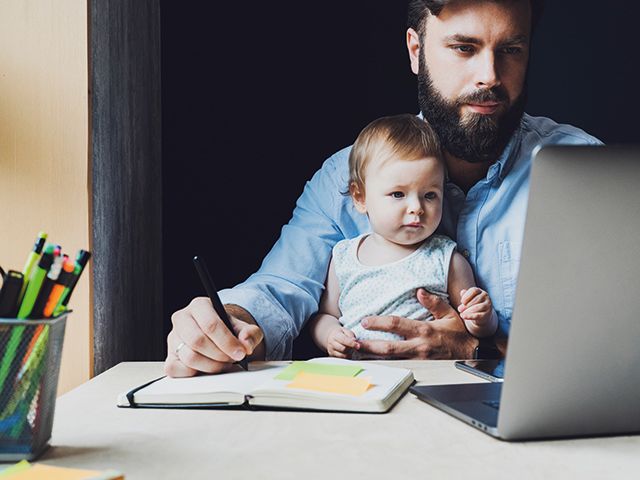
Like with every new concept, people learn best how to telecommute over time, slowly increasing the doses. But in the face of the epidemiological threat, companies have been forced into a “sink or swim” test. Most are doing just fine. The only question is: what will happen next? Once there is no more cause for concern (be it a month, a year or more from now), will companies go back to business as usual? Or perhaps, having tested the new work routine, they might be more open to it in the future. The benefits of teleworking, like less rush-hour traffic, better work-life balance and greater job satisfaction, are on the table. The overall impact on employee productivity has yet to be measured, but it’s been long established that happier employees work better.
And even amidst the economic recession the pandemic has flung the world into, there are reasons to be happy. We have found ourselves with a lot more spare time on our hands than we were accustomed to. Online entertainment has flourished over the past weeks. Social media is churning out content on new, creative ways of spending our free time. Ads abound on courses that can teach you useful, new skills, while you’re waiting for the social distancing to be over.
And on top of that, we have witnessed something that until recently seemed an impossibility. The total greenhouse gas emissions are expected to fall by 6 percent this year due to Covid-19, according to the World Meteorological Organization (WMO), the biggest drop since WWII. Unfortunately, historical data shows that emissions always picked up after each crisis even stronger than beforehand and there is no reason to expect the pandemic to be any different in that regard. But maybe, just a few percentage points more people and companies would commit to teleworking. It may not make much difference to global warming, but it would be a start.
It’s too early to say whether the newfound enthusiasm for telecommuting is going to continue after the current threat subsides, but if it does, we may be looking at the beginnings of a shift toward a more family-friendly and environmentally-conscious work culture.


