Uncertainty reshaping the office market
16:22
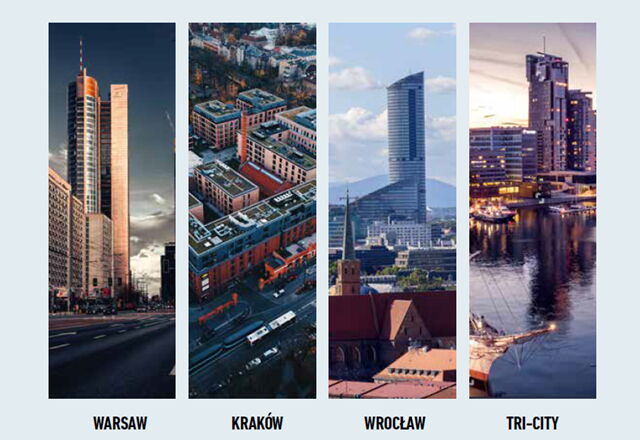
After years of ups and downs, the office market seems to have regained at least some sense of equilibrium. High construction costs are still keeping many developers on the fence about starting new schemes.
Supply gap ahead
The slowdown in developer activity, initially observed in Warsaw specifically, has now spread to regional cities, too. Developers remain cautious with new projects amidst the steep costs of capital, building materials, and the workforce. Many projects are contingent on securing an anchor tenant, which, considering the changes in the office take up in recent years, is challenging as well.
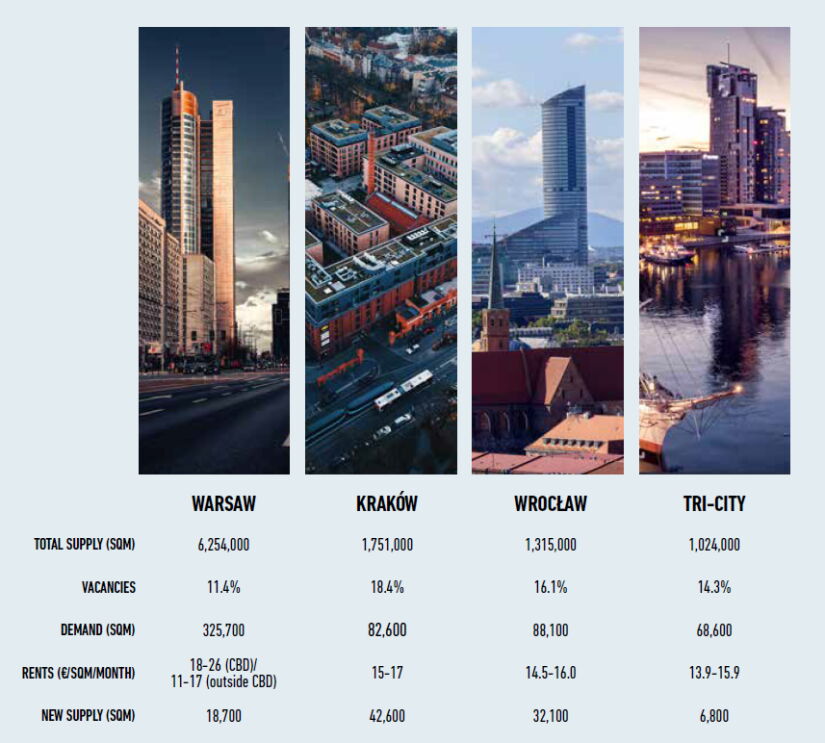
It shouldn’t come as a surprise then that the current office space pipeline of 700,000 sqm across Poland is but a fraction of pre-pandemic levels, according to JLL. In 2018, Warsaw alone was responsible for a similar volume, while over 1 million sqm of space was under construction in regional cities. As a result of the low developer activity, a supply gap is expected in 2024 in the cities outside Warsaw.
Hybrid work impact
Even though the market has stabilized after the pandemic, with over 330,000 sqm leased in regional cities in the first half of the year, renegotiations account for a third of the leased space, and pre-lease deals are few and far between.
Warsaw seems to have rebounded from the pandemic quickly, with 2022 seeing a strong growth in demand, to reach 860,100 sqm, which was second only to 2019 figures of 878,800 sqm, according to Savills. But that may have been just a gulp of air after tenants held their breath for too long. In the first six months of 2023, only 325,700 sqm was leased in Warsaw, marking a 32% decrease y/y.
Companies have gotten used to optimizing workstations, and combined with Work From Home policies and hybrid work models, demand has decreased.
“Something that was a kind of benefit for employees before the pandemic, e.g., one day a week, is now the norm and even a requirement for employees from their employer (also during recruitment). A significant percentage of companies operating in Warsaw conduct their business in a hybrid model, most often 3+2 (three days in the office, two at home), but the proportions may be even higher,” said Daniel Czarnecki, head of office agency, Landlord Representation at Savills.
Chasing quality
With developers and tenants cautious, it may come as a surprise that leases that are being signed are getting significantly longer. Landlords are now pushing for seven-year deals instead of the five-year contracts that used to be standard in the market. Even ten-year contracts started to appear on the market. The reason for the longer leases is high inflation, which until September has remained in the double digits (core inflation at 10.0% in August, according to the national statistics office, GUS). “Higher inflation translates into higher fitout costs. In recent years, tenants have been used to receiving a finished office to a high standard. At current costs, 5-year contracts, which were the norm in the market some time ago, make it difficult for landlords to pin down their budgets and reduce the profitability of the investment,” Czarnecki from Savills explained.
Since they are forced to sign longer leases, tenants are, in turn, choosing higher-quality buildings. In the first six months of the year, over half (54%) of take up was leased in office schemes no more than five years old (or still under construction), according to JLL.
Flex offices on the rise
There is a flip side. Tenants not willing to commit to a seven-year contract may, in turn, opt for an entirely flexible office. According to Savills, Warsaw currently has one of the highest shares of take-up in flexible offices (4%). Only London (13%), Prague (8%), Amsterdam (6%), and Madrid (5%) ranked higher in Europe.
“Across Warsaw, employers are looking for top locations and best-in-class space to attract talents and enhance office time. Newcomers are especially willing to bring people to the office and build the right culture.
Amenities are also key in driving this trend,” Thomas Jodar, Associate Director, Workthere Lead Poland, commented. Flexible offices in co-working spaces and serviced offices now have some of the highest occupancy rates.
According to Joanna Bartoszewicz, senior advisor and tenant representation at Newmark Polska, most co-working and serviced offices can boast even 90% take-up. “Even before launch, most flexible space is 70-80% leased. Even investment funds and developers seem to appreciate this trend and offer completely fitted-out offices for six, nine, or 12 months,” Joanna Bartoszewicz said.