



WARSAW: The City of Today & Tomorrow
15:05
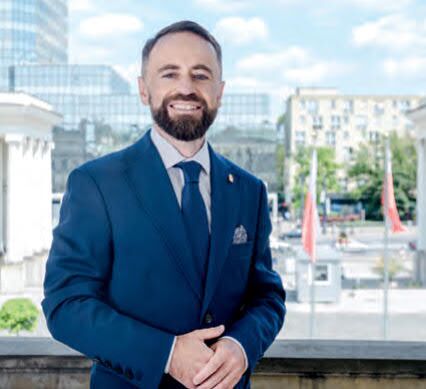
WBJ: How did the pandemic impact City Hall’s plans for Warsaw, and how did you evolve and adapt them?
Michał Olszewski: At the beginning, we all feared not only for the future of our city, but also for the whole country; that said, we were also well aware that the pandemic would eventually end. Once we knew what we were dealing with and how to counter it, we used the ‘pause’ to improve on our original plans and deduce what we really wanted to accomplish once the situation was under control.
The lockdown periods were a tremendously creative time for the city, and although people could not really see that looking from the outside, behind the scenes we kept our focus on planning ahead. I think primarily everyone learned how to organize their time better.
The Mayor has gone on record to say he wants to transform Warsaw into “a city in which people enjoy living in and want to live in”. How has he sought to achieve this?
Quality of life – both on a neighborhood scale and a wider city scale – is the key to this. In both cases, it depends on easy access to good public spaces and greenery, to the workplace and to public services.
What’s happened around the riverfront is a great example of these changes – today, Varsovians vote with their feet and we can see them on both the boulevards on the left side as well as the ‘wild side’ on the right bank. Encouraging residents to spend time by the river was a complicated and multi-faceted process, one that was closely related to changes in road infrastructure, the implementation of public space projects, the creation of the boulevards, as well as paths, playgrounds and recreational places along with the necessary infrastructure. Moreover, we took care of both safety and environmental concerns and also cooperated with entrepreneurs and nearby cultural institutions.
Doing so, we created a brand: the Vistula District. We showed it was a place worth visiting. I think, all things considered, this is a great example of the changes we have undertaken.
Our long-term plan though is tied up in our ‘new study’ of Warsaw which consists of a new spatial constitution that will look to create a locally focused, healthy and dynamic city. Step-by-step, we’re seeking to improve ‘satisfaction with life’. We know from our research and focus groups exactly what residents value, and which areas we need to concentrate more on to accomplish our targets.
Much importance has been placed on the Nowe Centrum project – does this stand to be the defining achievement of the current leadership?
Our analysis demonstrates that fewer and fewer young people are choosing to live in the center which has created a ‘donut effect’ – that’s far from ideal as the center has numerous public services such as schools, parks and lots of places for work and recreation. With that in mind, we don’t want it to be just a ‘salon’ but rather a place in which people want to live and spend time on a daily basis.
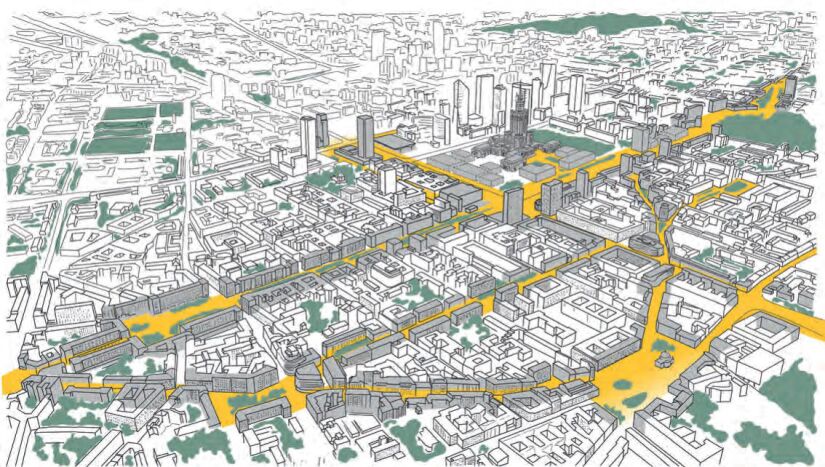
To make it so, we need to deal with previously identified problems – for instance, people feel uncomfortable walking around it. As it stands, our research shows that people consider it an archipelago of islands that are poorly connected to each other and lacking basics such as pedestrian crossings to link them up. The bicycle infrastructure is also poor. Finally, these islands are blisteringly hot in the summer, smoggy in the winter and noisy and thick with traffic all year round.
If we want the center to be livable, we simply have to implement a number of changes as part of the creation of a New Center for the city. This is not a revolution we’re talking about, but an evolution. The direction that these changes will take has already been outlined in StrategiaWarszawa2030, which was made in close consultation with residents.
What we already know is that more greenery will mean better air quality, more shade and cooler air. Calming the traffic, meanwhile, will encourage more pedestrians and cyclists who will naturally be drawn to spending more time in this quieter, greener environment.
Further, by encouraging people to walk around the city center, local business is expected to flourish. We need to remember that people are drawn to places that do not have heavy traffic – this isn’t just Warsaw we’re talking about, but the world over. When you’re in a car or stuck in a traffic jam you’re not going to get out to visit a store or grab a coffee.
The New Center of Warsaw project will realize the goals already being reached by other European cities and will promote its heart.
Also, there is no turning away from sustainable mobility solutions that focus on public transport and cycling. These don’t just improve quality of life but also prevent its degradation. With this in mind, the New Center of Warsaw will see a series of investments that follow a coherent vision – this will be the legacy of Rafał Trzaskowski's tenure.
The protection and conservation of historic landmarks such as, for example, Hala Gwardii, has become a big issue. What is the city’s vision for such places?
Obviously, Warsaw lost many of its valuable historic buildings during WWII so today we’re taking care of the elements that survived both this era and what followed. Of course, we also bear in mind how to breathe new life into these objects and can give a list of examples. For instance, Hala Koszyki – which is very similar to Hala Gwardii – is now recognized throughout Poland after undergoing a comprehensive renovation and gaining new functions. Now, every city in the country wants “their own Koszyki”.
Another place worth mentioning on account of its incredible transformation is the Powiśle power plant which has been reborn as Elektrownia Powiśle. People are eager to visit. Yes, it’s undergone a complete metamorphosis, but that’s exactly the point. With the Architectural Award of the President of the Capital City of Warsaw, we have a special category dedicated to investments that give buildings a new life, and each year we’ve noticed the competition growing even further. In the last edition, the winner was a music school in Mokotów where the historic interiors of a former orphanage were transformed into a beautiful concert hall.
You hear it said often by long-term residents – Warsaw has flipped from being a place that outsiders hated to being a place that they cherish. But what needs to happen to push Warsaw that extra bit forward so that it becomes a truly ‘world-class’ city?
That’s already happening. Todays’ Warsaw is successfully competing against other European capitals in terms of attractiveness. Tourists are visiting and are delighted with what they can see and how they can spend their time in Warsaw. An important element of that has been the way people perceive the true wealth and heritage of Warsaw’s districts. Nowadays, people are proud to say they’re from Żoliborz; residents of Praga have always been proud of being unique, but more so now than ever before; even younger districts like Ursynów are creating their own narrative.
We’ve observed districts blooming for over a decade and it’s become an important element when it comes to the development of Warsaw’s overall appeal. When David Bowie visited in the 1970s, his impressions were bleak and gloomy and manifested themselves in the song that he subsequently wrote about the city. A lot has changed since then – I’m sure if it were written now, the track would be entirely different.
When streets, areas or landmarks are restored or developed, gentrification quickly follows. Is this a bad thing? How can the city keep ALL people involved in the city’s development? In essence, how do you balance creativity with overt commercialization?
Gentrification is sometimes used as a patch – people apply it to any changes they want to criticize. Through this, it becomes a distortion and manipulation. We must remember that any change in the city will cause gentrification. The city can only control it, and that’s exactly what we do. We try to support the creativity of entrepreneurs and run programs in which they willingly participate. Their products are often export goods which we, in turn, promote at international fairs.
It appears that the biggest blow for Polish cities was the creation of shopping centers within downtown areas. Unfortunately, Warsaw did not escape this process today though, we’re thinking differently and supporting local business. As mentioned previously, by making streets more walkable and improving their infrastructure, people naturally are more inclined to explore, walk with greater frequency and – as a result – spend their money in the places that they pass.
The stock of city-owned flats is also key as these are an important tool when it comes to retaining residents in places that are undergoing transformation. The city has engaged a lot of resources in this, especially in Praga (but not only there). Currently, we have a competition for a multifunctional compound with communal flats in the Włochy district in the area of 1-go Sierpnia.
Public space is another burning issue and many people have voiced discontent at the number of car parks in squares such as Bankowy, Defilad and Teatralny. Changes are afoot, but what else needs to change?
The reconstruction of Pl. Defilad or Pl. Piec Rogow has shown the direction in which public space should change. Squares in the city, especially in its center, cannot be used only as parking lots and road junctions. Unfortunately, many squares are still dominated by cars. We want to change this gradually. Plac Powstańców Warszawy a few years ago ceased to be a car park, and an underground garage will soon be built under it. There will, therefore, be room for high-quality public space on the surface. New underground parking spaces will also allow to "ease" the surrounding streets and move some parking underground.
Other squares awaiting change include Pl. Bankowy and Pl. Trzech Krzyży, and in the coming years they’ll become less concrete and gain more greenery. We are also working on changes on Pl. Małachowski and are involving the cultural institutions located around the square. For the second year in a row, during the summer holidays, we are allocating part of the road on Pl. Zbawiciela to enable it to hold gastronomic gardens.
However, it is equally important that the squares do not become islands but are connected by pedestrian-friendly streets. Therefore, the main streets that connect them –for instance, Marszałkowska, Al. Jerozolimskie and Krucza, will also see changes.
Finally, what is the Warsaw that you dream of – and how realistic is this dream?
I dream of a Warsaw in which people enjoy spending time both at home and outside – a city with a diverse culture that offers something for everyone. I dream of a technologically modern, friendly Warsaw that promotes an ecological lifestyle. I dream of a city that feels local and is filled with community-driven neighborhoods. A city in which everyone can feel that they carry influence on its development and that we – as responsible managers – are open to cooperation and support civic spontaneity. I think Warsaw is like that now – it is a city for everyone.


