Wine market / Demand for premium on the up
10:00

WBJ: Why do Polish consumers mostly prefer semi-sweet wine over dry?
Robert Ogór: In northern countries, historically consumption of semi-sweet and sweet wine has prevailed. Some 30 to 40 years ago in Scandinavia, Germany and the UK the share of sweet wine was very high. Poland is not an exception, but to some extent there is a delay in consumption development. The transition to dry wine, through which other countries have gone, is just beginning in Poland. Extremely low wine consumption should also be taken into account.
I expect that with consumption growth and premiumization – the two main factors defining market development – the share of dry wine will grow.
Poland has the lowest wine consumption in Europe. What is the reason behind that?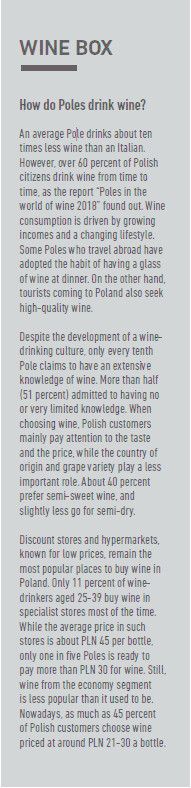
Before the political transformation [in 1989 – ed.] wine was barely available in Poland. Most other Eastern European countries produced their own wine, while Poland at that time did not. Furthermore, imported wine was very expensive. Poland started with very low wine consumption compensated by vodka and beer. An average Pole drinks about 100 liters of beer per year, and only about four liters of wine. Even with the wine market growing by 5-7 percent annually, Poland still has a lot of catching up to do to reach other EU countries.
What are the reasons behind the growing popularity of Prosecco and rosé wine?
Sparkling wine for a long time was associated only with New Year’s Eve celebrations. Prosecco has changed this perception and broken the stagnation on the market. Prosecco is the most spectacular global trend among sparkling wines. It is the world phenomenon impacting consumption in Germany, the UK, the US and Scandinavia.
Poles, just like other nationalities, are fascinated with the Italian lifestyle, of which Prosecco is a part. They discovered that light bubbly wine may serve as an aperitif or a summer drink. Thanks to this, rosé started gaining in popularity as well. In general, the rosé wine segment is growing fast, and not only in Poland. As with Prosecco, it is a global trend as consumers tend to switch to lighter drinks.
What is the role of women in shaping wine culture in Poland?
Wine is associated with a cultural lifestyle, with a better lifestyle. On the other hand, alcohol expenses are still dominated in Poland by men’s categories. Vodka and beer account for over 80 percent of spending on alcohol. Considering that there is more or less an equal number of men and women in Poland, women have a key role in wine consumption. With the growth of social status, women are in search of their preferred drink, and naturally they turn to wine.
What is special about the wine market in Poland?
There is a great variety in the countries of origin. At the end of 1990s, wine from New World countries started playing an important role. A significant market share now belongs to Chile, Argentina, Australia and the US. Additionally, wine from European countries – Portugal, Moldova, Greece and Georgia have seen some success. In Poland consumers have an unusually wide selection. Conversely, in countries that are wine producers, mainly domestic wines are available, and the share of imported products is very low.
How quickly is domestic wine production developing in Poland?
The total area of vineyards in Poland is about 1,000 hectares. This means a production of less than one million bottles per year. There is strong interest in Polish wine, but it is still a niche product. Domestic wine is expensive, but among them is some very good white wine. However, due to the small size of vineyards, Polish wine rarely appears in regular stores. Wine-makers usually sell directly to clients, tourists and some restaurants.