Reaching maturity
14:49
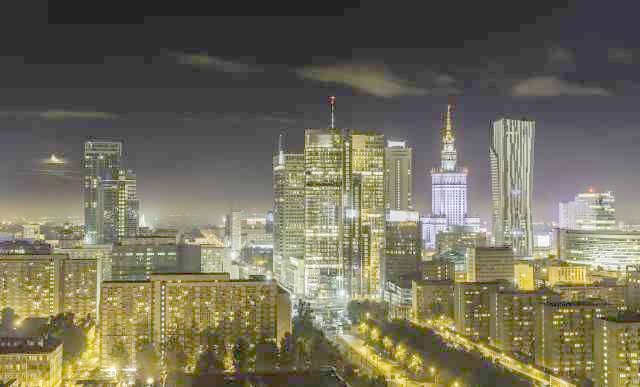
In 1989, Poland set off on a path of democracy and economic growth. What did the transformation mean for the real estate market? What was it like 25 years ago and where is it headed now?
by Beata Socha
Poland's modern history is divided into two eras: before and after the country's transformation to a modern democracy. On June 4, Poland celebrates the 25th anniversary of the first partially free elections that led to a period of growth and increasing prosperity. Few things portray the magnitude of change that followed the transformation better than the commercial real estate market, across all segments.
Looking for equilibrium
The office segment has thus far been the most volatile across all commercial real estate classes. In the late 1990s, Poland saw the highest GDP growth in its post-transformation history, of over 7 percent annually. With growth came a wave of international corporations opening branches in Poland, pushing rent levels in the precious few modern office schemes available at the time through the roof, up to $50-60 per sqm per month.
"The first offices that represented any reasonable quality, that is they had a minimum of air conditioning or more sophisticated ventilation systems, started to appear in 1993-1994 and were built by foreign developers," said Tomasz Trzółsło, managing director at JLL.
Like in any emerging market, it takes time to find equilibrium. After the spike in demand came a wave of supply, pushing vacancies up to 20 percent or more. The big boom for office space came in mid-2000, culminating in 2007. After a period of uncertainty and belt-tightening, developers seem to be back on track, albeit much more cautious than before the crisis.
Despite its ebbs and flows, the office market has developed quite remarkably over the past 25 years. Warsaw alone now has 4 million sqm of office stock, 60 percent of all the office space across the country. Kraków, the second largest city, has another 600,000 sqm and Wrocław - 500,000 sqm.
The rate of development remains strong, with 700,000 sqm under construction in Poland's capital and a total of 350,000 sqm across regional cities.
From the ground up
Some 25 years ago, retail was almost entirely state-controlled, not to mention the perpetual shortages of everything, from soap to lollipops. Retail space as we understand it today was virtually non-existent. In the early 1990s, when restrictions on trade were abolished, retailers and importers mostly operated from the back of trucks or at bazaar stalls.
[negative]"I cannot recall any other market that started from scratch to become a regional leader and one of the most rapidly expanding markets in all of Europe in only two decades."[/negative]
Then came the first generation of shopping centers: an anchor supermarket chain plus a few stores. The first international chains in the country were E.Leclerc and Real – they launched their first supermarkets in Poland in 1995. Auchan came in 1996, Carrefour in 1997 and Tesco in 1998.
The second generation of shopping centers increased the space dedicated to the fashion segment and other services, while the third generation turned shopping malls into the entertainment destinations we know today.
Poles do love their shopping malls, which has taken a toll on high street retail in some of the major cities. In Łódź, Manufaktura practically wiped out ul. Piotrkowska as a retail destination, while in Warsaw ul. Nowy Świat, once destined to be the shining beacon for other high streets in Poland, has turned into a restaurant and bar hub after the Złote Tarasy mall opened right smack in the city center, not one kilometer away. But developers and investors are convinced high street retail will boom in Poland again.
"Each year we see about 30 new brands entering the Polish market, most of which decide to debut in Warsaw. Depending on the strategy of the brand, some locate their stores in shopping centers, while others decide to open them exclusively on high streets," said Beata Kokeli, senior director at CBRE's retail department.
Currently rent levels in Warsaw are similar on high streets and in prime shopping mall units, which go for up to €100 euro per sqm per month. This could work in favor of the high street as they are generally considered more prestigious.
Still, shopping malls remain the dominant retail format in the country. Out of the 550,000 sqm of retail space currently under construction, 87 percent is being delivered within shopping centers. Currently Poland has 11.6 million sqm of modern retail space. With major cities already mostly saturated, developers are now filling up all the niches in smaller cities and towns, mainly with smaller shopping centers and with retail parks.
"Poland's retail map is developing increasingly evenly, with locations that were previously less active expanding their offer," said Anna Wysocka, head of retail agency at JLL.
Building a hub
The story of the last quarter-century would not be complete without the warehouse and logistics market, which has probably seen the most spectacular growth over the past 25 years.
Similarly to the retail market, the logistics and warehouse segment also started from scratch. In the early 1990s, there were some concrete warehouses here and there, but nowhere near the standard that tenants needed. The scarcity of space was not the only impediment.
"When we started our logistic operations in Poland, we could't find employees with qualifications and had to train them on the job," said Dorota Raben, CEO of the Port of Gdańsk, at the European Economic Forum in May. "The situation has changed dramatically over a few years, mainly because of the openness of Poles and their hard work," she added.
[caption id="attachment_53563" align="alignright" width="300"] Image : Shutterstock [/caption]
According to Piotr Frąckowiak, head of the rail division of Baltic Container Terminal Gdynia, "If it weren't for the economic transformation, we might still be nothing more than a peripheral terminal."
"Today, the sea ports in the Tri-City area are the second largest re-loading hub in the Baltic Sea region. We have become the leading terminal in the group and it's time for us to teach others," he added.
Poland's location, which used to be the country's greatest weakness in the whirlwinds of the two world wars and the cold war, is now beginning to pay off. Poland has become the perfect outsourcing destination for warehouse and logistic operators. The country now has 8 million sqm of modern industrial and warehouse space, with nearly 650,000 sqm under development, according to CBRE. It's also the most promising real estate segment for investors, offering the highest yields (7.25 percent).
"Poland's warehouse and industrial investment volume is only second to Germany, the biggest economy in Europe," said Robert Dobrzycki, managing partner at Panattoni Europe. "The Polish logistics market offers investors a base supporting the development of other markets. This translates into a higher investment volume in the market, also fueled by the country's attractiveness as an outsourcing destination," he added.
Law and transparency
Many would agree that what has contributed most to the success of Poland's real estate market was the fact that it's relatively easy for investors to come in and do business here, something that can't be said for all former members of the Soviet bloc.
"Comparing it with other countries in the CEE region, such as Hungary, I believe that Poles created very favorable conditions for investment by reducing bureaucracy and legal obstacles. The new construction law, which guarantees the security of businesses and customers was also a very important factor," said Arie Koren, CEO of OKAM Capital, a residential developer active also in Israel, Cyprus and Hungary.
Rooting out bribery and excessive red tape took some work, but looking at where Poland is now, it seems to have been worth the effort.
"Of course, the years of shaping the market were not that easy. Everyone, from developers to consultants, general contractors and tenants made efforts to make it transparent, modern, more developed and ethical," said Paul Gheysens, founder of Ghelamco.
[caption id="attachment_53556" align="alignleft" width="150"] Image : Ghelamco[/caption]
Interview with Tomasz Trzósło, managing director Poland, head of capital markets Poland, JLL
This year JLL is celebrating its 20th anniversary in Poland. What was it like when you opened your office here?
We opened our first office in 1994. I've been here the longest from all my colleagues currently working for JLL, as I joined in 1997. Initially, our office started with a team of 10 employees. When I joined, there were a dozen or so people at JLL. Now we have 200 core employees, plus all the property managers and facility managers working within clients' properties across the country, bringing the total number of JLL employees in Poland up to around 450.
Our office opened when European companies started expanding into Central and Eastern European countries. Most of them first looked to Prague, some to Budapest, with Warsaw third on their target list. We opened our Prague and Budapest offices in 1992 with our Warsaw office following two years later. These international companies were looking for offices and much needed advisory services. Back then we mostly negotiated lease transactions.
Was there anything to choose from back then?
The offer was limited. Just like Regus works now, back then you could secure a small office in the Marriott hotel, and there was not much more to choose from. This was the natural first step for companies entering Poland - to open a small branch in a room or two, and the Marriott office space was their first choice.
The first real offices were created in tenement houses. The first offices that represented any reasonable quality, that is they had a minimum of air conditioning or more sophisticated ventilation systems, started to appear in 1993-1994 and were built by foreign developers.
One of the first ones was the Warsaw Corporate Center, built by the American investor Golub, and located opposite the Marriott building. The Marriott scheme was built by Austrian Strabag, in co-operation with Marriott itself and LOT Polish Airlines, on a LOT-owned plot. Norway House was delivered in 1997 and was built, as its name suggests, by a Norwegian developer. And then others followed.
Interestingly, we now see a significant group of Polish developers active in the market, but back then the market was predominantly comprised of international development companies. The first Polish developer to build a few commercial properties for third-party use was Platan Group, a company set up in the second half of the 1990s. And they got their know how from JLL (or Jones Lang Wootton at that time) by hiring a senior person from JLW - Karolina Kaim - to run their Polish operations.
What happened when the boom came?
So far we've only really had one boom, the one between 2004 and 2007. At the beginning of the boom, it might be good to mention that when we moved to our current offices in 2003, the vacancy rate stood at some 17 percent in Warsaw back then.
Although only a few buildings were being delivered then, leasing took a long time, and it was mainly because of the scale of the market. When Metropolitan (38,000 sqm of space) or Saski Crescent were delivered, they added a significant percentage of the entire modern office stock to the market. Today we have over 4 million sqm of office stock in Warsaw, so even a scheme like Warsaw Spire that will add 100,000 sqm is relatively just a drop in the ocean. The current market can absorb such a scheme. Only if there were 10 Warsaw Spires being developed at the same time, would it push the vacancy rate back up to or above what we had 10 years ago.
The above just shows that the Polish office market has changed completely over the past two decades.
Another thing that changed substantially were the rents. In the 1990s, the office market was in its infancy, and as with every emerging market the rental rates were extremely high at the beginning. In the Marriott building, they were at some $50-60 per sqm. And the dollar was much stronger back then. Well, these were great times for those few owners of office properties in Warsaw.