WBJ: How has the logistics industry developed in Poland these last few years and what has been Raben’s role in this?
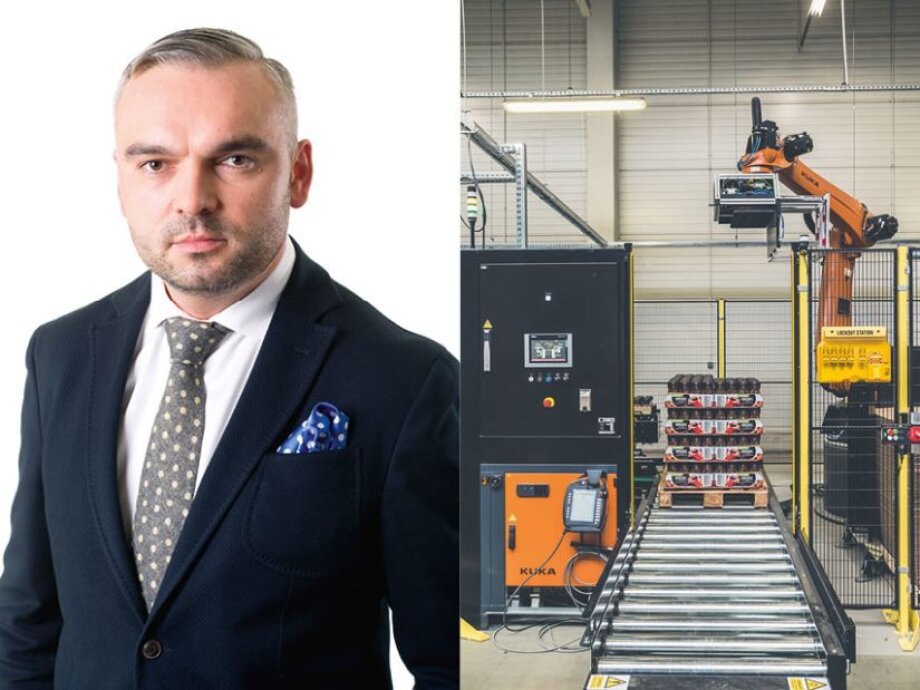
Artur Spała: Raben Group has been present in Poland for almost 30 years and during that time every segment of our business has developed dynamically. Due to its geographical location, Poland has proved to be the ideal place for European logistics centers and the TSL [transport, forwarding and logistics] market has constantly grown. Taken as a whole, the industry has great development opportunities based on modern IT solutions, terminal infrastructure development, as well as mechanization and automation. Despite the long period of returns on investment in automation, we can note that higher class storage facilities with a narrowed storage structure, roll conveyors, automatic foil lines and autonomous trolleys, are being created increasingly often.
Only a few years ago, the transport and logistics sector could only dream of such solutions because, with contracts lasting 3-5 years, advanced automation was not economically viable. The industry also faces challenges related to unfavorable regulations regarding international transport and we’ve also been affected by changes to the labor market, where it is increasingly difficult to recruit qualified employees. For example, drivers are now in short supply. Considering all these factors, reliable cooperation in supply chain management is needed between manufacturers, logistics operators and customers in order to change and improve processes together. Only in this way can we develop and educate the logistics market and that is how we are trying to act.
What are the principal drivers of the logistics sector and how have they impacted Raben’s activities?
The development of the logistics market is determined primarily by the needs of its customers. These needs are increasingly associated not so much with a given process but rather with issues related to environmental protection or the safety of goods entrusted to the operator. The ever-expanding e-commerce sector is also important, as it’s created a demand for a very effective supply chain – it needs to be fast, relatively cheap, safe and preferably environmentally friendly. On top of that, the process needs to be organized perfectly with reduced waiting times for loading and unloading, and shortened empty runs.
On the subject of e-commerce, how has the industry adapted its rapid growth?
The growth of this segment has required some change in attitude and increased flexibility. You need to be thinking about later hours to prepare individual outgoing orders, two-shift work patterns on Saturdays, round-the-clock courier vehicles, etc. E-commerce has created and consolidated changes in the approach to and the implementation of logistics processes. The rise of online shopping has also meant that the operator needs to work faster from an organizational perspective, and that’s created changes with regards to the optimization of processes and costs.
WBJ: What challenges has that created for those providing logistics services?
We’ve been required to define the profile of the clients that we serve, and the most important criterion here has been the pickup market. For instance, where this is concerned, the operator needs to personalize shipments for each country or handle returns in accordance with the legal requirements of a given nation. The common challenges, however, remain unchanged and are rooted in the quality and punctuality of shipment preparation as well as the ability to expand the scope of warehouse operations depending on seasonal or promotional campaigns.
WBJ: In terms of Poland’s logistics sector, which factors have you seen grow in importance?
The growing requirements on the partof customers, together with the lack of staff, including warehouse workers and drivers, have meant that the introduction of modern solutions has been forced through the market. In the face of these challenges, logistics companies must focus on innovation and flexibility, on more than one level. At Raben, we are also aware of the importance of “last mile” transparency from the customer's point of view. It’s important that information about the final delivery is provided to those that are interested in such as soon as possible. In respect to this, and to meet market expectations, we have created the myRaben.com platform in 2015, where our customers can find all information about their shipments, including delivery information, access to documents and invoices, comprehensive reports with graphic presentations and direct contact to their account manager.
What challenges is the logistics industry facing?
The challenges are many and the largest of these remains the rising labor market costs as well as the burdens resulting from anticipated new regulations. These changes apply to the entire market and span all industries which is why close cooperation and understanding across the entire supply chain are so important for the joint improvement of logistics processes. Logistics has to change, improve and take a new approach to business, and this has to be done through innovation, automation, advanced forms of data exchange and pro-ecological activities. Only financially stable companies with modern development potential and strong IT and research teams will meet this goal. Companies like Raben.
What kind of innovations are being introduced to the sector?
For several years we’ve been focusing on the automation and robotization of processes and services on various levels: physical processes, IT processes, as well as the robotization of office processes (RPA). Supply chain information management is another area we’ve looked at and we’ve strived to completely eliminate the circulation of paper documents both internally, as well where clients and other entities are concerned. Another area we’ve looked at is our approach to analytics where we now use big data systems.
In terms of immediate outlook, how is the new decade shaping up?
Recently, several trends have intensified, the accumulation of which has played a significant impact on the operation of the TSL industry. The logistics operator is expected to provide more, more often, more accurately, error-free and without damage. Distributors expect, above all, a quick response to changes in demand, ie ensuring greater availability of goods in the store. Deliveries for specific hours are also increasingly required, which are undoubtedly a big challenge for a groupage system offered by logistics operators.
In addition, among the key factors affecting the logistics sector, we can mention, above all, the increase in labor costs as well as the low level of unemployment – this has caused a shortage of drivers and warehouse workers, among others, rising energy costs, limited availability of means of transport in relation to demand andchanging expectations of employees, well as new legal regulations. And let’s not forget about the very important issue represented by environmental protection and the expected minimization of our carbon footprint.
Certainly, even greater automation of operations awaits us. On the one hand, to limited resources, and on the other, it facilitates the daily work of warehouse employees and drivers. In addition, over the next few years, where road transport and distribution are concerned, we will witness a virtually complete liquidation of paper documents. All of the above may be accompanied by the expected slowdown of the European economy and the need to respond quickly to economic fluctuations. Together, these will force the introduction of modern solutions that will not only answer the challenges that face our industry but also help achieve environmental goals, eg in reducing CO2 emissions.