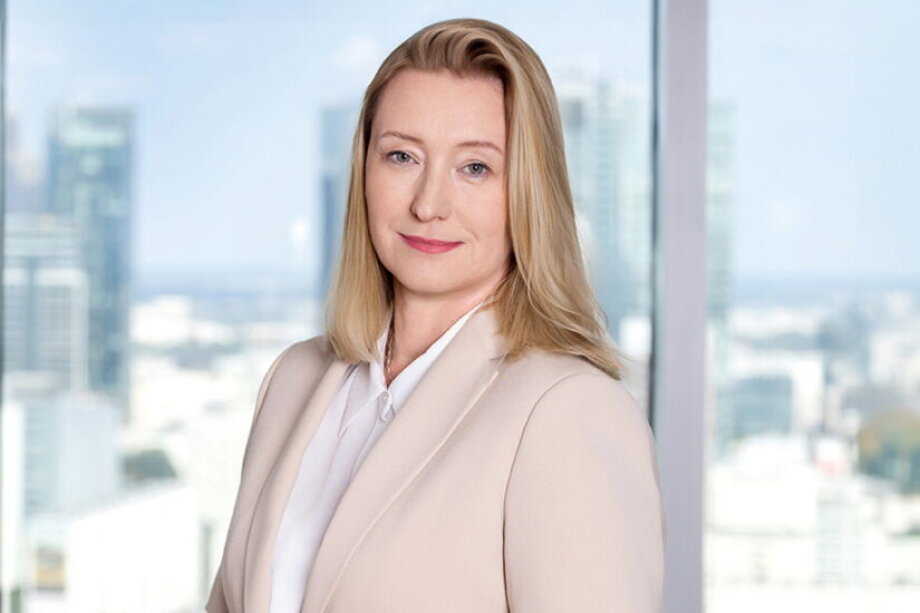
Joanna Erdman: My career started in my first year of university with a role in a bank’s administrative office, which gave me broad exposure to how the institution worked.
The first turning point came when I moved into payment cards and cheques, then a new area. Cards were rarely used in Poland, mostly by business customers and even ATMs were scarce. That was when I saw that banking could go beyond deposits and loans.
A defining moment followed in 1996, during a short visit to the United States. I saw banks already using the internet and operating on a completely different technological level. It showed me where Polish banking could go.
The next breakthrough was joining BRE Bank’s retail project in 1999, which laid the foundation for mBank, launched in 2000. It was a virtual bank with a simple product set and a new approach to offering transparency and customer service. It challenged the market and accelerated change in retail banking. I continued to develop my career at mBank, working through the rise of online and mobile banking, payment innovations and foreign expansion.
The third key moment was the creation of the Cashless Poland Foundation, bringing together banks, payment organizations, and the public sector. I joined first as a bank representative on the Supervisory Board, then as CEO, moving from a large corporation to a small organization where I can have a real impact on payment market development.
As you said, Poland was only developing a modern banking system in the 1990s, and now its payment systems are among the most advanced. How do you see the future of cashless payments?
Poland’s acceleration began around 2000, with the rise of new-generation banks and the spread of the internet, followed by mobile technologies and broadband. The next major driver will be artificial intelligence, enabling greater personalization and new service models.
We are already seeing the emergence of agentic commerce, where AI agents can make purchases based on user-defined parameters. At the same time, payments are increasingly happening in the background through connected devices such as cars, wearables, and household appliances.
Since the payment business is also impacted by cybercrime, education remains essential. Poles are comfortable with cashless innovations, which in 2025 accounted for 71 percent of transactions at points of sale. Contactless dominates, and mobile payments continue to grow taking approximately 1/3 of the transactions. Still, users must understand safety practices, from protecting data to using secure connections.
Technology, including AI, will strengthen security and personalization, but the weakest link remains the human factor. Social engineering continues to be the most difficult threat to prevent.
What advice would you give to a young woman at the start of her career who wants to develop in finance and banking in a deliberate way?
I believe you can shape your path if you are aware of your values and goals. I did not plan a career in banking. I was interested in international relations, but I ultimately entered that world from the business side. It’s important to be open to new opportunities: what looks accidental often turns out to be part of a logical sequence leading in a direction you set earlier.
At the start of a career, it is worth asking what you want to do, even if the answer is not clear yet. Early choices are often driven by opportunity, but once you enter an organization, you begin to see what truly interests you. My first role was not ambitious, but it was important for the bank, and it gave me broad exposure to cooperation with many people and helped me understand both what attracted me and what did not. Openness to exploration, lifelong learning and change is essential.
After over 30 years, I still feel I am constantly learning. Today this is even more important, with rapid changes in technology and ways of working. Equally important is building experience beyond your formal role. Careers are shaped not only by applications, but by networks. Opportunities often come through relationships, so clarity about your priorities helps you recognize the right ones when they appear.
How important is mentoring?
Very important and helpful if we are ready to use it. Often our first mentors are our managers, whether they play that role consciously or not. I was lucky. My first managers supported my development and created space for both work and study.
Today, mentoring is much more established, with many excellent mentors available. If someone has access to a mentoring program, I strongly recommend it. You can learn from your own mistakes, but guidance from someone more experienced makes the journey faster and safer.
Mentoring also helps clarify what you are really aiming for. Sometimes a goal we think we have turns out not to be the real issue. The barrier may be fear or uncertainty. A good mentor can help uncover that.
What role does women’s solidarity play, particularly in finance?
Finance is a highly feminized sector. Women make up over 60 percent of banking employees in Poland, but their participation declines at higher levels. At the management board level, it is around 20 percent, with regulatory pressure to reach 30 percent in supervisory bodies.
For me, women’s solidarity is part of a broader concept of diversity. Leaders should actively support it. At first, we look for competencies, but I also focus on age and gender diversity in my team, because it brings a wider perspective, better decisions, stronger results, and a better workplace atmosphere.
There are also practical steps: programs that strengthen competencies, support advancement, and expand mentoring. I take part in such initiatives as a mentor. At the same time, diversity should be seen more broadly than gender alone, as it delivers the greatest value for the company overall.
ABOUT:
Joanna Erdman is the President of the Board of the Cashless Poland Foundation and a co-creator of the Cashless Poland Program. With over 25 years in the financial sector, she helped build mBank into a six-million-customer institution across Central Europe. A recognized leader in digital payments, she has driven innovations in open banking, digital identity, and cloud solutions. Named among Poland’s 50 most influential women, she has received the Nicolaus Copernicus Medal and other industry awards. She holds degrees from the University of Łódź, SGH, and an MBA from the University of Maryland.