By Beata Socha
For much of the past three decades, Poland had a clear economic formula. A strong industrial base, foreign investment, an expanding services sector and a large pool of relatively inexpensive skilled workers helped turn the country into one of Europe’s most successful convergence stories. That model worked extraordinarily well, but may now be approaching its limits.
After decades of remarkable economic growth, Poland can no longer compete primarily on the cost of labor. Its working-age population is shrinking, and wages have risen substantially. The next stage of growth will have to come from productivity, technology and moving Polish companies further up the value chain, particularly in the AI space.
An AI opportunity
According to a June 2026 World Bank Group report, artificial intelligence alone could increase the country’s real GDP by between 1.3 and 12.1 percent by 2035, with productivity gains beginning within as little as three years. Whether Poland lands near the bottom or the top of that range, however, will depend less on AI adoption than on its ability to innovate with it.
There is considerable room to grow. Only 8 percent of Polish companies currently use AI in at least one business process. “Poland has the potential to become a beneficiary of AI and use it as a source of productivity, better jobs and economic growth,” said Ary Naïm, World Bank Group Country Manager for Poland. The challenge, he argued, is “productive use” of the technology, supported by investment in everything from digital infrastructure and energy to skills and education.
Business services, one of the sectors that helped propel Poland’s economic rise, illustrates both sides of that transition. Routine tasks are among those most exposed to automation, but AI also gives companies the opportunity to move toward more complex, higher-value work. In that sense, the technology could help Poland accelerate a transition that was already becoming necessary.
From adoption to innovation
AI is only one part of a broader productivity equation. Poland has considerable technological and scientific capabilities, but translating them consistently into commercial innovation remains difficult.
Some of the structural weaknesses are familiar. Polish companies have historically invested less than their European peers in software, research, data and management improvements, while cooperation between science and business remains weak. Universities generate knowledge, startups develop technologies and established companies modernize their operations, but the connections between these parts of the system are still too often fragmented.
The financing bottleneck
One persistent obstacle is access to risk capital. Even at the height of the venture-capital boom in 2021, VC investment in Poland amounted to only around 0.05 percent of GDP, compared with an EU average of 0.19 percent. For companies whose products may take years to reach the market, conventional bank financing is often not an option.
Michał Masłowski, PhD in Economics and a representative of the Association of Individual Investors, sees Poland’s relatively shallow capital market as part of the problem. “If Poland is to produce modern technology companies on the scale of those emerging from Silicon Valley, we need a highly developed capital market. Only risk capital provided through equity markets can finance companies in technology, biomedical sciences and similar sectors at an early stage of development,” Masłowski says.
Banks generally prefer established businesses capable of demonstrating revenues or positive cash flow. Innovative companies may instead need investors prepared to finance a team, an idea and promising intellectual property several years before profitability. If Poland wants to produce more globally significant technology companies, it will need much more capital willing to accept that risk.
From follower to creator
The encouraging part is that Polish companies increasingly demonstrate what can happen when ideas, expertise and investment come together. Poland is no longer simply importing global business trends; in some sectors, it is very much at the forefront. And these innovations range from cutting-edge computing and high-tech logistics, all the way to retail and lifestyle.
The good news is that AI and quantum computing advancements are often giving startups the level playing field they need to launch their groundbreaking concepts in industries like energy, medicine and 3D printing.
Rzeszów-based Muotech, founded by astrophysicist Dr. Noemi Zabari, uses naturally occurring cosmic-ray particles called muons to scan large or dense structures without damaging them, with potential applications in infrastructure, mining, energy and security.
Medalion is developing AI that can operate locally inside hospitals rather than sending sensitive medical information to external cloud infrastructure, alongside tools for medical speech recognition, document analysis and anonymization.
Photo4Chem, a scientific spin-off led by Prof. Joanna Ortyl, is commercializing photochemistry and photopolymerization technologies, including bio-renewable photocurable materials for 3D printing.
Uhura Bionics is developing next-generation electronic larynges combining hardware, real-time voice conversion and speech technology to give people who have lost their natural voice more expressive and personalized speech.
Innovation is not always only technological
Robotic advancements are visible in daily life already. Social media is rife with videos of Poland’s innovative retail concepts, such as the fully automated Żabka Nano, complete with a robot hot dog maker. The 2026 edition of Ebeltoft Group’s Global Retail Innovations report included three Polish concepts among notable innovations from around the world: Rebread, outdoor retailer 8a.pl and online supermarket Frisco.pl.
The same transition is visible across a surprisingly wide range of sectors. Raben Group is digitizing contract packing operations across seven Polish sites using Nulogy Shop Floor, creating a common platform intended to standardize processes, improve data consistency and speed up decisions.
“Innovation is no longer measured only by the scale of automation or the novelty of technology. It is measured by how effectively it helps businesses operate faster, smarter, and closer to their customers,” says Marek Styszyński, Value-Added Services Director at Raben Logistics Polska.
Innovation is also changing highly established industries. Sometimes it’s more conceptual than technological. Cavatina is developing high-end residential towers combining central locations and panoramic views with amenities such as spas, padel courts and private cinemas for buyers seeking something closer to a five-star hotel experience. “We design for people who no longer want to choose between where they live and how they live; for whom a home should offer time, quiet and room to breathe,” says Anna Łagowska-Cioch, Head of Residential Sales & Leasing at Cavatina Group and Vice-President of Resi Capital.
Turning potential into scale
These examples do not mean that Poland has solved its innovation problem. What they show is that the raw ingredients are already present: scientists capable of building deep technologies, entrepreneurs able to find international markets and established businesses willing to rethink how they operate.
The question is how frequently those ingredients come together. The World Bank’s AI scenarios make the stakes unusually clear. Technology could add as much as 12.1 percent to Poland’s economy by 2035, but that outcome is not a certainty. It requires companies to invest, managers to adopt new ways of working, workers to acquire new skills and institutions to create an environment in which innovative companies can grow.
Above all, growth requires capital. Poland’s previous economic model was powered by foreign investment, EU funding and an abundant workforce. The next will depend increasingly on whether capital can flow toward companies whose value lies not in inexpensive production but in ideas, intellectual property and technologies whose commercial payoff may still be years away.
Innovation is becoming easier to find. The harder task is ensuring that Poland can finance enough of it to turn promising exceptions into the foundations of its next growth model.
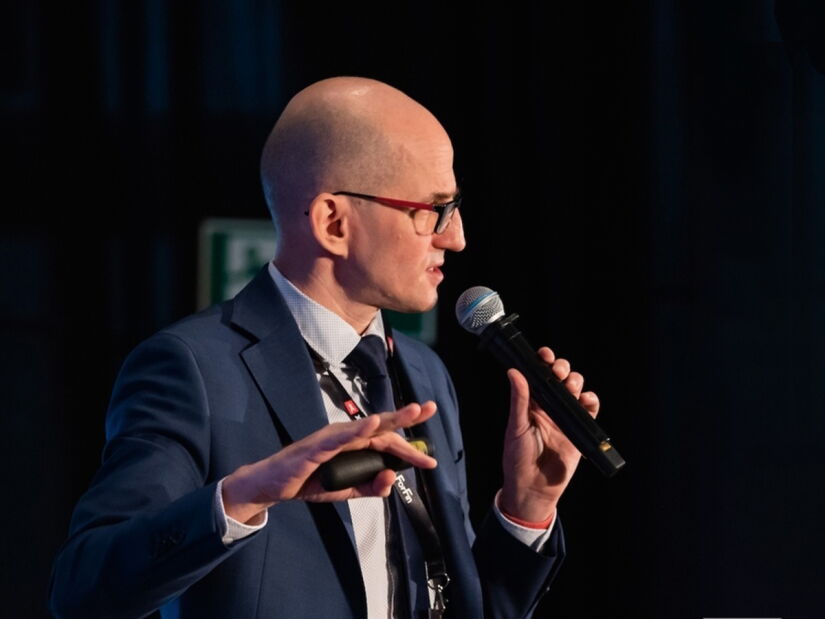
Poland needs risk capital
Poland has moved beyond its low-cost manufacturing model, but innovative companies still face one major constraint: access to capital. Dr. Michał Masłowski talks about why risk capital is essential to future growth
Interview by Beata Socha
WBJ: What does The Polish Association of Individual Investors (SII) do? How do you support innovation and the companies creating it?
Dr. Michał Masłowski: The Association of Individual Investors supports Polish retail stock-market investors. That is one of SII’s main objectives. We believe that a strong position for Polish investors ultimately strengthens everything else: the capital market and, consequently, the Polish economy.
But at the heart of SII’s activities is the well-being of individual Poles, who should have far more savings invested in capital markets and should feel secure when participating in them.
Poland was once seen primarily as a manufacturing and outsourcing base for Western European companies. How much has that model changed?
There has definitely been a visible shift. Over the past decade or so, Poland has stopped being primarily a provider of cheap labor. We are moving away from the traditional role of Europe’s “assembly plant” and a source of inexpensive accounting services.
Today, many of Poland’s leading companies operate in services and technology. It is worth looking at this from a stock-market perspective. Among the largest listed companies in Poland, we now have businesses valued at several billion PLN that are neither state-owned enterprises nor remnants of the privatization process.
These are companies that have grown considerably over the past decade or even several decades. They have entered the mWIG40 and WIG20 indices, they represent modern sectors of the economy, and they are becoming increasingly confident in expanding internationally.
What are the biggest obstacles preventing innovative Polish companies from growing? Is the main problem access to capital, talent, regulation, risk aversion, or something else?
We do not lack talent. Polish entrepreneurs can also cope with regulation. I would identify limited access to capital as the main obstacle, with the underlying cause being Poland’s relatively underdeveloped capital market.
I know that may sound strange after several years of a bull market, but when you look at the structure of Polish household savings and compare how much money Poles keep in the banking system or in cash with how much they invest in capital markets, there is still an enormous imbalance in favor of the banking system.
If Poland is to produce modern technology companies on the scale of those emerging from Silicon Valley, we need a highly developed capital market. Only risk capital provided through equity markets can finance companies in technology, biomedical sciences and similar sectors at an early stage of development.
Banks generally will not finance these businesses because they often require companies to have reached a much more advanced stage, frequently with positive cash flow already in place. In the capital market, by contrast, it is possible to find investors willing to provide funding when a company may still be little more than an idea and an ambitious presentation, with revenues potentially several years away.
That is one of the reasons Poland needs a strong capital market. If we want Polish technology giants, we need to take care of Poland’s capital market.