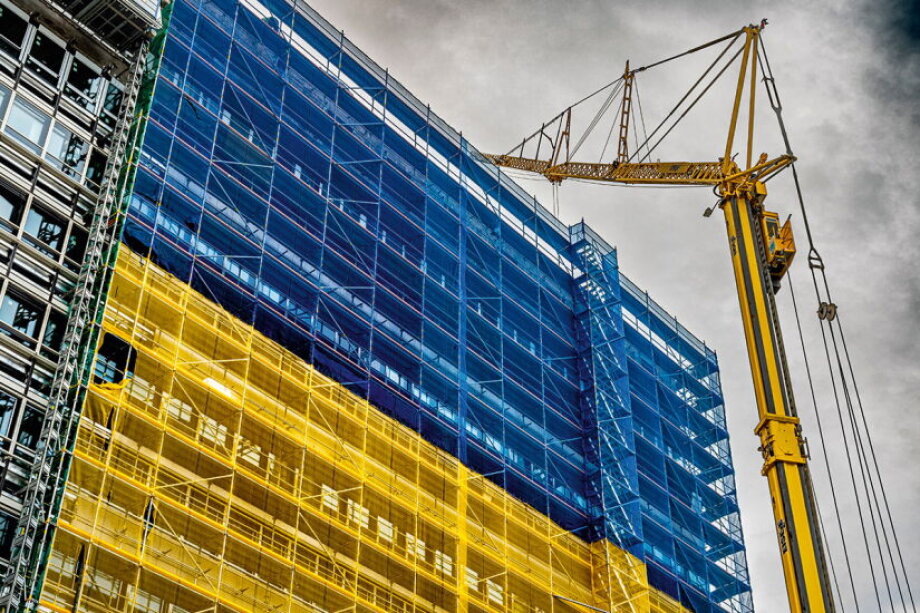
As of April 2026, we are now in the 1,500th day of Russia’s “special military operation” against Ukraine, a conflict that shows no signs of resolution. This relentless and devastating operation has resulted in an enormous financial burden, with BGK’s Rapid Needs and Recovery Assessment, 5th edition (RDNA5), estimating the cost at a staggering USD 588 billion. Rebuilding essential infrastructure and modernizing services – concepts designated as “building back better” by both the UN and the World Bank – will require over a decade of dedicated effort.
Once the bombs stop, efforts will have to focus not only on recovery but also on rebuilding the state. What will the state look like once the war is over? Will it include Crimea? Donbas? It’s all up in the air. What is more important, for the immediate future, is what rebuilding will look like and how Ukraine’s allies can avoid the challenges of past failed efforts.
Challenges
According to the BGK Monitor, electricity production in Ukraine is at approximately 35% of pre-war levels. Ongoing attacks disrupt power supplies and power plants make up a major part of Russia’s target list against Ukraine. Without power, citizens' lives are severely hampered, as is industrial output. GDP recovery is only possible with the ability to power factories and institutions. Without power, there is no reconstruction. There are also issues regarding Ukraine's nuclear assets. Chernobyl took a hit a few years ago but remains stable. However, the future of Chernobyl relies on funding for maintenance, monitoring and upkeep. Other nuclear assets are also in the hands of the Russians, and whether they will return them seems unlikely.
Labor
Once the bombs started flying, Ukrainians headed for the borders in droves. Approximately four million workers are needed post-war for the recovery. Around 3.1 million have emigrated from the country, permanently. There are 4.28 million Ukrainians living in the EU, who are essential for reconstruction efforts. Therefore, reconstruction depends on mass repatriation. This binding constraint will hinder recovery without an equal number of non-Ukrainian workers.
Poland’s intermediary financial role
As an authorized banking presence in Ukraine, BKG intends to serve as a capital gateway into Ukraine while also serving as an execution layer for EU funds. The EU guarantees €175 million for BGK to support lending for Ukrainian investment. According to BGK’s press release, its position in Ukraine guarantees reduced investment risk, thereby unlocking private-sector participation. Because it is risk, not capital, that is the real barrier in this war-torn region.
There are, however, legal challenges, as firms investing in Ukraine need, according to WNP, not only promised financing guarantees but also insurance and coordination. There is a gap between policy and execution, and the tools are more important than the regulation. What Polish firms need most is a risk-sharing mechanism and institutional coordination between Poland, Ukraine and EU actors that will make the successful execution of projects more of a sure thing. Tools matter more than regulation here.
Building capacity
The $160 billion package, spread over three years from 2026 to 2028, will have to be spent on Ukraine’s huge war expenses, its budget deficits, and its damaged economy, helping to offset a much lower level of tax revenue than before the war.
Without funds from the external sources, the state could not pay salaries, fund the military, or maintain basic services. External financing therefore keeps the state functioning by ensuring “macroeconomic stability.”
Macroeconomic stability prevents currency collapse, runaway inflation, and state insolvency, and allows for predictable budgeting, continued war effort, and basic economic activity. But there is a dependency here, as Ukraine relies on EU loans, grants, and international institutions. Long-term dependence may keep Ukraine financially tied to EU decisions about its future, to IMF programs and donor conditions, which will, in turn, affect Ukraine’s policy choices, reform priorities and economic direction. External funding keeps Ukraine afloat – but also locks it into dependence.
What determines success?
Ukraine is not the only country ever devastated by war. The U.S. invasion of Iraq and its fiscally dubious plan to rebuild provide a blueprint on what not to do, and why Ukraine needs its immediate neighbor (Poland) and allies at large (the EU and, increasingly unlikely, the U.S.) to coordinate a comprehensive plan.
Mismanagement failures by the U.S. included approximately $8.7 billion in allocated reconstruction funds that were unaccounted for between 2004 and 2007. The Pentagon failed to provide documentation substantiating how $2.6 billion in withdrawn funds were spent. Furthermore, poor oversight and a lack of coordination, coupled with the absence of a central organization within the U.S. Department of Defense responsible for overseeing the funds, led to vulnerabilities in how the money was used. Clearly, someone was profiting from the war, but the question was who.
Ukraine’s allies will not tolerate this sort of risk.
The capital to build Ukraine is there from the EU, IFIs, and donors, but the problem is getting the funds to projects. The war risks, administrative bottlenecks and weak absorption capacity make converting capital into activity a challenge. Lessons learned in Iraq and other attempts at financing broken states will help.
For Poland, building up Ukraine is an imperative, as Ukraine serves as a buffer between Poland and Russia. As with many geopolitical issues in Poland, security is of prime importance. Ukraine’s reconstruction reveals that the main challenge is not funding, but execution.
Despite massive financial commitments from the EU and international institutions, the ability to rebuild depends on managing risk, mobilizing labor, restoring energy systems, and coordinating public and private actors. Poland’s role – through institutions such as BGK and EU-backed guarantees – illustrates how reconstruction is operationalized in practice.
Success will not be determined by legal frameworks alone, but by whether states and firms can translate financial resources into real economic activity amid uncertainty and war.