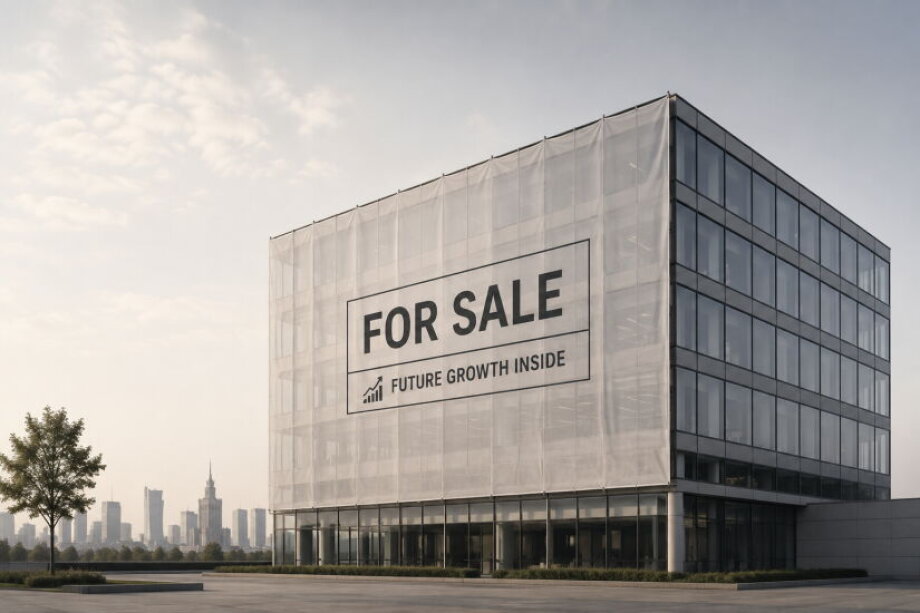
In Western Europe and the United States, the question of whether a company should own the warehouse it operates from was settled long ago. Most decided it should not. Retailers, manufacturers and logistics groups have spent decades selling the buildings they occupy and leasing them back — freeing the capital trapped in real estate to pour into the business they are actually in. In Poland, that idea is now taking hold, and the market is maturing fast.
The practice, known as sale-and-leaseback, is far from new, and it is far larger abroad than at home: across established Western markets the annual volume dwarfs anything Poland has seen. But the Polish market is catching up. In the first six months of 2026, the value of disclosed transactions here reached about €390 million, roughly 15 percent more than in the same period a year earlier, according to a report by the advisory firm INWI. Analysts say the full year could surpass the record set in 2025 — another step in the market's coming of age.
The logic is one Western boardrooms have long taken for granted. By selling a property and leasing it back, a company recovers the capital locked in its real estate and redirects it into expansion — new production lines, acquisitions, inventory — without turning to a bank. Crucially, for most of these firms, real estate was never the point. Their core business is groceries, or freight, or manufacturing; the buildings are simply where that business happens. Ownership ties up money that could be working harder elsewhere.
“For most of these companies, owning real estate was never the goal — their core business is something else entirely,” said Daniel Radkiewicz, chief executive of INWI. “Abroad this has been obvious for years: you don't need to own the building to use it. You can lease it, and put the capital you free up into growing the business. Poland is now realizing the same thing.”
Two deals that defined the half
The first half was defined by two large portfolio sales. The biggest was Auchan's disposal of eight shopping centers spread across cities including Białystok, Częstochowa, Gliwice, Legnica, Łomianki, Sosnowiec, Kołbaskowo and Wałbrzych. The portfolio, comprising more than 208,000 square meters of leasable space, was valued at over €210 million. Auchan remains the anchor tenant under a 15-year lease with an option to extend, while the new owner has signaled plans to develop the centers and court additional tenants.
The second was the sale of a logistics portfolio belonging to Raben Group, a deal worth €169 million covering more than 150,000 square meters. Together, the two transactions accounted for nearly €380 million — close to 1.6 billion złoty, and almost half of what the entire record-breaking 2025 delivered. And the true scale of the market may be considerably larger, since many sale-and-leaseback deals are never made public.
The shape of the market has shifted, too. In 2025, a single transaction worth more than €250 million drove the annual total. This year, the momentum came from portfolio deals spanning several segments: three disclosed transactions covered 16 properties in the first half, compared with five deals involving just 10 buildings a year earlier. Fewer contracts, in other words, but greater value.
Logistics and retail lead, manufacturers follow
Logistics and warehousing remain the market's engine, followed closely by retail, where demand for well-located assets — especially retail parks — has stayed strong. But the report notes a newer current: manufacturers are increasingly treating sale-and-leaseback as an alternative to traditional bank lending, a way to fund equipment and growth against the value of the plants they already run.
That widening appetite is matched on the other side of the table. “Investor demand is the strongest we have seen,” Mr. Radkiewicz said. “What they want are mission-critical assets — the buildings a business genuinely cannot operate without. But just as decisive is the strength of the future tenant: solid revenues, a positive EBITDA, a company that will comfortably pay its rent for years to come. That combination is what delivers stable, long-term income — and for assets like that, the appetite today is almost insatiable.”
INWI has already proved the depth of that demand. Last year the firm sold a manufacturing plant in Wrocław for more than €50 million — the sort of production facility that anchors a company's operations and, precisely for that reason, appeals to investors seeking dependable income. Now it is testing the market's appetite again: INWI is currently marketing a pan-European sale-and-leaseback portfolio valued at €60 million, and Mr. Radkiewicz said interest has already spilled beyond it.
“The €60 million portfolio is only the beginning,” he said. “Investors are already asking us for the next properties before this one closes. The capital is there; what the market needs now is more of the right buildings.”
A record within reach
The authors of the INWI report expect the second half to bring an even greater number of transactions, though likely of smaller individual value — single properties and modest portfolios priced from the low tens of millions of euros. If the deals now in progress close as planned, the year's total could edge past the 2025 record, which reached about 3.5 billion złoty.
For Poland, that would mark another step in a longer story: a market that once trailed its Western counterparts steadily closing the gap, as a tool routine elsewhere becomes routine here too — for logistics operators, retailers and, now, factories. The buildings are not going anywhere. The companies inside them are simply deciding they no longer need to own the walls to grow within them.
Figures for the first half of 2026 are drawn from a market report by INWI. Sale-and-leaseback refers to the sale of a property combined with the seller's continued use of it under a lease agreement.