14:04 5 December 2025
The Chess Advantage
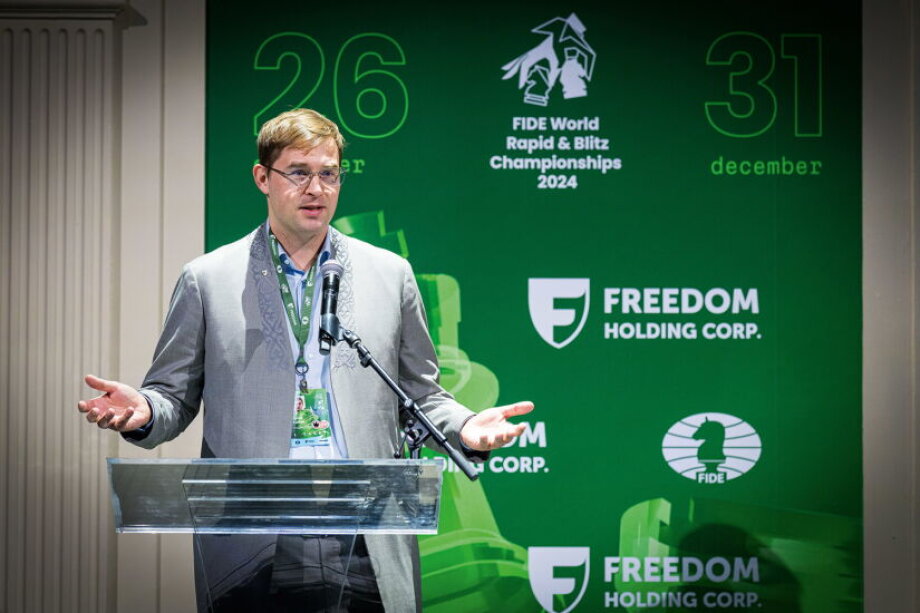










WBJ: Let’s start with the basics: What is Freedom Holding? Who is it for, and what differentiates it from other available tools?
Timur Turlov: Freedom Holding Corp. is an international financial holding registered in the US, with significant operational presence and origins in Kazakhstan. We create a network of broker-dealers, a bank, insurance and other financial businesses and consumer-facing fintech brands, known in Poland as Freedom24. Our core business is retail and institutional securities brokerage and related capital markets services. We are also building an integrated fintech and banking ecosystem in Central Asia and Europe.
You founded the company in 2008. How did you get the idea for it in the first place? Tell us something about how you got to that point.
In my professional life, I have always worked in investing and finance. My first job, at 16 in 2003, was as a trader at World Capital Investment. Later, I joined a large bank and helped with developing infrastructure for U.S. stock market access within its subsidiary. Starting a brokerage company was a natural continuation of my vocational path. But the final decision came with the 2008 financial crisis, when the bank closed their investment subsidiary where I worked. Five colleagues and I wanted to give regular people access to global markets, so we started Freedom.
Freedom Holding now operates in 22 countries, a considerable expansion from its foundation. How did you manage to grow the company to a global scale so quickly? Which markets are currently most important for Freedom24, considering the geopolitical situation and growth strategy?
From the beginning, we have focused on service quality and steadily expanded our operations based on market needs. Whether through new solutions or by establishing operations in different countries, we broaden our knowledge base with experiences from each market so that we can carry best practices wherever we operate. Importantly, we don’t shy away from innovating. Brokerage services remain our core, but over the years we have expanded our offer with banking and insurance.
This approach, applied globally, helped us achieve crucial milestones, such as the IPO on Nasdaq in 2019. While Freedom Holding Corp. remains as our centerpiece, we were always keen on expanding our presence in Europe, the US and Asia outside Kazakhstan. Central Asia is where we test innovations, and as our base of operations it will always remain important. However, Europe has been key for us for over 10 years since we obtained licensing, because of its large consumer base, with a growing number of financially aware people. This is especially true for Poland, which we see as one of the regional leaders of individual investing of Central and Eastern Europe. That’s why we entered the Polish market in 2021 and opened an office in Warsaw in 2023. We plan to keep developing a local presence in Poland, because we see it as crucial to further expand operations in the CEE.
Freedom Holding Corp. is developing an increasingly broad financial ecosystem – from brokerage, to banking, to insurance. What new technologies or innovations, such as super apps or fintech solutions, do you plan to introduce to strengthen Freedom Holding Corp.'s global position? Can we expect "AI-first" solutions in Poland, such as a voice assistant for banking operations and free access to ChatGPT, operating in Kazakhstan?
Like I mentioned, we don’t limit ourselves. First, when it comes to services provided, and second, with the forms in which we provide them. Kazakhstan serves as our proving ground, where we test innovations, pick the most successful ones and prepare to implement them across other markets. This process is still ongoing with our super app and voice assistant.
Thus, we only export the latest technology that is proven and scalable. In Kazakhstan, the Freedom super app has helped 10 million customers, offering both high- and low-frequency services such as brokerage, banking, and insurance, but also ordering food or buying flight or concert tickets. We want to broaden our global offer in a similar manner but first, we will make sure it’s well-tailored for markets different to Kazakhstan. With the voice assistant, this process is more complicated, because if we were to introduce it in Poland, we would aim to do so in Polish – not Kazakh or even English.
The global economy is multi-polarizing at an increasing rate, Europe is trying to become technologically independent from the US, Asia is gaining strength, and geopolitics is once again influencing capital markets. How is this affecting the brokerage industry and, more broadly, the financial sector? How, as the leader of an international group, are you trying to cope with the volatility in the world of finance and business?
This is a very timely subject but an important rule to underline is that you can never fully get rid of volatility or uncertainty in a market – especially a global one. While there’s no doubt that disruptions have recently escalated, in the world of finance, especially in investing, you always need to be ready for them. They can take the form of “black swans”, like earlier this year with DeepSeek AI, which also exemplified the growth of Asian markets you mention. Disruptions can also come as unexpected political decisions, and we’re bearing witness to that currently with the ongoing tariff disputes. But the point is this: the possibility of economical turbulence has always been there. While the broad finance industry may face challenges because of it – e.g. changes to interest rates, less consumption – in investing we actually see as many risks as there are opportunities. While these kinds of disruptions can harm a stock long thought safe, they can also create occasions for profit, putting new markets in the spotlight and opening them up for capital. The inflow of retail investors in recent months and years confirms that.
“Brokerage services remain our core, but over the years we have expanded our offer with banking and insurance”
We're seeing rapid technological advancements and growing regulatory requirements in the fintech and brokerage industries. Demand for innovative services, such as algorithmic trading and robo-advisory, is growing. What do you currently see as the biggest challenges or barriers to Freedom24's development? What steps is the company taking to address them?
With the world changing rapidly, we have to take care of our foundation, which is the digital infrastructure that allows our services to work. My home country is a good example of how we do this. Historically, Kazakhstan, has seen low tech infrastructure investment, and some time ago we realized there was a deficit in national cloud capacity. This prompted us to invest in data centers, in hopes of not only satisfying our own needs but also helping out other businesses in the country. We also partner with American blue-chip companies, namely OpenAI and recently, indirectly, Nvidia, which will supply infrastructure of an Independent Kazakhstan AI Center, managed by Freedom Holding.
My perspective is that you have to compete globally if you don’t want to lose locally. This is our biggest goal, and the newest solutions are just the next steps in achieving it. I believe we’ve been doing rather good so far. Of course, this sometimes means you need to adjust to a specific regulatory context. We see this in Europe, where fintech is heavily regulated. This can pose a challenge, but we have an advantage: we can roll out new solutions cost-effectively because we first test them and make them foolproof in our primary market.
There is a growing number of financially aware people in Poland who care about responsible money management. However, there are already several companies competing with Freedom24 in our country. Do you think the Polish market offers more opportunities or challenges for Freedom24?
There are challenges to be sure, but competition is a sign of a healthy economy. Moreover, the presence of other brokerage firms, including online brokers, in Poland is precisely the reason that Freedom is active here – the Polish market has big potential, with many financially aware people, who wish to take care of their savings responsibly. Other companies see that, and so do we. However, in many aspects, we fare better than other brokers. We have no entry deposit, low fees and perhaps most importantly, Freedom24 provides access to stock exchanges rarely found in the offerings of other market participants, such as the Kazakh Astana International Exchange or the Hong Kong Stock Exchange. Why are these valuable to investors? Because the global trends mentioned earlier can create a perfect chance to invest in niche markets they won’t find elsewhere. Here lies the opportunity both for Freedom as a company, and our potential Polish customers.
“My perspective is that you have to compete globally if you don’t want to lose locally”
You manage a holding company operating on three continents, in very different business cultures. Is it possible to combine such diverse management systems and values as American liberalism, European regulatory frameworks, and Asian pragmatism? What, for you, is the foundation of the comprehensive leadership necessary in such an ecosystem?
Let’s connect a few dots to answer this question. I mentioned earlier Kazakhstan as a market where we experiment with new solutions, we’ve just brought up competition. Let’s take these threads up a notch and try to place them in the global landscape.
The worst threat to a worldwide brand, which Freedom Holding has become, is lagging behind competitors – not only the local ones in each country, but also those operating globally. It shouldn’t strive only to follow trends, but to actively shape them. To do that in fintech, you need to have ready solutions, proven in different scenarios and easily scalable. To sum up, the base of comprehensive leadership is anticipating the moves of your competitors and making sure your technology is universal or flexible enough. But there’s one more crucial element: a team of people who will run operations, work in the field and can point out what’s working and what’s missing.
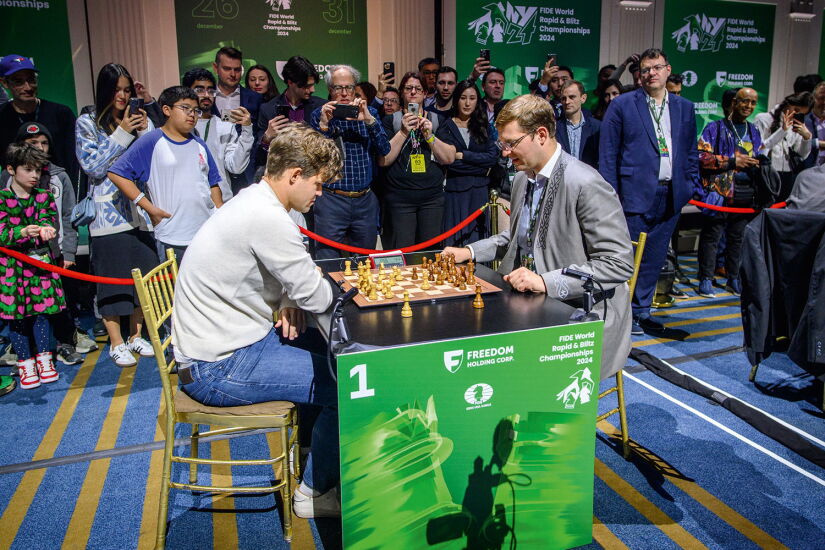
In interviews, you've mentioned that "chess has become one of the most popular and engaging games," and talented chess players work in corporations like Freedom Holding. How does your passion for chess influence your approach to company management and strategic business planning?
I must say, nowadays chess not only influences my business activity – it actually intertwines with it since Freedom has started sponsoring chess events and organizations. This includes the International Chess Federation, FIDE, and we also have plans to partner with the Polish Chess Federation, PZSzach.
Beyond strategy, chess teaches resilience and adaptability. I try to spread my passion for chess through Freedom, because I believe that nurturing these values at the same time promotes entrepreneurship and innovation. Something I also like to bring up is an analogy between the king in chess and the trust in business: in both cases, they are the cornerstone, without which every strategy falls apart.
“I must say, nowadays chess not only influences my business activity– it actually intertwines with it since Freedom has started sponsoring chess events and organizations”
Freedom Holding Corp. was included in the Russell 3000 Index, and BlackRock increased its stake in the company. How does the presence of such partners impact the company's strategy and its credibility with individual investors in Europe?
Our inclusion in the Russell 3000 Index was a significant milestone, the second of this scale after being listed on Nasdaq. It showed that the hard work of our team since that moment paid off, and was a sign for retail as well as institutional investors that we strive to create value for our shareholders. To some extent, it probably paved the way for BlackRock to purchase the equivalent of $89 million in FRHC shares a few months ago. Such an investment is a testament to Freedom’s stability and strategic potential on international markets. For Europeans, it clearly shows that our development will continue, and if they want to take care of their money in the long run, they can trust us.


Timur Turlov
CEO & Founder, Freedom Holding Corp.
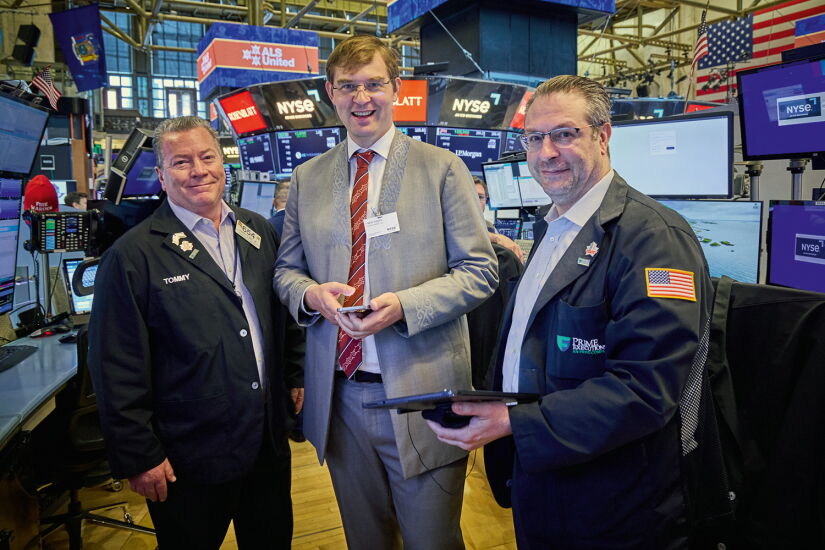
Timur Turlov is the Founder and CEO of Freedom Holding Corp., a fintech group operating across the U.S., Central Asia, and Europe. He launched Freedom in 2008 to expand access to global markets and later made it the region’s first financial firm to list on Nasdaq. In Kazakhstan, he is building a digital ecosystem serving over 11 million users, anchored by the Freedom SuperApp. The company has expanded in the U.S. through Prime Executions and LD Micro, and in Europe via its Tradernet (Freedom24) platform. Turlov also leads major chess and civic initiatives in Central Asia.
All photographs: Freedom24