by Beata Socha
Should CSR operate as a separate part of a company’s strategy, or should it be integrated into every business decision? There is no universal organizational model. A dedicated CSR function can provide expertise, accountability and focus. An integrated approach can bring social considerations closer to daily management. The more revealing question is whether companies see these commitments as sources of measurable business value.
This is particularly important in the social dimension of CSR. Companies can publish ambitious statements about people, inclusion, and well-being, but their real impact is determined elsewhere: in workload decisions, management practices, employee benefits, recruitment processes and workplace accessibility. The test is whether responsibility changes how the organization operates.
The cost is visible
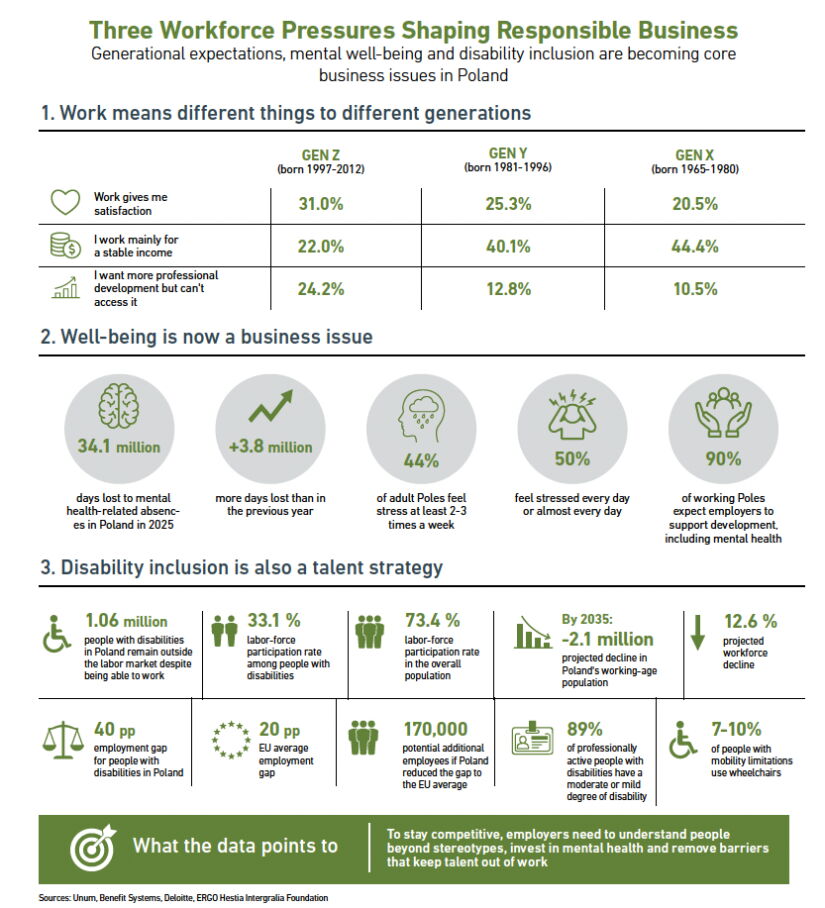
Mental health provides perhaps the clearest example. In 2025, absences related to mental and behavioral disorders accounted for 34.1 million days away from work in Poland. That was 3.8 million more than in the previous year. These figures already place mental well-being firmly within the discussion about workforce capacity and operational stability.
Absence, however, captures only the point at which an employee can no longer continue working. A nationwide Multi.Life survey found that 44% of adult Poles experience stress at least two or three times a week, while half feel stressed every day or almost every day. Many remain at work throughout, answering emails, attending meetings and completing tasks while their ability to concentrate, recover, and perform gradually declines.
“Before an employee truly drops out of the daily rhythm, they often try to cope for a long time: answering emails, attending meetings, and completing tasks, only with increasing effort,” says Prof. Andrzej Silczuk, psychiatrist and Head of Mental Care at Benefit Systems, Multi.Life.
Beyond the benefit package
The data changes the way companies need to think about well-being. A meditation app, webinar, or occasional well-being day may be useful, but it cannot compensate for persistent overload, unclear expectations, or a management culture that discourages people from asking for help. Support needs to reach working conditions as well as the benefits package.
“Companies should not replace the healthcare system or diagnose employees, but they can build a work environment that does not exacerbate overload and makes it easier to reach out for help,” says Izabela Nasiłowska-Włodarek, Business Development Director for Muli.Life at Benefit Systems.
Employee expectations are also moving in this direction. As many as 90% of working Poles expect their employers to support their development, including mental health.
Well-being influences more than sick leave. It increasingly affects employer reputation, engagement, and retention.
“Employee engagement is the foundation of productivity. In our recent interventions with Polish teams, investing in the quality of employee relational skills and wellbeing translated into a more than 20% increase in perceived teamwork productivity and a more than 35% increase in peer support within four weeks,” explains Iga Pilewska, founder of Oneness UP, and former Senior Principal at Gartner. “In our experience, these shifts also strengthen intent to stay and willingness to recommend the workplace,” Pilewska adds.
Companies can either address mental strain before it escalates or absorb the consequences later through reduced performance, absence, and turnover.
Generations at work
Retention is often discussed through the language of generations, particularly when employers talk about Gen Z. Younger workers are frequently portrayed as ambitious but impatient, demanding and quick to leave. A recent Unum study suggests a more complicated picture.
Among Gen Z respondents, 31% said they were focused on their careers and that work gave them satisfaction, compared with 25.3% of Millennials and 20.5% of Gen X. Almost one-quarter of Gen Z, 24.2%, said they would like to work more and develop professionally but could not. The corresponding figures were 12.8% for Millennials and 10.5% for Gen X.
Older respondents were more likely to frame work through financial necessity. A steady income was the main reason for working for 40.1% of Millennials and 44.4% of Gen X, compared with 22% of Gen Z. This may say less about commitment or ambition than about mortgage payments, children, caregiving responsibilities, and the financial pressures attached to different stages of life.
A question of perspective
The report also asked whether respondents believed their generation changed jobs more frequently than their parents had. All three generations broadly agreed, although Gen Z recorded the lowest percentage. Almost 80% of people born between 1981 and 1996 said their generation changed jobs more often than their parents, compared with 68.6% of Gen Z.
The results broadly align with the historical experience of each generation. Many Gen X Poles entered the labor market during the transition from communism to a market economy, often after growing up in households where parents spent most of their careers with one or two employers. Millennials entered a very different environment, shaped by the dot-com crash, the 2008 global financial crisis, and successive technological shifts, from widespread internet access and social media to mobile technologies and, more recently, AI. After repeated economic and technological disruption, they may be especially likely to see adaptability and job mobility as defining features of their working lives.
This does not measure actual job turnover. It shows how each generation perceives its behavior in relation to the generation before it. Still, the result complicates the claim that frequent job changes belong mainly to the youngest employees. Millennials and Gen X were even more likely to see increased mobility as part of their generational experience.
“Too often, we try to manage generations, when we should be trying to understand people and their current needs,” says Aneta Podyma, CEO of Unum Życie. “A young employee starting a career may need something different from a parent of young children or someone preparing for retirement. This does not result from different values, but from where that person is in life.”
More common ground
The distinction matters for employers. Generational labels can help identify broad social changes, but they become less useful when applied mechanically to individual workers. Benefits, development opportunities, and working arrangements designed around assumed generational personalities can easily miss what people actually need.
“Regardless of age, people want very similar things: security, respect, development opportunities, stability, and good relationships,” Podyma says. A flexible employer will recognize that these shared needs take different forms over the course of a person’s working life. The goal is not to construct a separate workplace for every generation, but to avoid treating age as a substitute for understanding.
Age, of course, is only one aspect of workforce diversity. Companies often discuss diversity in terms of age, sex, and ethnicity while paying far less attention to disability. In Poland, that omission carries a growing economic cost.
Talent left outside
Poland recorded an unemployment rate of 3.1% in 2025, one of the lowest in the European Union and well below the EU average of 6%, according to Eurostat. The country has also brought a growing share of working-age people into employment. In 2025, almost 79% of Poles aged 20–64 were employed, compared with an EU average of 76.1%.
Employers are therefore operating in a market with limited readily available labor. At the same time, Poland’s working-age population is projected to decline by 2.1 million people, or 12.6%, by 2035.
Against that backdrop, 1.06 million people with disabilities remain outside the labor market even though they are able to work. Their labor force participation rate stands at 33.1%, compared with 73.4% for the overall population. This is a substantial reserve of skills and experience that employers continue to overlook.
“The employment gap for people with disabilities in Poland is among the highest in Europe,” says Dagmara Senda, President of the ERGO Hestia Integralia Foundation. The gap is approximately 40 percentage points, twice the EU average of around 20 points. Reducing it to the European average could create the potential for approximately 170,000 additional employees.
Barriers and assumptions
Some of the exclusion is sustained by misconceptions about disability and workplace adjustment. As many as 89.9% of professionally active people with disabilities have a moderate or mild degree of disability. Only 7 to 10% of people with mobility limitations use wheelchairs.
These numbers challenge the assumption that disability inclusion usually requires major reconstruction or high expenditure. In many cases, the necessary changes involve accessible recruitment, flexible processes, suitable technology, or relatively simple organizational and ergonomic adjustments. Employers also need to recognize disabilities that are not immediately visible.
“A company that can remove barriers expands its candidate pool, strengthens operational resilience, and makes decisions based on facts, not stereotypes,” Senda says. This places disability inclusion squarely within workforce planning. A company facing talent shortages cannot reasonably claim that skills are unavailable while its recruitment and working practices continue to exclude capable candidates.
Where strategy begins
Mental health, generational inclusion, and disability employment may appear to be separate CSR topics. In practice, they lead to the same question: how effectively does a company understand, support, and use the people available to it?
The difference between strategy and social washing is rarely found in a slogan or reporting structure. It appears in operational choices. Does the company examine whether workload and management practices contribute to poor mental health? Does it respond to employees’ actual life circumstances rather than generational stereotypes? Does it remove barriers that keep qualified people outside recruitment and employment?
CSR becomes strategic when those answers influence decisions about talent, productivity, risk, and long-term growth. When the social commitments remain disconnected from everyday business choices, its company may still have a strong story to tell. Its workforce will see the gap.
For more from our experts on Corporate Social Responsibility 2026
Business strategy needs sustainability to be completed Agata Rudnicka, Knowledge Management Director at the Responsible Business Forum in Poland
One million untapped talents Dagmara Senda, President of the ERGO Hestia Integralia Foundation
Well-being is not a perk but a strategy Izabela Nasiłowska-Włodarek, Prof. Andrzej Silczuk, MD, PhD
Shared values over generational divides Aneta Podyma CEO of Unum Życie
INEA highlights the role of well-being in campaign against hate speech