A family business often stems from the initiative, hard work, and risk-taking of its founder. With the generational transition, the company evolves into a legacy upon which the future of the family, employees, and future owners depends. While ownership continues to confer decision-making rights, over time it becomes increasingly intertwined with responsibility for the long-term impact of those decisions.
Wealth that spans generations
A founder is entitled to say, "This is my company." They built it, invested their own money, bore the risks, and took responsibility for decisions over the years. Ownership rights grant them the freedom to manage the accumulated capital, even when their plans differ from their children's expectations. In the next generation, however, the significance of wealth begins to shift; successors inherit not only shares but also the brand, the family name’s reputation, relationships, knowledge, and obligations toward both the family and the organization. The founder’s legacy thus becomes a resource capable of ensuring family security, funding new ventures, and supporting the development of future generations. Referring to the owner as a "custodian" does not undermine their rights. Instead, it draws attention to the consequences of decisions concerning mature family business—consequences that extend beyond the situation of a single individual.
Responsibility allows for various scenarios
Multi-generational thinking is often mistakenly equated with the necessity of passing the business on to one’s children. However, keeping the company within the family is merely one possible scenario; selling the business, bringing in an investor, altering the ownership structure, or handing over management to external professionals can also be responsible choices. Sometimes, a mature decision by the owners leads to the family withdrawing from a business with which the next generation does not envision its future, or for which they lack the necessary competencies. A sound ownership decision does not always mean retaining the company and shares within the family. What matters is that the chosen path preserves the value of the assets and enables the family to continue making decisions together. Clicking to a company that has lost its competitive edge or become a source of persistent conflict can weaken the family more than a well-executed sale. At the same time, selling a business also requires a plan, as the transaction eliminates the organization that previously structured the family members' roles. Transitioning to an "investing family" model requires shared goals, decision-making rules, an agreed-upon risk appetite, and a defined scope of individual autonomy.
Succession begins with everyday decisions
Responsibility for capital arises even before the formal transfer of shares. It is shaped by decisions regarding profit reinvestment, debt, asset diversification, family involvement, and the separation of ownership from management. Alongside structuring the current owners' decisions, it is essential to prepare successors who will eventually assume responsibility for the capital in a mature manner. Ownership maturity is grounded in an understanding of the business model, finances, risk, governance principles, and obligations toward other family members. This maturity is fostered by gaining experience outside the family business, gradually involving successors in decision-making, and having the opportunity to build one’s own professional standing. For this reason, the family should establish rules regarding employment within the company, the assumption of roles, profit distribution, owner representation, and dispute resolution. Mechanisms such as a family council, a family constitution, an ownership strategy, a family foundation, and a family office help formalize these principles. However, their effectiveness depends on trust and the consistent observance of agreed-upon arrangements.
Owners Need a Shared Answer
The decisions described raise questions about the limits of an owner's rights and the scope of their obligations toward future generations. Two opposing viewpoints will be weighed against each other during the Oxford-style debates at the 4 GENERATIONS Symposium for Business Families. The first perspective views the current generation as custodians of an accumulated legacy that should be safeguarded and passed on. The second emphasizes the owner's absolute right to sell the company, divide the assets, or allocate them for other purposes. However, as every family is at a different stage of development, it is crucial to define the obligations arising from capital ownership—which can serve future generations—and strike a balance between caring for successors and limiting their autonomy.
Multigenerational Dynamics in Practice
The boundaries of responsibility become apparent in specific decisions: choosing a succession model, determining how to protect assets, defining the family's role after a sale, and preparing the company for its next phase of growth. These challenges form the basis of the upcoming 4 GENERATIONS discussions. A presentation by Dr. Adrianna Lewandowska, titled The Dual Transformation Model: Why Succession Without Strategy Makes No Sense Today, will demonstrate that generational change runs parallel to the transformation of the enterprise itself. Consequently, a successor should take over a company prepared for future conditions, rather than one merely designed to continue the model established by the previous generation. Corporate transformation requires simultaneous restructuring of ownership. A family foundation can support this process, yet its longevity depends on the quality of its statutes, family governance, and the beneficiaries' ability to cooperate. These tensions will be the subject of a debate moderated by Mateusz Kowalewski, featuring participants such as Sławomir Łuczak, Henryk Orfinger, and Katarzyna Borowicz-Gabarska.
What role should the family play after the change?
A family foundation is one way to ensure ownership continuity. Selling the company opens a different scenario: the capital remains, but the family must redefine its shared role. The debate "Life After the Exit! Is This the End of the Company or the Start of a New Chapter?" will focus on building a new identity, establishing rules for cooperation, and managing the released capital. Maciej Filipkowski, Maciej Duda, Dariusz Pietrzak, Tadeusz Wesołowski, Amadeusz Król, and Sebastian Muliński will compare the experiences of families who have gone through this process. Whether a family retains the company or chooses to sell, questions regarding identity, the legitimacy of leadership, and the actual division of roles remain. Subsequent debates will cover the future of the family business model, the significance of the CEO’s surname, and the influence of "invisible roles" on formal decisions. This approach allows for a view of succession that extends beyond the mere transfer of shares and positions.
Farsightedness as a Common Denominator
The common thread running through these debates and discussions is farsightedness—the ability to make decisions today while considering their impact on people, the company, and future generations. The discussion "Farsightedness: What Do We Owe Future Generations? Can Modern People Still Think Beyond Their Own Lifetimes?" will center on business families as guardians of a multi-generational perspective, the courage required to choose enduring value over short-term success, and the process of raising future owners to take responsibility for a shared legacy. Participants in the conversation will include Roman Wieczorek, Dr. Marcin Popkiewicz, Dr. Adrianna Lewandowska, and Tomasz Wróbel.
Different Paths to Multi-Generational Success
Addressing these questions requires comparing the experiences of families at various stages of development, succession, and professionalization. For years, Dr. Dennis Jaffe has studied and supported families that sustain their entrepreneurial spirit and wealth across multiple generations. He analyzes the mechanisms by which they pass on not only capital but also the capacity for collaboration and the creation of new ventures. Marco Lavazza—Vice Chairman of the Lavazza Group and a fourth-generation family member—will discuss with Szymon Krawiec from Wprost Magazine how family ownership can coexist with professional management, role division, and corporate transformation. Carmen Berbegal Roque, a second-generation representative of Actiu, leads the company’s ESG initiatives and chairs the Family Council. Michał Wypychewicz, CEO of Koronea Family Office and Chairman of the Supervisory Board of ZPUE S.A., will outline the transition from managing a family business to professional asset portfolio management; meanwhile, Bogusław Wypychewicz—co-founder of ZPUE S.A., Vice Chairman of its Supervisory Board, and Non-executive Director at Koronea Family Office—will share insights regarding the company’s founding and long-term growth.
This international perspective will be complemented by Polish experiences regarding succession, family leadership, professionalization, and asset portfolio development. These insights will be provided by Paweł Wielgomas (President of Dawtona Group and second-generation representative), Maciej Duda (President of Duda Holding), Adam Mokrysz(Successor and President of Mokate Group), Piotr Andrzejczak (from the DZP law firm), Anna Hajduk-Baruch(CEO and co-owner of Hajduk Holding), Joanna Klimas (Successor at Klimas Wkręt-Met), and Prof. Bolesław Rok; Paulina Borowicz-Hardeman, successor at Barbara Luijckx; Agnieszka Browarny, co-owner of Huta Szkła Julia; Jakub Siemiątkowski, President of the Management Board of Trefl S.A.; Michał Sowa, successor at Cukiernia Sowa; Anna Andre, Vice President of Andre Abrasive Articles; and Maia Wiśniewska, successor at Colours Factory. The perspectives of a founder and a successor will be contrasted by Patricia Popławska of Popławska Group and her daughter, Aleksandra Popławska-Ślązak, who is carving out her own role in the family business.
A Decision That Transcends Any Single Model
The 4 GENERATIONS Symposium compares various models of succession, ownership, and wealth management. The value of this dialogue lies in contrasting the consequences of different decisions, as every family requires a solution aligned with its history, competencies, and vision for the future. Responsible ownership can lead to succession, the sale of the company, the professionalization of management, or the creation of a new wealth structure. Each of these scenarios requires an approach that considers the perspectives of current owners alongside the future generations' capacity for collaboration. Thus, the multi-generational nature of the enterprise is defined primarily by the quality of decisions made and the family's readiness to embrace their long-term consequences.
The 4 GENERATIONS Symposium will culminate in the presentation of awards to the winners of the "Family Business of the Year" competition. Honors will be bestowed upon enterprises that demonstrate how family involvement can drive longevity, responsibility, and growth, and how family-cultivated values can strengthen both the business and intergenerational relationships.
About the Event:
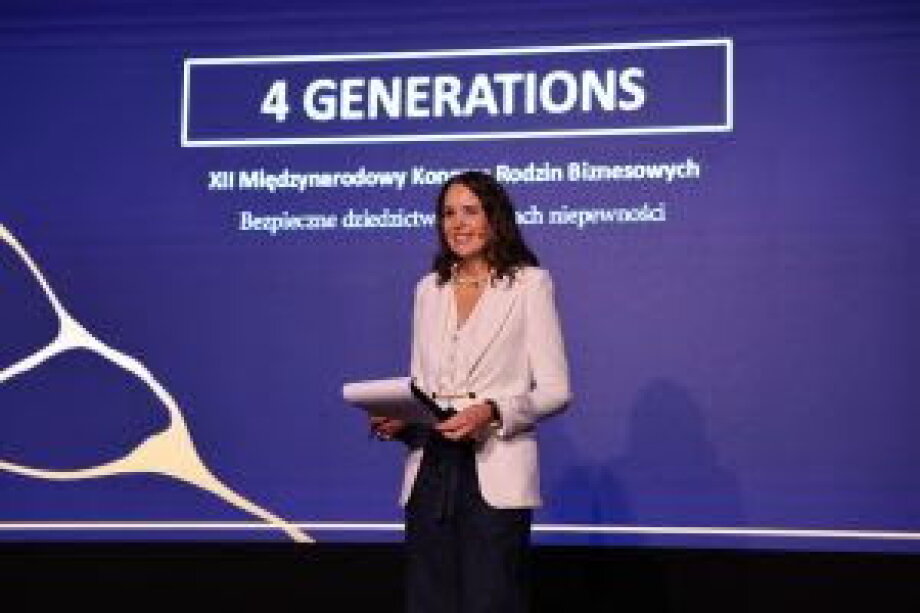
The 4 GENERATIONS Symposium for Business Families will take place on October 12, 2026, at Hotel Verte in Warsaw. The event is organized by the Family Business Institute. The program is designed for owners, successors, and members of business families, as well as individuals serving on management boards, supervisory boards, and family councils.
Visit 4generations.eu for more information.